
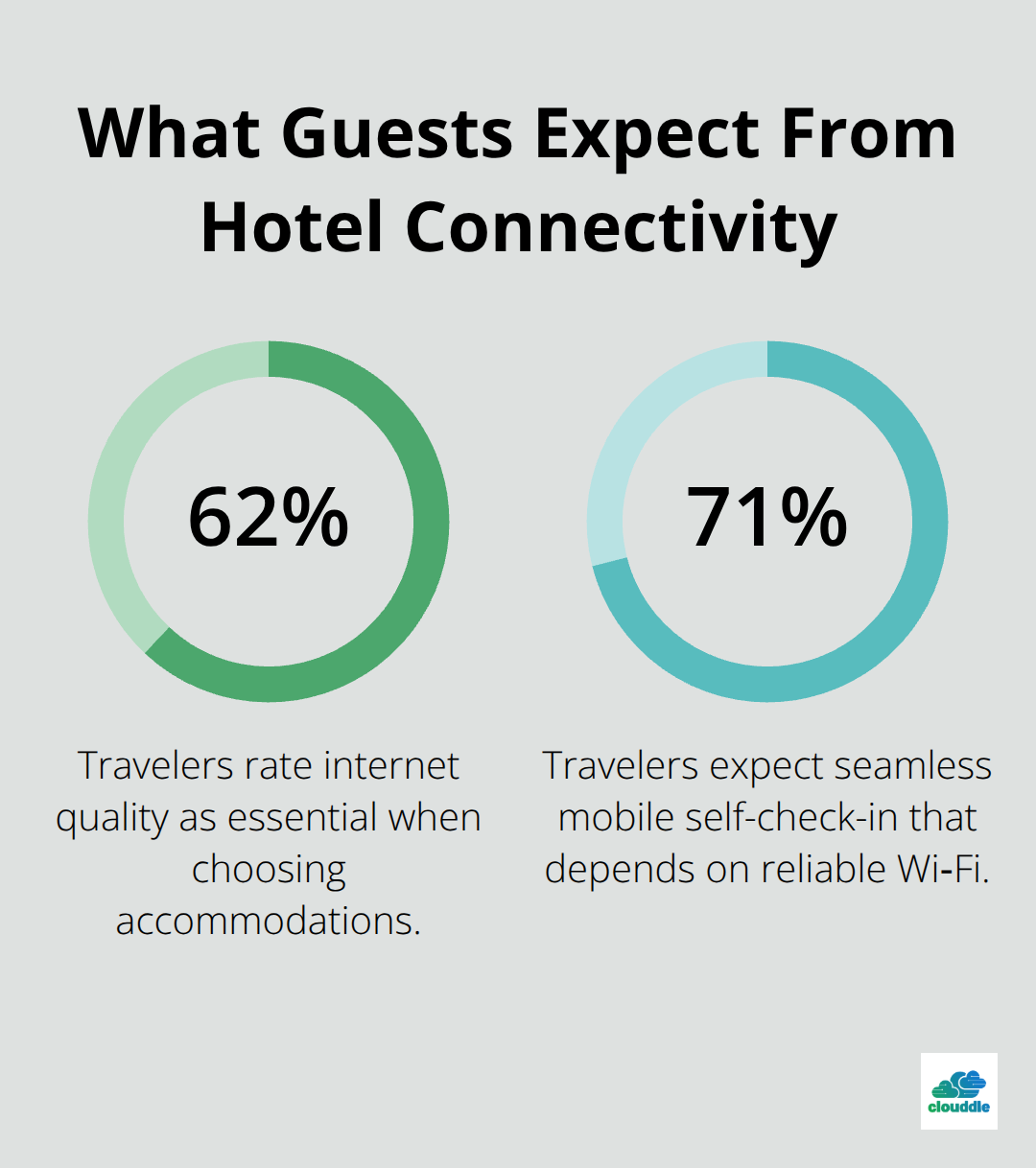
Hotels lose guests over spotty WiFi. A 2023 Statista survey found that 62% of travelers rate internet quality as essential when choosing accommodations.
At Clouddle, we’ve seen firsthand how cable installation in the hospitality sector directly impacts both guest satisfaction and your bottom line. Poor connectivity isn’t just an inconvenience-it drives negative reviews and lost bookings.
Why Cable Infrastructure Directly Impacts Your Bottom Line
Guest complaints about internet quality don’t just hurt feelings. They tank bookings. The 2023 Statista survey found that 62% of travelers rate internet quality as essential, and poor WiFi appears consistently in negative TripAdvisor and Booking.com comments. Hotels lose repeat customers because of spotty connectivity.
A single hour of network downtime disrupts 50+ guest interactions and costs thousands in lost transactions. One property management system failure during check-in cascades into staff chaos, guest frustration, and immediate revenue loss. Your cable infrastructure isn’t decorative. It’s the physical layer that either delivers or destroys guest satisfaction, and guests vote with their wallets.
The Connectivity Demand Hotels Face Today
Modern hotels require 1 to 10 Gbps uplink capacity per property to handle streaming, video conferencing, and the density of connected devices guests bring. A decade ago, one guest room supported maybe two devices. Today, each room handles 4 to 6 devices simultaneously. Copper cabling like Cat5e and Cat6 hits capacity limits fast under this load.
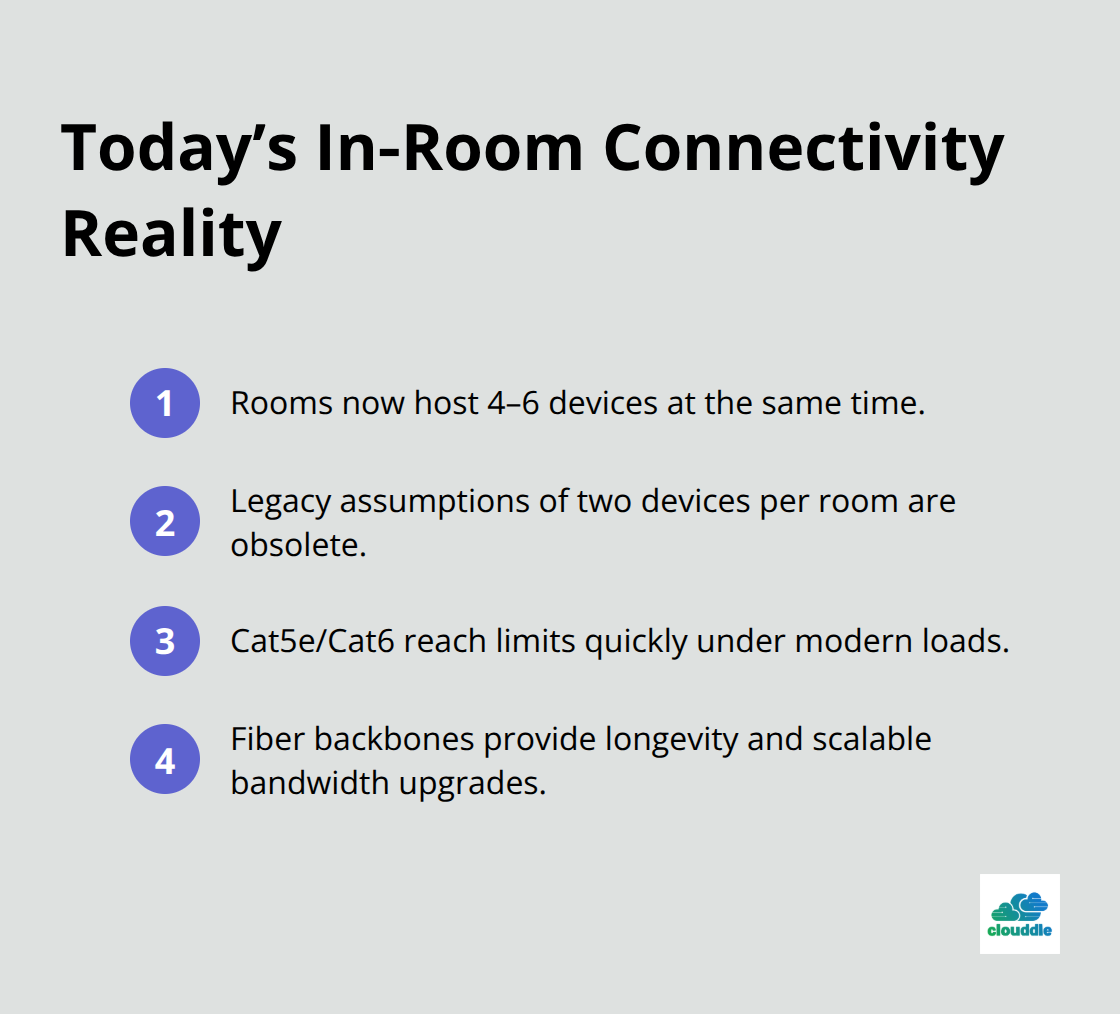
Fiber optic cabling solves this with a 20+ year service life and the ability to increase bandwidth at your data center without rewiring entire floors.
Why Cutting Corners Costs More Later
When you avoid fiber and stick with aging copper, you’re setting up expensive emergency calls. Unqualified installations cost $2,000 to $5,000 per incident. Cutting corners upfront means exponential costs later through emergency repairs, troubleshooting time, and guest dissatisfaction that spreads across review platforms. Proper cable installation with standards compliance and redundancy prevents these failures.
What Your Staff and Guests Actually Need
Industry data shows 71% of travelers expect seamless self-check-in via mobile apps, requiring reliable network access from arrival. Your staff depends on stable networks for property management systems, point-of-sale terminals, security cameras, and access control. When that infrastructure fails, operations grind to a halt. A well-engineered structured cabling backbone supporting your systems means fewer outages, faster problem resolution, and guests who actually return. These operational demands make cable installation decisions far more than a technical checkbox-they shape whether your property runs smoothly or faces constant firefighting.
Getting Your Cable Installation Right From Day One
Conduct a Thorough Site Audit Before Installation Starts
Start with a detailed site audit before any cable touches the ground. Count every device per room, map all systems from your property management platform to security cameras to point-of-sale terminals, measure distances from guest floors to your data room, and calculate your Power over Ethernet budget. Add 40 to 50 percent headroom to that calculation because you will add devices later. Most hotels skip this step and regret it within two years when they run out of capacity. A proper audit takes time upfront but prevents the exponential costs of retrofitting later.
Select the Right Cabling Infrastructure for Your Property
Fiber optic cabling should form your backbone between your main distribution frame and intermediate distribution frames across the property. Copper cabling like Cat6A works for in-room and access point runs if your distances stay under 100 meters, but fiber eliminates electromagnetic interference and gives you a 20-plus-year service life without rewiring. When you choose your installer, demand hospitality-specific experience and references from similar properties. Verify they understand Power over Ethernet budgeting, VLAN segmentation, and TIA/EIA standards compliance. Unqualified installers create cascade failures that cost $2,000 to $5,000 per incident to fix. Insist on as-built documentation and service loops in your cable runs so future upgrades don’t require tearing out walls.
Plan Installation Timing to Minimize Guest Disruption
Installation timing matters more than most hotel operators realize. Plan your cable work during your slowest occupancy period or coordinate with major renovations to minimize guest disruption. Structured cabling installed to predictable standards lets you troubleshoot faster and upgrade easier when new equipment arrives. Poor labeling and missing service loops turn simple moves into emergency calls. Enforce adherence to TIA/EIA standards from day one because standardized cabling prevents the rip-and-replace cycle that drains capital budgets.
Invest in Certified Installation and Redundancy
Upfront certification of installers costs 20 to 30 percent more than cutting corners, but that premium pays for itself within 2 to 3 years through reduced emergency repairs and eliminated troubleshooting time. Redundant fiber paths protect your uptime during renovations and equipment failures. A single unplanned outage during peak season costs far more than the redundancy you built into the system. When your property management system, payment processing, and guest Wi-Fi all depend on the same cable infrastructure, redundancy stops being optional.
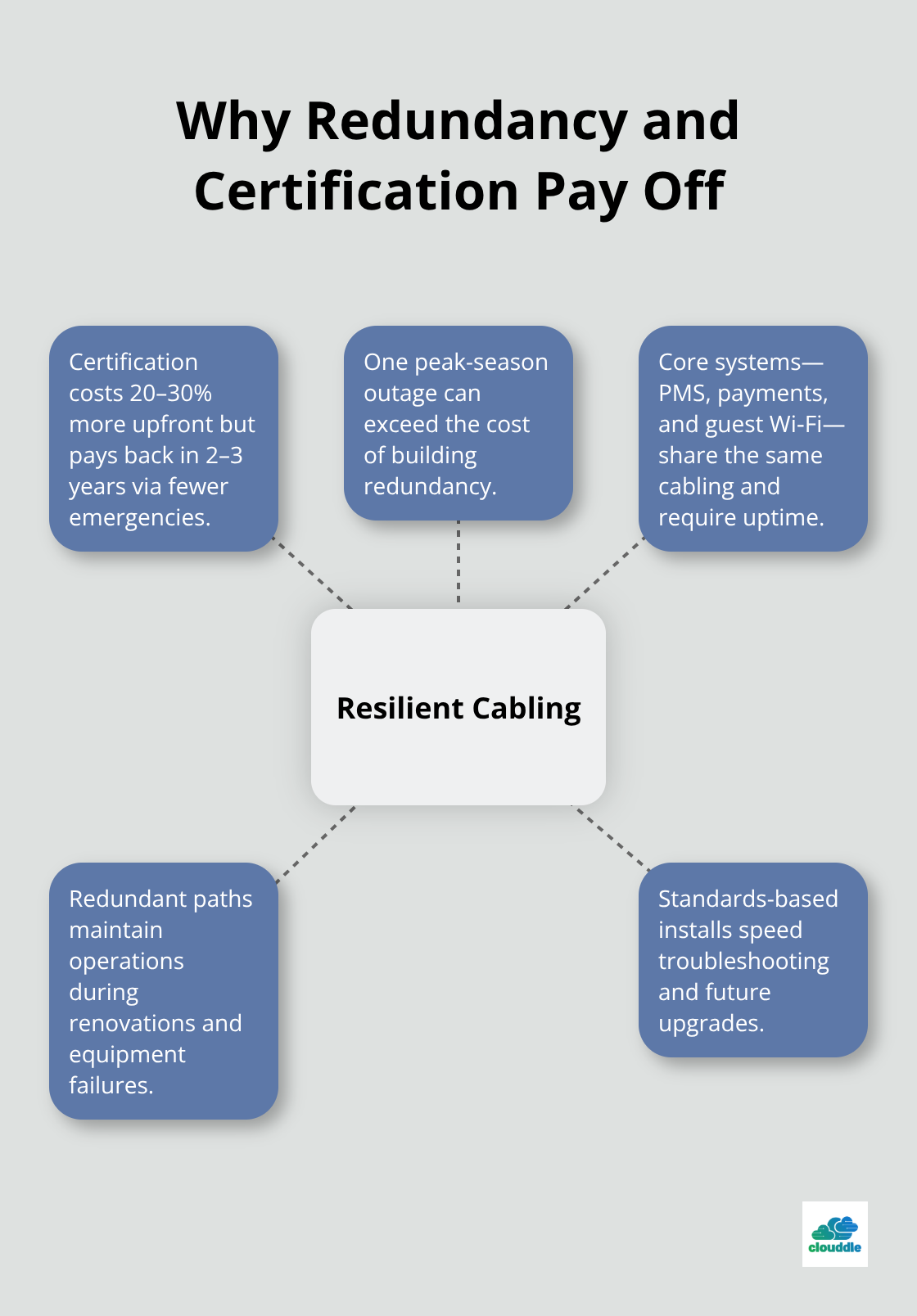
These installation decisions shape whether your property runs smoothly or faces constant firefighting-and they directly influence which mistakes you’ll encounter next.
Common Cable Installation Mistakes to Avoid
Site Surveys Separate Success From Costly Rework
Most hotel cable projects fail when teams skip the site survey. Hotels assume they understand their infrastructure and move straight to installation, then discover mid-project that cable runs cross HVAC ducts, distances exceed copper limits, or power budgets don’t account for future devices. A proper survey takes two to three days and costs $2,000 to $4,000, but missing one costs $50,000 in rework when Cat6A runs prove too long to reach the data room or PoE switches cannot power the security cameras you planned to add. Count devices in five representative rooms, not just one. Measure actual distances from each floor to your data center, accounting for building architecture. Test existing cable runs for signal loss if you’re retrofitting. Hotels that skip this step spend months fighting problems that a survey would have prevented.
Low-Quality Materials and Unqualified Installers Trigger Expensive Emergencies
Low-quality cables fail faster and cost more to diagnose than proper installations. Unshielded Cat5e in walls near electrical conduit introduces crosstalk that degrades performance unpredictably. Cheap connectors oxidize and cause intermittent failures that appear random to your IT team. Unqualified installers don’t understand PoE budgeting, so they overload switches and create cascade failures across your network. Hotels that hire the lowest bidder face $2,000 to $5,000 emergency service calls within months. Certified installers with hospitality experience cost 20 to 30 percent more upfront but eliminate these disasters. Demand references from three similar properties installed in the last two years. Verify the installer understands TIA/EIA standards, VLAN segmentation, and redundancy design before signing contracts. Cheap installation that avoids service loops forces you to tear walls apart for future upgrades.
Copper-Only Infrastructure Locks You Into Expensive Rewiring Cycles
Hotels that install copper cabling without a fiber backbone plan for expensive rips within five years. Guest device density increases every two years. Today’s Cat6A solution becomes tomorrow’s bottleneck. Fiber backbones let you upgrade bandwidth at the data center without touching guest floors. Hotels that commit to copper-only infrastructure face the rip-and-replace cycle that drains capital budgets repeatedly. A fiber backbone costs 30 to 40 percent more during initial installation but eliminates that cycle for years. Calculate your bandwidth needs today, then add 50 percent for growth you cannot predict. Design your cable plant to support the devices your property will have in five years, not just today.
Final Thoughts
Your cable infrastructure determines whether guests return or leave negative reviews. Hotels that invest in proper cable installation in the hospitality sector see measurable improvements in guest satisfaction, operational uptime, and revenue retention. The data proves this: 62% of travelers rate internet quality as essential when selecting accommodations, and poor connectivity drives them straight to competitors.
The mistakes outlined in this post repeat across the industry because they appear to save money upfront. Skipping site surveys, hiring unqualified installers, and avoiding fiber backbones all reduce initial costs, but within months or years these decisions trigger expensive emergency repairs, cascade failures, and rip-and-replace cycles that drain capital budgets repeatedly. Hotels that properly plan their cable infrastructure, invest in certified installation, and build redundancy into their systems avoid these disasters entirely-the 20 to 30 percent premium for certified installation pays for itself within 2 to 3 years through eliminated emergency calls and prevented downtime.
Your property’s connectivity backbone shapes guest experience, staff efficiency, and your ability to compete in a market where connectivity expectations rise constantly. Partner with Clouddle to get your cable installation right from day one, and let our managed IT and networking expertise support your property’s growth without the constant firefighting.