

Think of automated building control as the "central nervous system" for your property. It’s the technology that connects and manages all the essential systems—heating, cooling, lighting, and security—so they work together intelligently, without someone having to flip a switch or turn a dial.
What Is Automated Building control
Let's imagine your building is a living, breathing thing. Just like your body automatically controls your heart rate and body temperature, a smart building senses what's happening and adjusts on its own. It uses a network of sensors, software, and equipment to make decisions in real time.
For example, the system can tell when a meeting room is empty and automatically turn down the lights and adjust the thermostat. It can even look at the weather forecast and pre-cool the building before a heatwave hits, saving a ton on energy costs. This technology shifts a building from being reactive—where you fix problems after they happen—to being proactive, where everything is constantly fine-tuned for peak performance.
The Brains Behind the Building
At its core, automated building control is all about communication. It gets all of your building’s separate systems—HVAC, security cameras, lighting, key card access—to speak the same language and cooperate.
An automated building doesn't just react; it anticipates. It learns occupancy patterns, predicts maintenance needs, and adjusts for weather conditions, transforming a static structure into a responsive and dynamic environment.
This kind of integrated system used to be a luxury reserved for brand-new, high-end construction. Not anymore. With energy costs on the rise, new environmental regulations, and guests or residents expecting more, it's become a necessity. This is no longer just a cool gadget; it’s a strategic asset for:
- Slashing Operational Costs: When you automate routine tasks and stop wasting energy, the savings add up quickly.
- Boosting Occupant Experience: Keeping spaces comfortable and responsive makes tenants, guests, and residents happier and more productive.
- Hitting Sustainability Targets: Precise control over energy use is one of the fastest ways to shrink your property's carbon footprint.
- Strengthening Safety and Security: Connecting security systems provides a far more cohesive and responsive way to protect the property.
A Market on the Rise
The proof is in the numbers. The global market for this technology is booming, with one industry analysis projecting it to grow from $100.14 billion in 2024 to $232.28 billion by 2033.
This massive growth tells us one thing: intelligent building management is the new standard. You can dig deeper into these market trends on Straits Research's website. The takeaway is clear: smarter buildings are simply more valuable, efficient, and desirable. Understanding this core concept is the first step toward unlocking that potential in your own property.
Understanding The Core Components
To really get a feel for how automated building control works, it helps to think of it as a coordinated team. Each member has a specific job—sensing, thinking, or acting—and when they work together, the building starts to run itself with impressive efficiency. We can skip the complex technical diagrams for now; this is about understanding the simple, powerful roles each piece plays.
The whole process is a constant feedback loop: the system senses a change, thinks about the best response, and then acts to create the ideal environment.
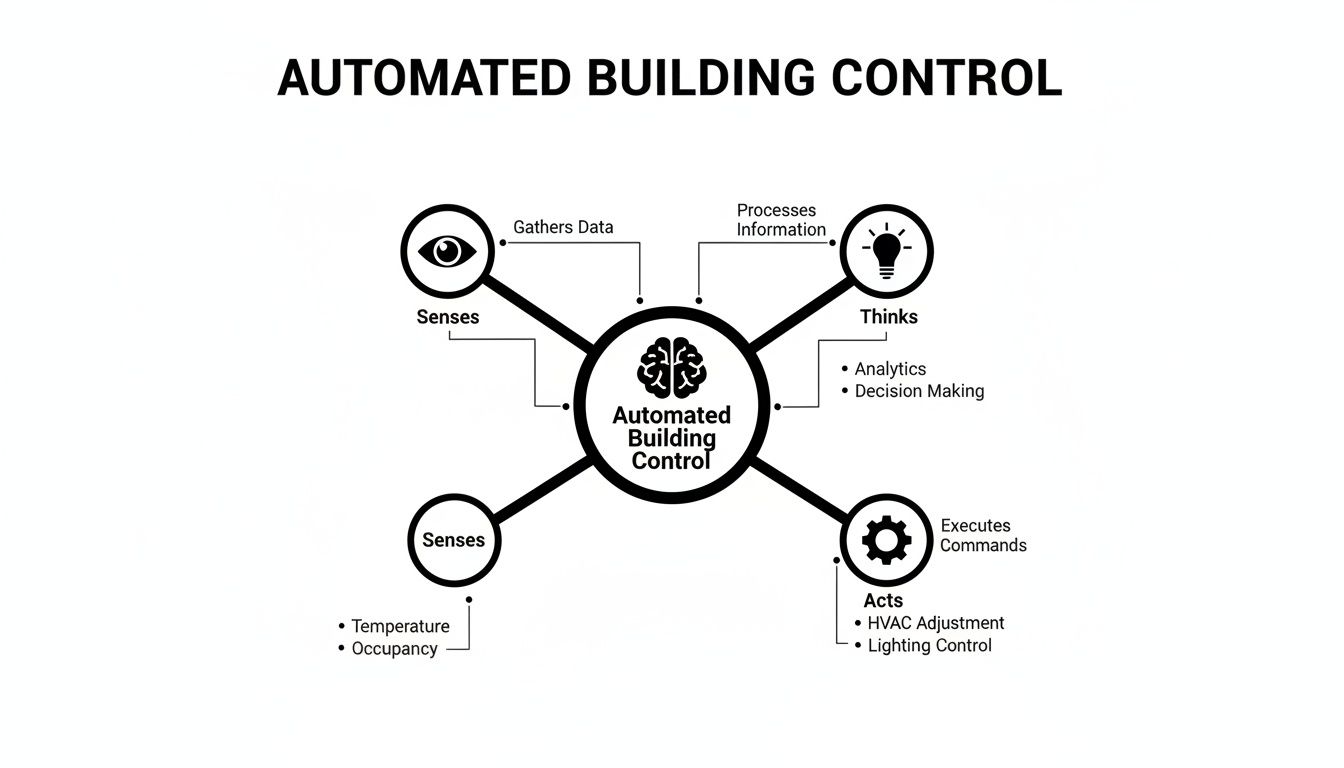
This cycle of sensing, thinking, and acting is the foundation of any smart building. It’s this continuous loop that allows the building to adapt and optimize itself without someone needing to manually flip a switch.
The Brain: The Building Management System (BMS)
At the heart of any automated building is the Building Management System (BMS), sometimes called a Building Automation System (BAS). Think of it as the central brain. It’s the command center that pulls in information from every corner of the property, processes it, and sends out clear instructions.
This isn’t just a glorified on-off switch. The BMS runs on software programmed with specific rules, schedules, and setpoints to make intelligent decisions. For example, it knows the lobby needs to be a comfortable 72°F during business hours but can let that temperature rise overnight to save a significant amount on energy bills.
The Senses: A Network of Smart Sensors
So, how does the BMS "brain" know what's going on? It relies on its senses—a network of sophisticated sensors installed throughout the building. These devices are the eyes, ears, and nerve endings of the system, constantly feeding it data about the environment.
Common types of sensors include:
- Occupancy Sensors: These detect motion or body heat to figure out if a room is empty or in use, which is critical for smart lighting and HVAC control.
- Temperature Sensors: Placed in guest rooms, common areas, air ducts, and even outside, they provide the real-time readings needed to fine-tune heating and cooling.
- Light Sensors: These measure ambient daylight, allowing the system to automatically dim indoor lights when the sun is bright enough, saving electricity without anyone noticing.
- Humidity Sensors: Essential for maintaining good air quality and comfort, these help the BMS manage ventilation and prevent problems like mold growth.
This constant stream of information gives the BMS a complete, live picture of the entire building. It's a perfect example of how the Internet of Things is revolutionizing building automation by connecting dozens of these small devices into one cohesive, intelligent network.
The Muscles: Actuators That Get The Job Done
Once the BMS receives data from the sensors and decides what to do, it needs a way to make it happen. This is where actuators come in. If sensors are the senses and the BMS is the brain, then actuators are the muscles. They are the physical devices that actually execute the commands.
An actuator is a component that gets a signal from the control system and performs a physical action, like opening a valve, moving a damper, or switching a light on or off.
For instance, when an occupancy sensor reports a conference room has been empty for 15 minutes, the BMS sends a signal to the actuators in that room. One actuator might switch off the lights, while another closes a damper in the air duct to reduce airflow. These small, automated actions, repeated hundreds of times a day across a property, are what generate massive operational savings.
To tie it all together, here's a quick breakdown of how these hardware and software components function in the real world.
Key Components of Automated Building Control
| Component | Function (Analogy) | Examples |
|---|---|---|
| Building Management System (BMS) | The Brain that processes data and makes decisions based on pre-set rules. | A central dashboard that controls HVAC schedules, lighting scenes, and access control. |
| Sensors | The Senses (eyes, ears) that collect data from the environment. | Occupancy sensors in meeting rooms, temperature sensors in hotel suites, daylight sensors in lobbies. |
| Actuators | The Muscles that carry out physical commands from the BMS. | A motorized valve on a water pipe, a damper in an air duct, a smart light switch. |
| Integration Layer | The Nervous System that connects all components so they can communicate. | BACnet or Modbus protocols, APIs connecting the BMS to a property management system (PMS). |
This table shows how each part plays a distinct yet connected role. The "muscles" are useless without the "brain," and the "brain" is blind without its "senses."
While the hardware like sensors and actuators is crucial, the industry is shifting. Some research suggests hardware might account for around 57% of market value, but the real growth is in software and integration services. As buildings get smarter, the value is moving toward the advanced analytics and cloud-based features that make the whole system work together seamlessly.
The Real-World Benefits of Building Automation
Knowing what goes into an automated building control system is one thing, but what really matters are the results you can see and measure. Putting this technology in place isn't just a modern facelift for a property; it's a smart investment that pays dividends across the board. From gutting utility bills to making tenants genuinely happy, the "why" behind building automation is powerful.
These benefits don't exist in a vacuum. They create a positive cycle where operational savings, happier residents, and a safer environment all feed into each other, ultimately making the entire property more valuable. Let's dig into the four main ways an integrated system delivers real-world value.
Driving Significant Energy Savings
Right off the bat, the most tangible benefit of automated building control is a major drop in energy use. Buildings are famously thirsty for power, but automation brings a level of fine-tuned control that humans just can't replicate.
Instead of running the heat or AC on a rigid schedule, the system reacts to what's happening right now. It knows when rooms are empty and dials back the conditioning. It senses bright sunlight streaming through a window and dims the lights automatically. Not a single kilowatt gets wasted. This intelligent grip on HVAC and lighting is a massive win and a core reason people adopt these systems.
A well-implemented automated system can slash a building's total energy consumption by 10% to 30%. Those aren't just numbers—they're real savings that hit the bottom line and help meet sustainability targets.
This efficiency is a huge driver for properties looking to cut costs and their carbon footprint. Consistent, double-digit savings create a clear business case, helping buildings stay ahead of new environmental regulations. You can explore some of the 8 Unmissable Benefits of Smart Thermostats to see how even a single component can make a difference.
Boosting Operational Efficiency
Beyond the energy bill, building automation completely changes the game for day-to-day operations. It frees up your facility staff from tedious, repetitive work so they can focus on what really matters. Think of the system as a tireless digital assistant that handles routine tweaks and keeps an eye on equipment health 24/7.
This proactive approach stops small problems from blowing up into expensive emergencies. For example, the system can monitor an air handler's performance, notice a subtle change indicating strain, and automatically log a maintenance ticket long before the unit breaks down. Moving from reactive firefighting to predictive care is a game-changer for maintenance budgets and the lifespan of your equipment. To see how this works, it’s helpful to understand the difference between predictive maintenance vs preventive maintenance.
Automated workflows also take tasks that used to eat up hours and get them done in seconds.
- Automated Scheduling: You can program the lighting and temperature for common areas months in advance, with automatic adjustments for holidays or special events. No more last-minute runs to the thermostat.
- Remote Management: Facility managers can check in and make adjustments across an entire portfolio of properties from a single screen on their laptop or tablet.
- Centralized Alarms: Instead of walking the halls to check on individual pieces of equipment, staff get instant, detailed alerts on their phones pinpointing the exact location and nature of any issue.
Enhancing The Occupant Experience
Let's be honest: a smart building is a comfortable building. By keeping the environment consistent and responsive, automated controls directly improve life for guests, residents, and employees. This isn't just a nice-to-have feature; in a crowded market, it's a huge competitive advantage.
In a hotel, it means the room is perfectly cool the second a guest walks in. In an apartment complex, it means the gym and lobby are always comfortable and well-lit. In an office, it means consistent air quality and lighting that actually helps people focus and be more productive.
The system virtually eliminates those classic complaints about a space being "too hot" or "too cold" by constantly making tiny, imperceptible adjustments based on who's in the room and what the weather is like outside. That seamless comfort creates a premium feel that builds loyalty and can justify higher rents or room rates.
Strengthening Safety and Security
Finally, when you tie your security systems into a central automation platform, you create a smarter, more coordinated safety net. When access control, cameras, and fire alarms can all talk to each other, their response to an emergency becomes incredibly powerful.
Imagine a fire alarm goes off. An integrated system can instantly and automatically:
- Unlock specific doors to create clear escape routes.
- Shut down HVAC fans to stop smoke from spreading through the vents.
- Turn on all the lights in hallways and stairwells for better visibility.
- Send an immediate notification to building management with the alarm's exact location.
This kind of synchronized reaction is infinitely more effective than having a bunch of separate systems acting on their own. It keeps people safer, protects the property, and gives management a clear view of what’s happening during a crisis. This is how a building transforms from a simple collection of parts into a truly smart, secure, and efficient ecosystem.
How Building Automation Works Across Industries
The real power of automated building control is its chameleon-like ability to adapt. It’s not a rigid, off-the-shelf product but a flexible framework you can shape to fit the unique needs of any building. What works for a bustling hotel won't be the right fit for a senior living community, and that's the point. The core technology gets customized to solve very specific problems and deliver real-world value.
A multi-family property might focus on reining in energy costs and making life easier for the management team. Meanwhile, a commercial office is probably more interested in creating a productive workspace. Seeing how this technology plays out in different settings is where its true potential really clicks.
Hospitality: A Seamless Guest Experience
In the hyper-competitive hotel world, the guest experience is king. Automated building control is the secret ingredient to creating a stay that feels truly special and effortless, right from the moment someone checks in. By tying the system directly into the Property Management System (PMS), hotels can create personalized "welcome scenes."
Imagine a guest's key card is activated. The system instantly gets to work:
- The room temperature is set to a comfortable 70°F.
- The blinds slowly rise, revealing the city view.
- Soft, ambient lighting fades on.
- The TV powers up with a welcome message on the screen.
This kind of detail makes every guest feel like they're walking into a perfectly prepared space, and it happens without a single staff member having to run from room to room. On the flip side, the moment a guest checks out, the system powers everything down, putting a stop to wasted electricity on empty, fully lit, air-conditioned rooms.
Multi-Family Residential: Smart and Efficient Living
For apartment buildings and condo complexes, automated building control is a game-changer for solving big operational headaches while making residents happier. Think about all the common areas—lobbies, gyms, hallways. Centralized management keeps them comfortable and well-lit without running up the utility bills. Property managers can schedule HVAC and lighting that automatically adjust for weekends, holidays, or time of day.
In multi-family housing, automated control transforms building management from a constant manual effort into a streamlined, data-driven operation that reduces costs and elevates the resident lifestyle.
It gets better. When you integrate smart access control, you boost both security and convenience. Residents can use a mobile app to get into the building and common areas, while property managers can grant or revoke access for vendors or new tenants from anywhere. This connected approach also means you can monitor critical systems like water heaters and pumps, getting an alert about a potential leak long before it becomes a catastrophic flood.
Senior Living: Safety and Comfort First
When it comes to senior living facilities, the priorities are crystal clear: safety, comfort, and well-being. Automated building control is perfectly suited to create an environment that supports these goals. For instance, the system can provide gentle, automated pathway lighting that turns on at night when a resident gets out of bed, a simple feature that dramatically reduces the risk of falls.
Advanced systems can also keep a close eye on air quality in real-time. They’ll adjust ventilation to control humidity and filter out allergens—a critical feature for residents with respiratory conditions. Other key applications here include:
- Temperature Regulation: Maintaining precise, stable temperatures in rooms and common areas is non-negotiable. It prevents health risks tied to residents getting too hot or too cold.
- Automated Alerts: Tying the nurse call system into the building’s lighting and door locks can provide instant visual cues and secure pathways during an emergency.
- Water Monitoring: Sensors can detect unusual water temperatures or leaks, protecting both residents from scalding and the property from expensive water damage.
The result is a safer, healthier, and more comfortable home for residents, all while giving staff better tools to provide top-notch care.
Commercial Offices: The Productive Workspace
For commercial office buildings, automated control is a powerful tool for getting the most out of the space and slashing operating expenses. The system can manage conference room bookings by linking with calendar software, turning on the lights and adjusting the temperature just before a meeting starts, then powering everything down the moment the room is empty.
This dynamic control is perfect for modern work styles like hot-desking. Occupancy sensors can report back in real-time which desks are in use, giving companies a clear picture of how their space is actually being used. Those insights lead to much smarter real estate decisions. Ultimately, by ensuring the lighting, air quality, and temperature are always just right, building automation directly contributes to a more productive and comfortable environment for everyone.
Your Roadmap to a Successful Implementation
Deciding to bring automated controls into your building is a big move. But to really get it right, you need more than just new tech—you need a solid game plan. A well-thought-out roadmap is the difference between a project that delivers and one that just causes headaches.
The real work starts long before you ever call a vendor. First, you have to get brutally honest about your property's current state. Think of it as a health check-up for your building: find the pain points, spot the inefficiencies, and see where the real opportunities are hiding.
Once you have that baseline, you can map out a clear path forward, covering everything from setting goals and picking a partner to the actual rollout and getting your team up to speed. Following a few key steps helps you sidestep common traps and sets you up for success.
Step 1: Assess Your Building and Define Goals
Before you can fix anything, you have to know exactly what’s broken. Walk your property with a critical eye. Where are you bleeding energy? Are you getting the same comfort complaints over and over again for the same zones? Is your maintenance team constantly running around putting out the same fires?
Jot all of these issues down. Then, turn that list into clear, measurable goals. Vague ambitions like "be more efficient" won't cut it. You need specific targets to aim for.
For instance, you might set goals like:
- Cut HVAC energy consumption by 15% in the first year.
- Reduce maintenance calls for "too hot/too cold" complaints by 25%.
- Automate lighting in all common areas to knock 10% off the electricity bill.
Having concrete goals like these will anchor every decision you make down the line, from the features you prioritize to the vendor you ultimately hire.
Step 2: Select The Right Vendor and Technology
Choosing a partner for this project is probably the single most important decision you'll make. Don't just look at the price tag; find a vendor who truly understands your goals and can design a system that fits your building like a glove. The best ones act more like consultants than salespeople.
When you’re comparing options, make sure to ask about open protocols. Technologies like BACnet or Modbus are the industry standard for a reason—they ensure that devices from different brands can all speak the same language. This is huge, because it prevents you from getting locked into one company's hardware and gives you the freedom to upgrade or expand with other solutions in the future.
The right vendor won't just sell you a box of hardware. They will provide a scalable, interoperable solution supported by robust training and long-term service, ensuring your system evolves with your building's needs.
A detailed building automation system installation requires careful planning and expertise. For a deeper look into this process, you can find valuable insights by exploring our comprehensive guide on building automation system installation.
Vendor Selection Criteria Checklist
Finding the right technology partner is crucial. This checklist can help you compare potential vendors and ensure you're asking the right questions.
| Criteria | Key Questions to Ask | Why It Matters |
|---|---|---|
| Industry Experience | Have you worked with properties like mine (hospitality, multi-family, etc.)? Can you share case studies? | A vendor with experience in your sector understands your specific challenges, from guest comfort to tenant billing. |
| Technology & Interoperability | Does your system use open protocols like BACnet or Modbus? How easily can it integrate with our existing equipment? | Open protocols prevent vendor lock-in, giving you flexibility for future upgrades and integrations. |
| Scalability | Can the system grow with us? What's the process for adding new buildings, floors, or equipment later on? | Your needs will change. A scalable system saves you from having to start over from scratch in a few years. |
| Training & Support | What kind of training do you provide for our facilities team? What does your post-installation support look like? | A powerful system is useless if your team can't operate it. Strong training and accessible support are non-negotiable. |
| Long-Term Partnership | What is your roadmap for future software updates? How do you help clients adapt to new challenges and technologies? | You're not just buying a product; you're entering a long-term relationship. Look for a partner invested in your success. |
Taking the time to vet vendors thoroughly ensures you find a true partner, not just a supplier.
Step 3: Plan The Integration and Rollout
With your goals set and vendor chosen, it's time to plan the actual installation. For older buildings, this usually means retrofitting new technology into an existing structure. A good implementation partner will start with a detailed site survey to figure out the best way to install new sensors, actuators, and controllers without causing a major disruption.
Instead of trying to do everything at once, a phased rollout is almost always the smarter move. This lets you tackle the project in manageable chunks. You could start with one floor, one building, or just one system (like HVAC).
This approach lets you test everything out, get feedback, and score some early wins—which is great for building momentum and getting buy-in for the rest of the project.
Finally, don't forget about the people. The fanciest system in the world won't do you any good if your staff doesn't know how to use it. Make sure your vendor provides a solid training program so your facility managers are comfortable with the new dashboard, know how to read the data, and can make adjustments with confidence. When your team is empowered, you'll start seeing the benefits on day one.
Common Questions About Automated Building Control
It's completely normal to have a few big questions when you're thinking about bringing this kind of technology into your building. Most property managers and owners want to get a handle on the financial return, what it means for security, and whether it’s even practical for an older property.
Getting solid answers to these questions is the first step toward building an automation strategy that actually works. Let's tackle them one by one.
What Is The Typical Return On Investment?
This is usually the first question on everyone's mind, and for good reason. The good news is that the return on investment (ROI) for automated building control is often one of its strongest selling points. While every building is different, most properties see a full payback within three to seven years. Some can even get there faster.
Where does that return come from? It boils down to two main areas:
- Energy Savings: This is the most immediate and tangible benefit. A well-tuned system can easily slash energy consumption by 10% to 30%. You'll see this directly on your monthly utility bills.
- Operational Efficiency: Think about the time and money saved on maintenance. Predictive alerts mean you fix small issues before they become big, expensive problems. You also reduce the need for manual checks and adjustments, freeing up your staff for more important work.
It helps to stop thinking of it as a pure expense and start seeing it as a capital improvement—one that actively pays for itself over time.
Do These Systems Create Cybersecurity Risks?
That’s a smart question to ask. The truth is, a modern, professionally installed system is built to enhance your security, not weaken it. Any reputable vendor treats your building's operational network with the same seriousness as your core IT infrastructure. They build security in from the very beginning.
A properly secured automated building control system operates on an isolated or protected network. It uses encryption and strict access controls to shield it from external threats, making it far more secure than a random collection of unmanaged, consumer-grade smart devices.
When done right, the system’s centralized monitoring can actually help you spot unusual network activity much faster than you could otherwise. The key is to partner with a vendor who lives and breathes cybersecurity and follows best practices for protecting your network.
Can I Retrofit an Older Building?
Absolutely. While it’s certainly easier to install these systems in a brand-new building, retrofitting older properties is incredibly common and effective. We’ve seen successful installations in buildings that are 50 to 100 years old.
The magic here is modern wireless technology. Instead of tearing open walls for new wiring, integrators can strategically place wireless sensors and controllers with minimal disruption. This has been a complete game-changer, allowing historic and architecturally significant properties to gain modern efficiency without losing their character. A good integrator will perform a detailed site survey to design a system that works with your building's quirks, not against them.
Ready to transform your property with intelligent automation and robust security? The experts at Clouddle Inc specialize in designing and implementing integrated technology solutions that boost efficiency and enhance occupant experiences. Learn more about our managed services and get started today.