


IT projects fail at alarming rates. According to the Project Management Institute, 14% of IT projects fail outright, while 44% face significant challenges. At Clouddle, we’ve seen firsthand how the right knowledge makes the difference between success and costly setbacks.
The best IT project management books cut through the noise and give you proven frameworks that work. This guide walks you through the essential reads, from foundational classics to modern approaches, so you can build stronger projects and lead more effectively.
What Really Makes IT Projects Fail
Poor Communication Destroys Projects
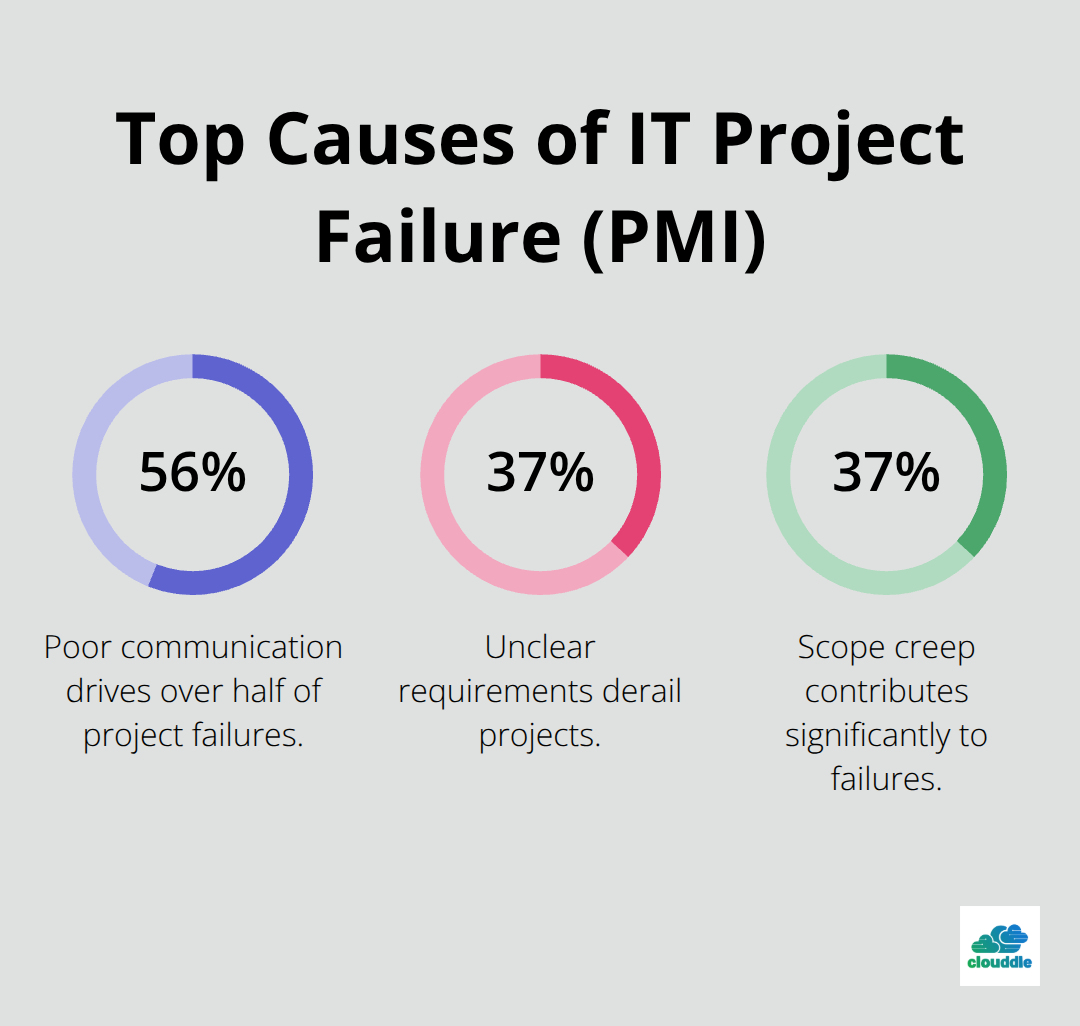
IT projects collapse for specific, preventable reasons. The Project Management Institute reports that poor communication accounts for 56% of project failures, while unclear requirements and scope creep each contribute roughly 37% to project derailment. These aren’t mysterious forces-they’re execution gaps that Making Things Happen by Scott Berkun addresses directly through practical decision-making frameworks and risk management strategies.
Berkun emphasizes that project managers must own communication actively rather than assume it happens naturally. Weak stakeholder alignment tops the list of avoidable failures, yet many organizations still treat it as secondary.
Leadership Mindset Beats Command-and-Control
The PMBOK Guide by PMI establishes clear governance structures that prevent communication breakdowns, but governance alone fails without the leadership mindset that Drive by Daniel H. Pink highlights. Pink’s research shows that autonomy, mastery, and purpose drive team performance far more than command-and-control tactics.
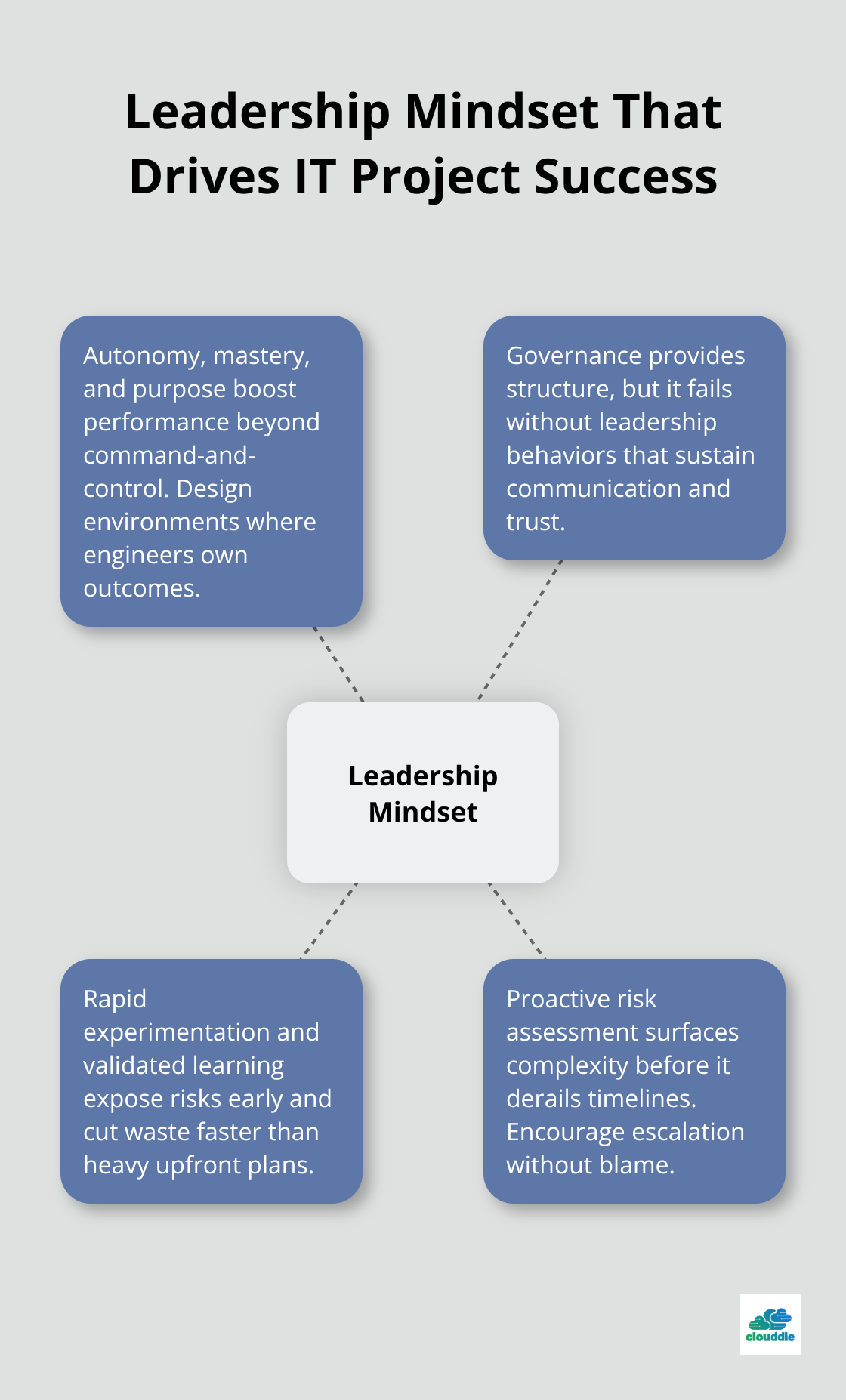
IT projects fail because managers underestimate technical complexity, skip risk assessments, or ignore team burnout signals. The Lean Startup by Eric Ries flips this approach entirely-rapid experimentation and validated learning replace lengthy upfront planning, cutting waste and exposing problems early.
Speed Catches Problems Before They Explode
Scrum: The Art of Doing Twice the Work in Half the Time by Jeff Sutherland demonstrates that breaking work into two-week sprints creates feedback loops that catch misalignment before it becomes catastrophic. Most failed IT projects had warning signs months before collapse; they simply went unheeded because nobody measured the right metrics or had permission to escalate concerns. Early detection prevents expensive rework and team demoralization.
The Skills That Separate Success from Failure
Technical knowledge matters less than most people think. The ability to communicate complex ideas in plain language, negotiate competing priorities, and make decisions under uncertainty separates successful IT project managers from those who watch projects implode. Emotional intelligence-understanding team dynamics, recognizing stress, and building trust-appears across nearly every major project management text because it directly impacts execution. Interactive Project Management by Nancy Lyons and Meghan Wilker specifically addresses this gap by treating people-centered leadership as the foundation rather than a soft skill afterthought.
Structured Risk Management Prevents Disasters
Risk management requires discipline, not intuition. A Systems Approach to Planning, Scheduling, and Controlling by Harold Kerzner teaches structured risk identification and mitigation planning that prevents small problems from becoming project killers. Too many IT managers wait for problems to surface rather than hunting for them proactively. The ability to track progress against clear metrics separates those who know their project is in trouble from those who discover it during a status meeting. Getting Things Done by David Allen provides a practical system for managing workflow and priorities at both personal and team levels, which directly impacts your ability to spot delays early. Hybrid approaches that blend traditional PMBOK methods with Agile practices yield better IT project outcomes than rigid adherence to a single framework, according to practitioners across industries. Understanding these failure patterns and the skills that prevent them shapes how you select and apply the books that follow.
Which Books Actually Move the Needle for IT Project Managers
Foundation: The Books That Build Credibility
The PMBOK Guide by PMI remains the gold standard for foundational knowledge, and skipping it handicaps your credibility in formal project environments. However, PMBOK alone teaches governance without execution muscle. Scott Berkun’s Making Things Happen cuts deeper into the decisions you actually face-how to handle scope creep, manage difficult stakeholders, and make calls when information is incomplete. Berkun spent decades shipping real software projects, and his essays on risk, decision-making, and team dynamics translate directly into your next meeting.
For IT specifically, Harold Kerzner’s A Systems Approach to Planning, Scheduling, and Controlling teaches structured risk identification that prevents small problems from metastasizing into project killers. These three form your technical foundation, but they won’t fix the leadership gaps that sink most IT initiatives.
Leadership: The Missing Piece in Most IT Projects
Daniel H. Pink’s Drive proves that command-and-control management destroys IT team performance. His research on autonomy, mastery, and purpose explains why your best engineers leave after a poorly managed project-and how to build environments where they stay. Peter Drucker’s The Effective Executive teaches time management and decision-making discipline that separates managers who actually ship from those who drown in meetings.
David Allen’s Getting Things Done provides a personal workflow system that scales to team management, helping you spot delays before they cascade. Nancy Lyons and Meghan Wilker’s Interactive Project Management treats emotional intelligence and people-centered leadership as foundational, not supplementary. If you manage remote or distributed IT teams, this book directly addresses the communication and trust gaps that plague virtual projects. These books address the leadership vacuum that kills IT projects faster than bad architecture.
Modern Execution: Speed and Adaptation Win
Modern IT demands speed and adaptation that traditional waterfall approaches cannot deliver. Eric Ries’s The Lean Startup proves that rapid experimentation and validated learning beat lengthy upfront planning in uncertain environments-exactly where IT projects live. Jeff Sutherland’s Scrum: The Art of Doing Twice the Work in Half the Time demonstrates that two-week sprints create feedback loops that catch misalignment before it becomes catastrophic.
Gene Kim’s The Phoenix Project shows how DevOps integration and IT service management eliminate bottlenecks and accelerate delivery, with real data on deployment frequency and failure rates. For portfolio and strategy alignment, John Doerr’s Measure What Matters outlines how OKRs drive organizational growth, with case studies showing how aspirational targets focus teams on what actually matters.
Building Your Reading Strategy
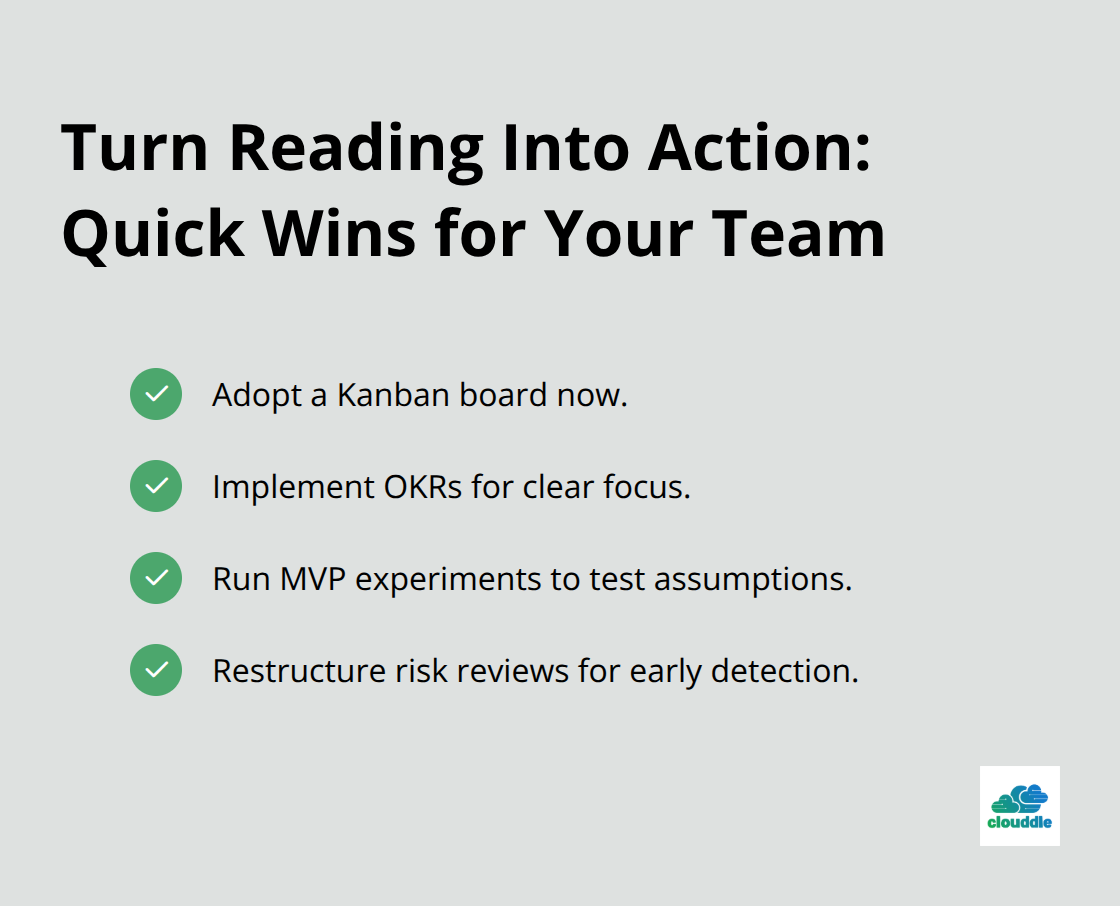
The hybrid approach-blending PMBOK structure with Agile execution-yields better outcomes than rigid adherence to either methodology alone. Start with one foundational text from each category: a governance reference like PMBOK or Kerzner, a leadership book like Berkun or Pink, and a modern execution guide like Ries or Sutherland. Then extract specific actions immediately: adopt a Kanban board, implement OKRs, run MVP experiments, or restructure your risk reviews.
Books that sit on shelves unread waste money and time. The job market shows 7% projected growth for project managers through 2033, which means competition intensifies for those who actually execute versus those who merely know theory. The real test comes when you apply what you read to your team’s next sprint, your next risk review, and your next difficult stakeholder conversation.
How to Turn Reading Into Results
Reading project management books means nothing without action. The gap between theory and execution kills more projects than bad methodology ever could. Extract one concrete practice from each book you finish, then implement it within two weeks. If you read Making Things Happen by Scott Berkun, establish a formal risk review process where you hunt for problems weekly rather than waiting for them to surface. If you finish Scrum: The Art of Doing Twice the Work in Half the Time by Jeff Sutherland, move to two-week sprints immediately and measure velocity to spot capacity problems before they derail timelines. The Lean Startup by Eric Ries teaches validated learning-pick one assumption about your next project, design a small experiment to test it, and measure the results. Most IT teams read about these practices and never implement them, which wastes the reading time entirely.
Install One Practice at a Time, Not Everything at Once
Organizations that try to adopt PMBOK governance, Scrum ceremonies, Lean principles, and OKR tracking simultaneously create chaos. Pick the single biggest pain point your team faces right now. If communication breakdowns dominate your post-mortems, focus on the stakeholder alignment practices that Making Things Happen emphasizes. If your projects consistently miss deadlines, implement the risk management discipline from A Systems Approach to Planning, Scheduling, and Controlling by Harold Kerzner. Once that practice sticks for three months-meaning your team executes it without prompting and sees measurable improvement-add the next one. Research on organizational change shows that sustainable adoption requires 66 days of consistent practice before a behavior becomes automatic. Rushing adoption guarantees failure and creates cynicism about process improvements.
Measure What Actually Changed
Document what changed after you implemented each practice. Did sprint velocity increase by 15%? Did risk escalations happen earlier, preventing one major delay? Did team satisfaction improve according to your next survey? Data proves to skeptics that reading actually matters. Without measurement, your team dismisses process changes as management theater. Track these metrics before and after implementation so you have concrete evidence that the book’s lessons work in your environment.
Build Peer Learning Into Your Team Rhythm
Assign one team member to present a chapter from your current book during a 20-minute monthly meeting. Require them to explain one idea and suggest how your team could apply it. This costs nearly nothing, keeps people engaged with the material, and creates accountability for finishing the books. Rotate who presents each month so everyone participates. After six months, your team has covered multiple perspectives and generated dozens of implementation ideas from people who actually do the work. Discussion matters more than individual reading because execution problems surface during conversation. Someone will say, “That won’t work for us because…” and you’ll identify the real blocker earlier. Teams that skip this discussion phase read books and change nothing.
Align Reading With Your Project Calendar
Pair reading assignments with your project calendar. When you plan next quarter’s work, assign Measure What Matters by John Doerr to help your team design OKRs that actually focus effort. When you enter a high-risk initiative, assign The Phoenix Project by Gene Kim to help people understand how to eliminate bottlenecks. Reading becomes relevant when it directly addresses what your team faces today, not abstract knowledge for someday. This approach transforms books from optional self-improvement into practical tools that solve immediate problems your team encounters.
Final Thoughts
The best IT project management books share one common thread: they bridge the gap between knowing what to do and actually doing it. PMBOK teaches governance, Berkun teaches decision-making under pressure, Pink teaches motivation science, and Ries teaches rapid learning. Your team’s next sprint, next risk review, and next stakeholder conversation will reveal whether you extracted real value or simply accumulated unread pages. Start small by picking one book that addresses your biggest current pain point, finish it within a month, extract one concrete practice, and implement it within two weeks.
The job market shows 7% projected growth for project managers through 2033, which means competition intensifies for those who execute versus those who merely know theory. Teams that implement risk management discipline from Kerzner, leadership practices from Pink, and sprint velocity tracking from Sutherland outperform those that skip implementation entirely. Build peer learning into your team’s monthly rhythm by assigning one person to present a chapter and suggest how your team could apply it-discussion surfaces real blockers faster than individual reading ever will. Align your reading with your project calendar so that when you plan high-risk work, you assign The Phoenix Project to help eliminate bottlenecks, and when you design quarterly goals, you assign Measure What Matters to focus effort on what actually matters.
At Clouddle, we provide the networking, security, and managed IT services that keep your projects running smoothly while you apply the leadership and execution practices from these books. Our Network as a Service combines connectivity, entertainment, and security without upfront investment, so your team focuses on execution rather than infrastructure headaches. Your personal development plan starts with one book and one practice-commit to finishing it, implementing one idea, and measuring the result.