
Your hotel’s network is only as strong as its cabling foundation. Poor infrastructure leads to dropped connections, frustrated guests, and lost revenue-problems we at Clouddle see hotels struggle with constantly.
Data cabling installation in hotels demands precision planning and flawless execution. This guide walks you through every stage, from assessing your connectivity needs to maintaining peak performance long after installation wraps up.
Planning Your Hotel’s Data Cabling Infrastructure
Your hotel’s bandwidth demand has exploded. Guest Wi-Fi now accounts for 40–60% of total network traffic in most properties, and this number keeps climbing as visitors expect streaming, video calls, and seamless connectivity across every corner of the building. Before you order a single cable, you need to understand exactly what your property must support: guest-facing services, back-of-house operations, security systems, emergency communications, and future technologies you haven’t even deployed yet.
Map Every Space That Needs Connectivity
Start by mapping every room, hallway, parking garage, and outdoor area that needs connectivity. Include your front desk, kitchen, laundry, engineering spaces, and any conference or dining areas. This isn’t about guessing-count devices, measure distances, and identify which areas face signal challenges due to construction materials like concrete, brick, or metal. Hotels with proper assessments upfront avoid costly rework later. Many properties discover mid-installation that their plans don’t account for elevator shafts, underground parking, or the shielding needed in kitchens where HVAC and electrical systems create electromagnetic interference that kills signal quality.
Choose Between Copper and Fiber Optic Cabling
Copper cabling dominates most hotel installations because it’s familiar, less expensive upfront, and works well for standard guest-room and office connectivity. Cat6a copper supports 10 Gbps speeds and handles the bandwidth most hotels need today. However, fiber optic cabling makes sense if your property spans multiple buildings, requires extremely long cable runs, or needs future-proofing for bandwidth demands you know are coming. Fiber avoids electromagnetic interference entirely, a major advantage in hospitality environments where kitchens, laundry rooms, and mechanical spaces generate constant noise. The trade-off is cost and complexity-fiber requires specialized termination and testing equipment, and your maintenance team needs training. For most single-building hotels, copper delivers performance at half the price. For large resorts or properties with distributed infrastructure, fiber becomes the smarter long-term investment. Your cabling design should also specify plenum-rated cables in walls and above drop ceilings to meet fire codes and reduce smoke generation during fires. This detail matters legally and operationally, yet many installations overlook it entirely.
Build Scalability Into Your Network Layout
Structured cabling systems organize your entire network backbone into a logical, expandable framework. Instead of running cables randomly, a structured approach uses central equipment rooms, organized patch panels, and consistent labeling that lets you add new access points, cameras, or guest-room services without ripping out existing infrastructure. Design your equipment rooms with 24-port patch panels and Layer 2/3 switches that support VLANs, allowing you to separate guest traffic from administrative and point-of-sale networks. This segmentation improves security and prevents guest congestion from slowing down critical hotel operations. Plan for at least 30% excess capacity in your cable runs and conduit-hotels constantly add devices, upgrade systems, and modify layouts. Access points placed strategically on ceilings with roaming support ensure seamless Wi-Fi across multi-floor properties far better than wireless-only solutions. Your layout should also account for Public Safety Distributed Antenna Systems (DAS), a legally required system that enables first responders to communicate inside your building during emergencies. DAS coverage must reach all areas including parking garages, elevators, and stairwells-this isn’t optional. Label everything consistently using color-coding and clear identifiers from day one; this small discipline saves hours during troubleshooting and future upgrades.
Plan for Installation Complexity and Compliance
Your cabling plan must address fire codes, electrical safety standards, and accessibility requirements before installation begins. Plenum-rated cables, proper grounding, and ADA-compliant routing protect your guests, staff, and liability exposure. Coordinate early with your internet service provider, phone company, and cable TV vendor to align timelines and avoid surprises that derail your budget. A transparent, turnkey approach with clear costs prevents scope creep and keeps projects on schedule. With your infrastructure plan finalized, the next stage focuses on execution-minimizing disruption to guests while maintaining the precision that separates a reliable network from one that fails under pressure.
Installation Best Practices for Hospitality Environments
Executing a data cabling installation in an operating hotel demands military-level coordination. Hotels cannot simply close for weeks while cables run through walls and ceilings. Every hour of downtime costs money, frustrates guests, and damages reputation. The solution involves planning installation windows during low-occupancy periods, scheduling work during night hours, and phasing deployment across zones so guest-facing areas stay operational.
Schedule Installation During Low-Occupancy Windows
Most hotels experience occupancy drops of 30–40% during winter months or shoulder seasons; this is when you should schedule major cabling work. If your property runs year-round with high occupancy, negotiate after-hours installation with your cabling team starting at 10 PM or midnight. Coordinate with your front desk, housekeeping, and engineering staff weeks in advance so they understand which areas will be affected and when. Clearly mark construction zones with signage to prevent guests from wandering into active work areas.
Your cabling contractor should provide a detailed timeline showing exactly which areas will be affected each day, allowing you to adjust guest assignments and maintenance schedules accordingly. Phased installation lets you complete one zone, test it thoroughly, and move to the next area without ever fully shutting down operations. Use conduit and cable trays wherever possible rather than running cables loose through walls, which slows installation and creates fire hazards.
Conduct Pre-Installation Surveys to Prevent Costly Surprises
Many hotels discover mid-project that electrical panels or HVAC systems occupy the exact space needed for equipment rooms. A proper pre-install survey prevents this disaster entirely. Your cabling contractor should map existing infrastructure, identify potential conflicts, and document the exact routing before any work begins. This upfront investment saves weeks of delays and thousands in rework costs.
Follow Industry Standards and Compliance Requirements
Industry standards like BICSI and TIA/EIA establish minimum requirements for structured cabling installations. Following these standards from day one prevents costly rework and compliance violations. Fire codes mandate plenum-rated cables in walls and above drop ceilings, and electrical codes specify grounding and spacing requirements that protect both equipment and people. Public Safety DAS must meet FCC regulations and local fire codes, which means proper testing and documentation are non-negotiable.
Use certified contractors who hold RCDD (Registered Communications Distribution Designer) credentials, proving they understand hospitality-specific challenges and compliance requirements. These professionals bring expertise that prevents mistakes and protects your liability exposure.
Implement Proper Cable Management Systems
During installation, your team must use proper cable management systems including 24-port patch panels, cable trays, and color-coded labeling from the start. Poor cable management creates tangled messes that slow troubleshooting, increase installation time, and make future upgrades exponentially harder. Shielded RJ45 patch cords in EMI-prone areas like kitchens preserve signal integrity and minimize cross-talk that degrades performance.
Segment your network using Layer 2/3 switches with VLAN support so guest Wi-Fi traffic stays completely separate from administrative systems and point-of-sale networks. This separation prevents bandwidth congestion and security breaches. Every cable run should receive labels with clear identifiers using consistent color-coding protocols; this discipline saves your team hours during troubleshooting and future modifications.
Test and Document Everything
Testing happens on every installation using Fluke testing equipment that documents compliance with current standards, creating records for your liability protection. Your contractor should provide these test results and keep them on file. Proper installation upfront eliminates the majority of performance problems that plague hotels months or years after go-live. With your cabling infrastructure installed and tested, the next stage focuses on optimizing performance and establishing maintenance routines that keep your network running at peak efficiency.
Optimizing Performance and Maintenance
Your cabling infrastructure enters its most critical phase after installation wraps up: validation and ongoing optimization. Testing immediately after installation identifies problems while your contractor remains on-site and can fix them without rework costs. Your cabling team should run Fluke certification tests on every cable run, documenting compliance with TIA/EIA standards and creating records that protect your liability. These tests measure signal integrity, attenuation, and near-end crosstalk to confirm each cable meets performance specifications. Request these test results in writing and store them permanently; they become essential documentation if performance issues arise later or during insurance claims.
Conduct Testing and Validation After Installation
Proper installation upfront eliminates the majority of performance problems that plague hotels months or years after go-live. Your contractor provides test results and keeps them on file for your records. Beyond the initial certification, establish a quarterly inspection routine where your engineering team physically walks critical infrastructure zones checking for pinched cables, water damage, loose connections, or signs of rodent activity. Hotels in older buildings particularly need this discipline because aging infrastructure deteriorates faster than new construction.
Establish a Regular Maintenance Schedule
Set up a real-time Wi-Fi dashboard that displays access point performance, device counts, and bandwidth usage across your property. This data reveals exactly where congestion happens and when, allowing you to adjust channel configurations or add capacity before guests complain about dropped connections. Define specific KPIs for your network including ticket resolution time per room, total concurrent devices, uptime percentage, and peak bandwidth usage times.
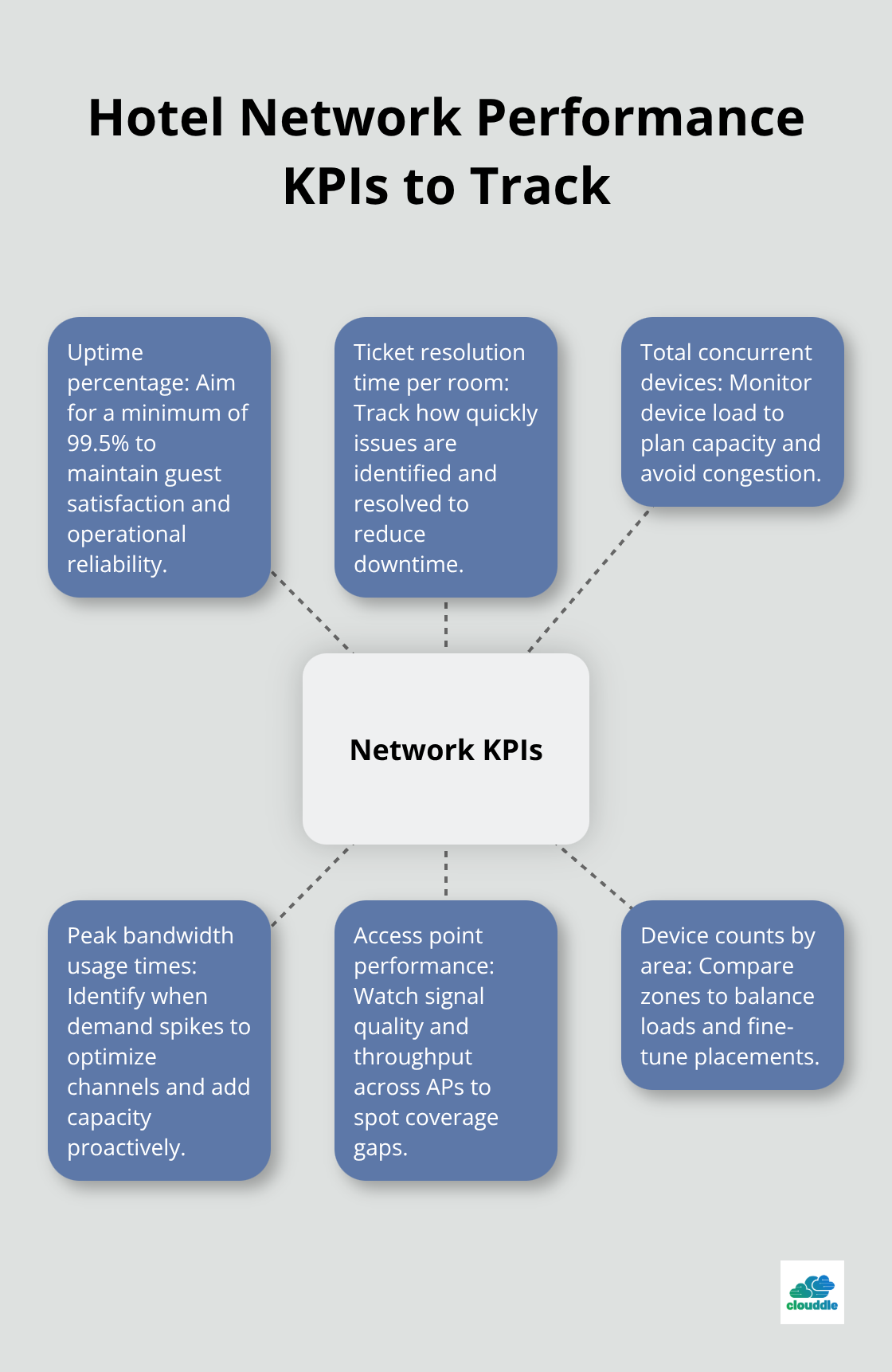
Most hotels target 99.5% uptime minimum.
Track these metrics monthly and compare them against your baseline from the first 30 days post-installation; degradation signals problems brewing. When performance dips below target, analyze access point data to identify interference patterns, coverage gaps, or overloaded channels. Many hotels discover that simply repositioning access points or adjusting transmit power restores performance without new equipment.
Monitor Network Performance Metrics
Schedule annual comprehensive testing using professional-grade equipment to validate your system still meets standards and identify components approaching end-of-life. Replace aging patch cables, switches, and access points proactively rather than reactively; waiting for failures costs far more in emergency repairs and guest dissatisfaction than planned maintenance ever does. For properties running Network as a Service solutions, 24/7 monitoring catches issues automatically before guests even notice problems. This continuous oversight (combined with your quarterly inspections and monthly metric reviews) creates multiple layers of protection that keep your network performing at peak efficiency.
Final Thoughts
Data cabling installation in hotels represents one of the most important infrastructure decisions your property will make. The planning, execution, and maintenance processes outlined in this guide directly determine whether your guests experience seamless connectivity or frustrating dropouts that damage your reputation and revenue. Hotels that invest time in proper assessment, choose appropriate cable types, and build scalability into their network layout avoid expensive rework and performance failures years later.
Once your cabling system operates, regular testing, quarterly inspections, and continuous performance monitoring catch problems before guests notice them. Your real-time dashboard and KPI tracking reveal exactly where congestion happens and when, allowing you to optimize capacity without guessing. This data-driven approach transforms your network from a static installation into a living system that adapts to your property’s changing demands.
A well-designed data cabling installation for hotels supports guest Wi-Fi, security systems, emergency communications, and future technologies without requiring a complete rebuild. If you’re ready to assess your property’s specific needs and create a deployment plan that fits your timeline and budget, Clouddle provides managed IT, networking, and data cabling solutions specifically designed for hospitality properties.


0 Comments