
Hotels face a constant balancing act: investing in technology to meet guest expectations while managing unpredictable revenue streams. When occupancy drops in off-season months, IT budgets shouldn’t stay frozen at peak-season levels.
Flexible IT contracts for hospitality solve this problem by letting you scale your technology spending up or down based on actual business needs. At Clouddle, we’ve seen firsthand how the right contract structure transforms how hotels manage their infrastructure costs and operational efficiency.
Why Your Hotel Needs Flexible IT Contracts Now
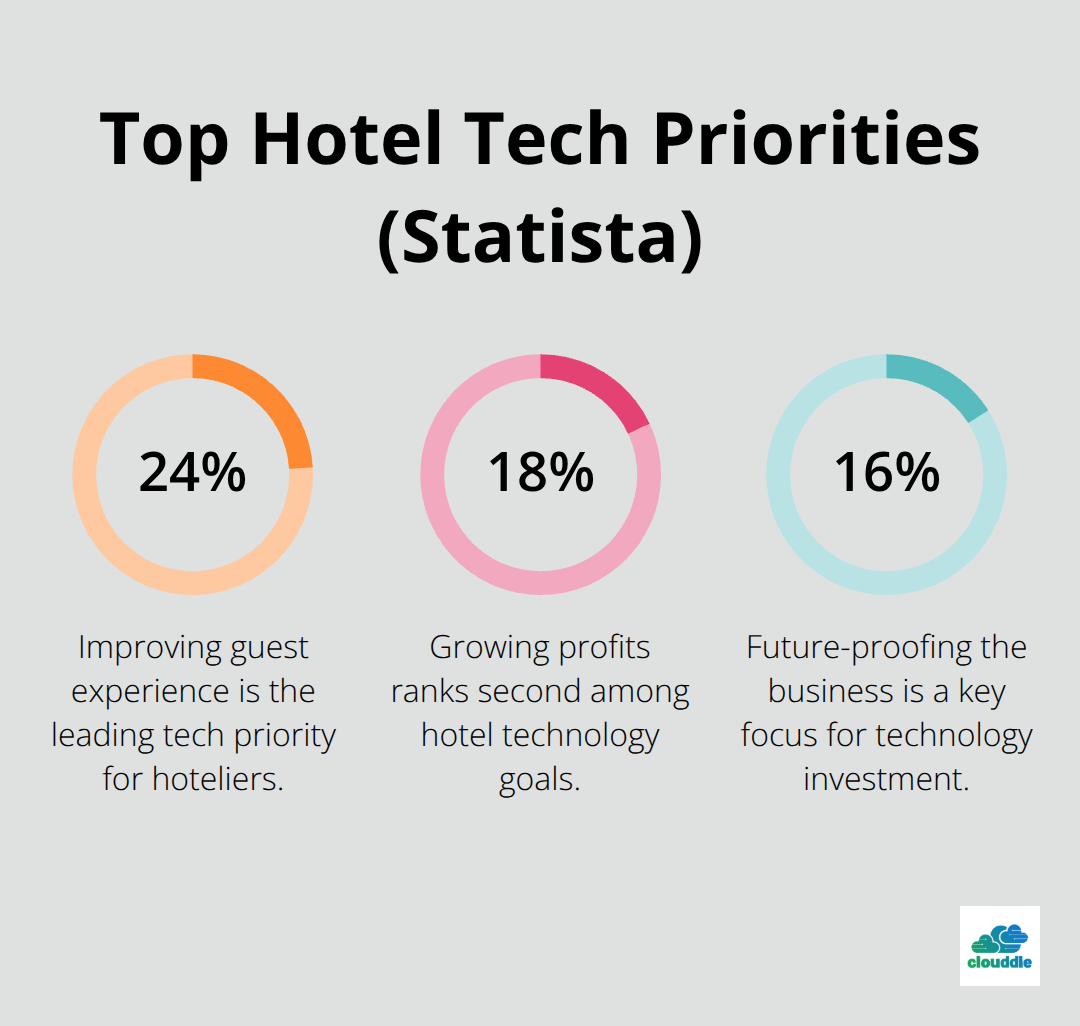
The hospitality industry operates on thin margins and unpredictable demand. According to Statista, hoteliers prioritize improving guest experience (24%), growing profits (18%), and future-proofing their business (16%) as their top technology goals. Yet most hotels sign rigid IT contracts that lock them into fixed costs regardless of occupancy rates.
This creates a fundamental mismatch between how hotels actually operate and how they pay for technology. When your property runs at 45% occupancy in February, your IT bill shouldn’t reflect July’s peak-season demand. Flexible IT contracts solve this problem by aligning your technology spending with actual business performance.
Guest Expectations Shift Faster Than Traditional Contracts Allow
Guests now expect seamless technology across every touchpoint. According to Oracle Hospitality’s latest customer survey in 2023, 60% of travelers ranked mobile check-in as a top tech feature they expect. More than 60% of hospitality leaders plan to implement fully contactless check-in, keys, and payments within three years. Half of business travelers require free Wi-Fi to influence their booking decision. These expectations shift rapidly, which means your IT infrastructure must adapt without lengthy contract renegotiations. A flexible contract lets you upgrade your Wi-Fi, add contactless systems, or integrate new software within weeks instead of waiting for a contract renewal. Hotels locked into outdated infrastructure lose bookings to competitors who invested in modern guest-facing technology.
Seasonal Revenue Swings Demand Cost Flexibility
Your occupancy fluctuates dramatically throughout the year. Summer peaks might hit 85% occupancy while winter valleys drop to 40%. Traditional IT contracts charge the same monthly fee regardless of this volatility. A flexible contract structure instead ties your costs to actual usage and needs. If you reduce staff during off-season, your networking infrastructure, support hours, and software licensing scale down proportionally. Hotels using pay-as-you-grow pricing models report 20-30% cost savings during low-occupancy periods while maintaining full capabilities during peak season. This approach protects your cash flow when revenue declines and prevents overspending on unused capacity.
The Right Contract Structure Enables Rapid Technology Deployment
Rigid multi-year agreements force you to plan technology investments years in advance. Market conditions change, guest preferences evolve, and new solutions emerge that your original contract never anticipated. Flexible IT contracts eliminate this constraint. You can pilot new technology with clear business goals, measure impact, and scale what works without penalty. This agility matters because hotels that respond quickly to technology trends gain competitive advantage over slower competitors. Your contract should support milestone-based payments or phased deployments that mirror your actual project progress, not arbitrary annual schedules.
Transparent Pricing Prevents Budget Surprises
Hidden fees and surprise charges plague traditional hospitality IT contracts. Transparent pricing for IT services (including connectivity, software, and support) lets you forecast costs accurately and avoid lock-in through flexible upgrade paths. Usage-based licensing and regular audits ensure your IT capacity aligns with hotel demand, preventing over-provisioning. Hotels that negotiate clear risk allocation and adaptable terms in their contracts secure better outcomes than those who accept boilerplate agreements. The best providers listen to your operational needs and adapt terms accordingly, building long-term relationships instead of extracting maximum revenue from locked-in customers.
These contract fundamentals set the stage for understanding which specific features actually deliver value. The next section examines the concrete features that separate flexible contracts from traditional agreements.
What Makes Flexible IT Contracts Actually Work for Hotels
Pay-as-You-Grow Pricing Aligns Costs with Real Demand
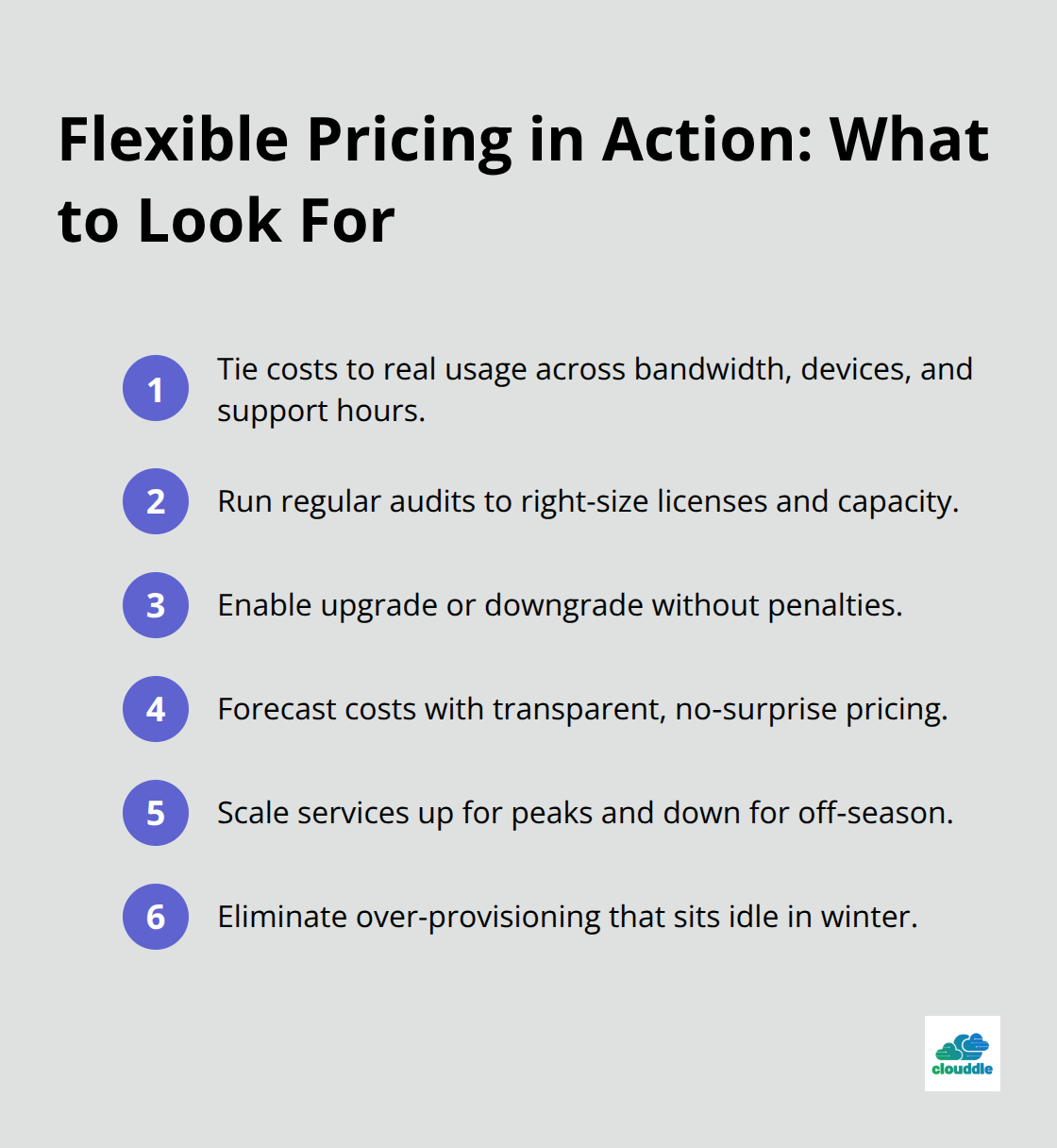
Pricing models matter far more than contract length. Most hotels waste money on fixed-tier pricing that assumes consistent usage throughout the year, but actual needs fluctuate dramatically. Pay-as-you-grow pricing models tie your costs directly to consumption-whether that’s bandwidth during peak season, the number of active guest devices, or support hours needed during high-occupancy periods. Hotels implementing usage-based licensing report 20–30% cost savings during low-occupancy months while maintaining full capabilities when demand spikes. You only pay for what you actually use, not for theoretical capacity.
Transparent pricing for connectivity, software, and support lets you forecast costs accurately without hidden fees or surprise charges. Regular audits ensure your IT capacity aligns with real hotel demand, preventing over-provisioning of expensive infrastructure that sits idle during winter months. When you can upgrade or downgrade your services without penalty, you gain the flexibility to respond to market conditions immediately.
Flexible Upgrade Paths Prevent Overspending on Peak-Season Capacity
A hotel that needs additional bandwidth for a conference can activate it within days, then scale back when the event ends. This agility prevents you from overspending on permanent capacity increases that only serve peak periods. Contracts with flexible upgrade paths and vendor choice eliminate lock-in, meaning you can switch providers or adjust configurations without punitive penalties.
Some hotels negotiate milestone-based payments tied to actual deployment progress rather than arbitrary annual schedules, which aligns costs with tangible value delivery. This structure protects your cash flow and ensures you invest in technology only when you need it.
24/7 Support Delivers Results When Speed Matters Most
Support quality separates premium contracts from mediocre ones. Rapid response times matter more than availability alone-a hotel losing Wi-Fi connectivity during check-in needs resolution in minutes, not hours. The best providers offer on-site oversight during critical periods and pre-shift confirmation processes that prevent small issues from cascading into guest-facing problems.
Proactive monitoring catches infrastructure problems before they impact operations, which reduces the unplanned downtime that directly damages revenue and reputation. Dedicated support teams familiar with your property’s specific configuration respond faster than generic helpdesks cycling through hundreds of hotels. 24/7 support response time commitments should aim to resolve critical issues within four hours, minimizing downtime and disruption. Hotels should prioritize partners with strong accountability structures and scalable capabilities for large events or seasonal peaks, not just basic troubleshooting.
Accountability Structures Separate Quality Providers from the Rest
When you evaluate providers, ask about their average response time for critical issues, their staff’s familiarity with your specific systems, and whether they offer escalation to senior engineers without delay. The difference between a 30-minute response and a 2-hour response can mean thousands in lost bookings during peak season. Integration across scheduling, analytics, and mobile access to support systems ensures your team can request help quickly and track resolution status in real time.
The strongest contracts specify exactly what “24/7 support” means-response time commitments, escalation procedures, and penalties if the provider misses service levels. This clarity transforms support from a vague promise into a measurable obligation that protects your operations.
These contract features create the foundation for operational reliability, but the real payoff emerges when you connect flexible agreements to actual revenue and guest satisfaction outcomes. The next section shows how these structural elements translate into measurable business results.
How Flexible Contracts Transform Guest Experience Into Revenue
Guest Wi-Fi Quality Drives Booking Decisions and Loyalty
Guest Wi-Fi quality directly impacts booking decisions and satisfaction scores. According to Oracle Hospitality’s 2023 survey, half of business travelers require free Wi-Fi, yet most hotels treat connectivity as an afterthought buried in standard IT budgets. A flexible IT contract lets you invest in enterprise-grade Wi-Fi infrastructure without committing to multi-year payments for capacity you won’t use during winter months. Hotels that upgrade to managed Wi-Fi services through flexible agreements report measurable improvements: faster connection speeds reduce guest frustration at check-in, seamless coverage across all properties eliminates dead zones where guests lose service, and reliable bandwidth supports the 73% of guests who want to book, check-in, and order room service from their smartphones. When your network infrastructure works flawlessly, guests complete transactions faster, post positive reviews more frequently, and return for repeat bookings. The financial impact compounds quickly because improved guest experience directly increases your Net Promoter Score and direct booking rates, reducing your dependence on OTA commissions that drain 15-25% of revenue per booking.
Proactive Monitoring Prevents Revenue-Killing Downtime
Operational downtime costs far more than most hotels realize. A single Wi-Fi outage during peak check-in hours disrupts 50-100 guest arrivals, forces staff to process manually, and creates bottlenecks that damage guest satisfaction. Flexible contracts with proactive monitoring and 24/7 rapid-response support catch infrastructure failures before they cascade into guest-facing problems. Hotels that work with providers offering dedicated on-site oversight during high-occupancy periods and pre-shift confirmation processes eliminate the cascading failures that turn minor technical issues into operational disasters. Network infrastructure reliability becomes non-negotiable during events, conferences, or seasonal peaks when your occupancy spikes and guest expectations peak simultaneously.
The best flexible contracts specify exact response time commitments for critical issues-ideally resolution within four hours for network outages-rather than vague promises of availability. This accountability structure transforms your IT support from a cost center into a revenue protection mechanism.
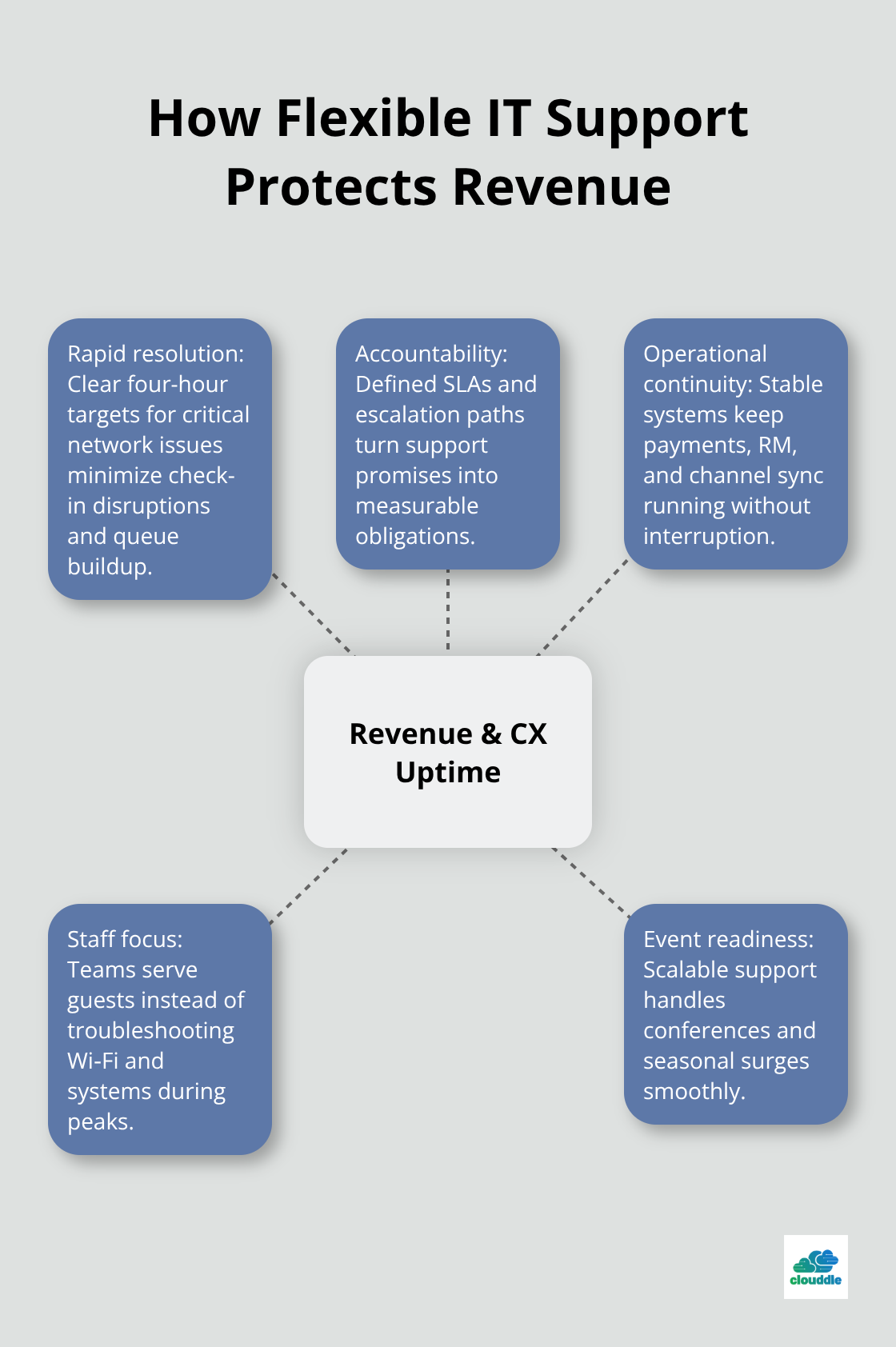
When your technology works reliably, your staff focuses entirely on guest service instead of troubleshooting connectivity problems, your revenue management systems stay synchronized across all channels preventing overbookings, and your payment systems process transactions without interruption. These operational improvements directly feed your bottom line because reduced downtime means higher occupancy conversion, fewer service recovery costs, and staff efficiency gains that reduce labor expenses during peak periods.
Final Thoughts
Flexible IT contracts for hospitality eliminate the false choice between investing in technology and protecting your cash flow. Hotels that align their IT spending with actual occupancy rates, guest expectations, and seasonal demand patterns gain immediate competitive advantage over properties locked into rigid agreements. Your technology infrastructure should scale when your business scales, not force you to pay for unused capacity during winter months or scramble for upgrades when summer peaks arrive unexpectedly.
The strongest contracts share common characteristics: transparent pricing that prevents budget surprises, usage-based models that reward efficiency, and support structures with measurable response time commitments. These features matter because they transform IT from a fixed cost burden into a flexible investment that grows alongside your revenue. When your contract adapts to your business rhythm instead of fighting against it, your team focuses on guest service rather than managing technology constraints, and you can deploy flexible IT contracts for hospitality that actually match how your property operates.
Selecting the right provider determines whether flexible contracts deliver real value or simply shift problems around. We at Clouddle build solutions specifically for hotels, multi-family properties, and senior living communities, combining networking, entertainment, and security without requiring upfront capital investment so you can deploy enterprise-grade infrastructure immediately and scale costs as your needs evolve.



0 Comments