
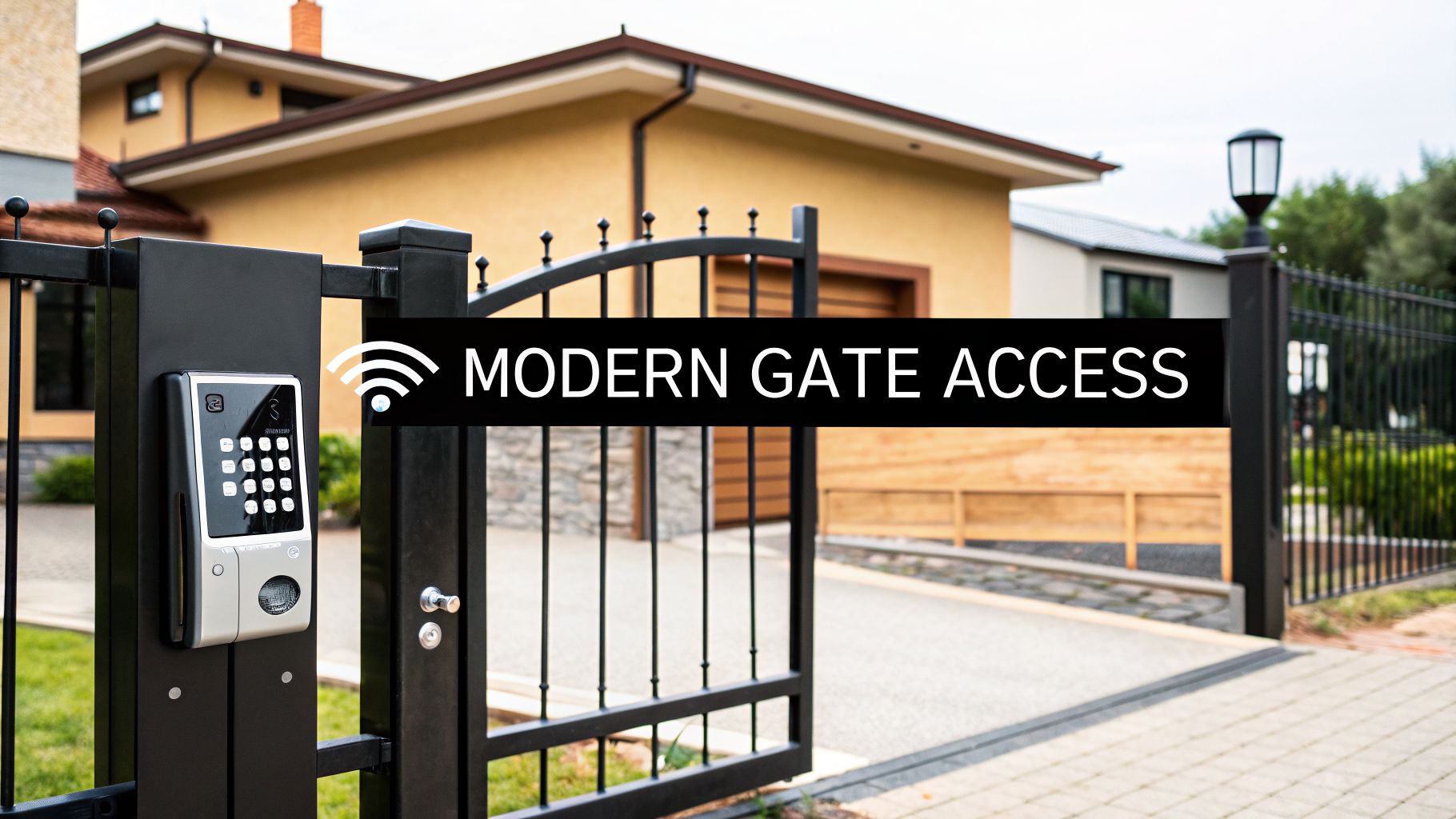
A modern gate entry system isn't just about opening and closing a gate anymore. It's the central nervous system for your property's entrance, acting as a smart doorman, a security guard, and a concierge all rolled into one. It intelligently manages who gets in, how they get in, and when, moving miles beyond a simple lock and key.
Understanding Modern Gate Entry Systems
Think back to the old way of doing things—a basic gate with a keypad felt a bit like a nightclub bouncer clutching a paper list. It worked, sort of, but it was slow, clunky, and easy to fool. A modern gate entry system, on the other hand, is more like having a highly-coordinated security and hospitality team that knows every resident, anticipates deliveries, and handles guest access without missing a beat.
This jump from a standalone keypad to a fully integrated platform is a game-changer. These systems are no longer just a line item under "security." They're a core part of how a property runs efficiently. The market growth alone tells you how essential these solutions have become.
The Automatic Gate Opening System market, a key part of modern gate entry systems, was valued at USD 11.28 billion in 2024 and is projected to reach USD 19.45 billion by 2032. This explosive growth shows just how much properties now rely on automation for secure and smooth access control. You can explore more data on the automatic gate market to see the full scope of this trend.
More Than Just a Gate
For any property in hospitality, multi-family housing, or senior living, that first moment of arrival sets the tone. A modern system can turn what used to be a frustrating delay into a seamless, welcoming experience. It’s about more than just granting access; it’s about making that process smarter for everyone involved.
Here’s where you see the real-world difference:
- Rock-Solid Security: These systems create a digital log of everyone who comes and goes. This isn't just for show—it's a powerful audit trail that deters unauthorized access and gives you concrete evidence if an incident occurs.
- Smarter Operations: Imagine granting access to a plumber or a new resident from your phone, without ever leaving your desk. That's what this technology does. It frees up property managers from having to physically be at the gate, saving huge amounts of time and simplifying the daily grind.
- A Better User Experience: For residents and guests, a frictionless entry is a huge perk. When the gate just opens as they approach, thanks to their smartphone, it creates a feeling of convenience and modern living. That directly translates to happier residents, better reviews, and higher retention.
At the end of the day, choosing the right gate entry system is a major business decision. It's an investment in your property’s value and reputation, not just a simple security upgrade. It’s about building a better, safer, and more efficient community from the front gate inward.
Comparing The Different Types Of Gate Entry Systems
Choosing a gate entry system isn't a one-size-fits-all decision. The right fit depends entirely on your property's unique needs—who needs access, how often they come and go, and the level of security you require. Let’s break down the common technologies, moving from the most basic to the most advanced, to see how they work in the real world.
For a small, private business park with a consistent group of employees, a simple Keypad System often does the trick. It’s the digital equivalent of a shared key. Staff members just punch in a code to get in. It's straightforward, budget-friendly, and perfect for environments with low foot traffic and minimal security risk.
From Basic Codes To Smart Credentials
As your property gets bigger or more complex, a simple keypad starts to show its limitations. Imagine managing a single code for a large residential community—it quickly becomes impractical and insecure. This is where Radio-Frequency Identification (RFID) technology really comes into its own.
With RFID, a small tag or sticker is placed on a resident's car. As the vehicle nears the gate, a reader picks up the signal and opens the gate automatically. It's a seamless experience that eliminates traffic jams at the entrance. Think of it as an E-ZPass for your property, giving each resident a unique, secure key that works from a distance.
This hierarchy shows how modern systems build upon basic physical security, adding layers of intelligence and control.

As you can see, a modern system isn't just a lock—it's the brain of the operation, coordinating everything.
For properties where verifying visitors is non-negotiable—like senior living communities or gated neighborhoods—Video Intercoms are a must. They let residents or security staff see and speak with guests before buzzing them in. This adds a critical human touchpoint, giving everyone peace of mind. These systems often serve as the foundation for integrating various other types of access control.
Advanced Automation For High-Traffic Environments
In busy environments like hotels, corporate campuses, or large apartment complexes, manual processes just can't keep up. This is where automated technologies make a huge difference in both security and daily operations.
- License Plate Recognition (LPR/ANPR): This technology turns a vehicle's license plate into its access key. A camera reads the plate, checks it against an approved database, and opens the gate in seconds. It’s a fantastic way to offer a premium arrival experience for guests while maintaining a precise log of every vehicle on site.
- Mobile & Cloud-Based Systems: These systems give property managers incredible flexibility. You can grant temporary access to a delivery driver, instantly add a new tenant, or check entry logs—all from a smartphone or computer, no matter where you are. This remote control is a massive boost to operational efficiency.
The market for these automated systems is growing fast. The swing gate opener market, for example, hit $415 million in 2024 and is expected to reach $611 million by 2034. Residential installations are climbing by 12% annually, with over 65% of new installs now featuring smart capabilities like geofencing and voice commands.
To help you sort through these options, here's a quick comparison of the most common technologies.
Gate Entry System Technology Comparison
| Technology | Ideal For | Key Benefit | Consideration |
|---|---|---|---|
| Keypad | Small offices, private lots with few users | Simple and low-cost | Security risk if code is shared; no entry logs |
| RFID | Gated communities, corporate campuses | Frictionless, automated access for regulars | Managing physical tags can be a hassle |
| Video Intercom | Multi-family, senior living, managed properties | Visual verification of guests for high security | Requires someone to monitor and grant access |
| LPR/ANPR | Hotels, hospitals, high-volume commercial sites | Hands-free access and detailed vehicle tracking | Higher initial cost; dependent on camera quality |
| Mobile/Cloud | All property types, especially with remote staff | Ultimate flexibility and remote management | Relies on internet connectivity and user adoption |
Each system offers a different mix of security, convenience, and cost. By understanding these trade-offs, you can find the perfect solution for your property's specific needs.
The Core Benefits of Upgrading Your Gate System
Sure, the new hardware is impressive, but what does a modern gate entry system really do for your property? It's about much more than just a new box at the entrance. A well-chosen system delivers real, measurable improvements to your security, daily operations, and the overall experience for residents and guests.

The most immediate payoff is a major security upgrade. A modern system doesn't just block access; it gives you a complete, digital log of everyone who comes and goes, which is a powerful tool for accountability.
By keeping detailed records of who entered a specific area and at what time, you create a powerful deterrent. If an incident does occur, you have concrete data to support an investigation, rather than relying on guesswork.
This shift from a passive barrier to an active monitoring tool fundamentally changes your security posture from reactive to proactive. That provides both genuine protection and invaluable peace of mind.
Boosting Your Operational Efficiency
Beyond the security perimeter, the effect on your day-to-day operations can be profound. For property managers, a cloud-based gate system is often the key to getting hours back in their week.
Think about it. A delivery driver shows up unexpectedly at your apartment community. Instead of dropping everything to let them in, you can grant one-time access right from your phone. Need to let a contractor in for a scheduled repair? Issue a temporary digital credential that only works during their appointment window. No more coordinating key handoffs or rushing back to the property.
That kind of remote management gives you incredible control and flexibility. It automates tasks that used to eat up your day, freeing up your team to focus on work that actually improves resident life and the property's bottom line.
Enhancing Resident and Guest Satisfaction
Never underestimate the power of a first impression. The experience at your front gate sets the tone for the entire property, and making it seamless is a huge competitive advantage.
For residents, this means an end to fumbling with key fobs or waiting in a long line to get in. With a modern system, their smartphone or the car's license plate can open the gate automatically as they arrive, making it feel like a smooth, welcoming return home.
For a hotel guest, this translates to a premium arrival that feels both exclusive and effortless. That first positive touchpoint is often the thing that earns glowing online reviews and brings them back again. In a crowded market, these thoughtful details are what separate a good property from a great one.
How to Choose the Right System for Your Property
Picking the right gate entry system is a bigger deal than most people think. This decision goes far beyond just security—it directly affects your budget, daily operations, and the first impression you make on visitors. What works perfectly for a five-star resort will almost certainly be the wrong choice for a bustling apartment building or a quiet senior living facility.
To make a smart investment, you have to look past the upfront cost. The number that really matters is the Total Cost of Ownership (TCO). This includes not just the hardware but also professional installation, any software subscriptions, and the inevitable maintenance down the road. A system that seems cheap initially can easily become a money pit if it's unreliable and constantly needs repairs.
Match the System to Your Property Type
Think about the natural flow of people and vehicles at your property. A gated community with hundreds of residents driving in and out all day has a completely different set of challenges than a small office building with a handful of employees. Each property type has its own rhythm, and your gate system needs to match it.
-
Hospitality: For hotels and resorts, the guest experience is everything. A smooth, welcoming arrival sets the tone for their entire stay. Technologies like License Plate Recognition (LPR) and mobile access are fantastic here, as they let registered guests drive right in without fumbling for a key card. Seamless integration with your Property Management System (PMS) is also essential to automate access when guests check in and out.
-
Multi-Family: When it comes to apartment complexes and HOAs, durability and scalability are the name of the game. The system has to withstand heavy, daily traffic and be simple for property managers to oversee. A great setup often combines RFID tags for residents' cars with a video intercom so they can easily vet guests and delivery drivers.
-
Senior Living: Here, the top priorities are ease of use and uncompromising security. The system needs to be incredibly straightforward for residents to operate. Video intercoms are especially critical, giving both staff and residents the ability to see and speak with visitors before ever opening the gate.
For those involved in new developments, it’s also wise to understand the governance and funding structures of a CDD Community Development District. This can directly impact how long-term amenities, including sophisticated security systems, are funded and maintained.
Create a Strategic Selection Checklist
Before you even start talking to vendors, it’s crucial to sit down and map out what you actually need. This simple exercise saves you from getting upsold on flashy features you'll never use and helps you focus on finding a system that solves your real-world problems.
A well-planned gate entry system should feel like a natural extension of your property's operations, not a clumsy add-on. The goal is to enhance security and convenience simultaneously, creating a secure but welcoming environment for everyone who enters.
To help you get started, ask yourself these core questions:
- Traffic Volume: How many cars and pedestrians do you expect daily? Is access needed 24/7 or only during specific hours?
- User Types: Who exactly needs access? Think about all the groups: residents, employees, guests, vendors, and delivery services.
- Security Risks: What are you really trying to prevent? Are you deterring casual trespassers or protecting against more specific, targeted threats?
- Management: Who is going to be in charge of the system day-to-day? Do they need to manage it from their desk, or is remote, cloud-based control a must?
Choosing the right hardware is only half the battle; professional installation is what makes it all work together. To ensure your system is set up for long-term success, it pays to work with qualified access control system installers who understand the nuances of proper integration and ongoing support.
Why an Integrated Security Ecosystem Is a Game Changer
A standalone gate entry system does its job, but it’s essentially an island. It keeps unwanted people out, and that's about it. The real magic happens when you connect that gate to your property's other technologies. It stops being just a barrier and becomes the brain of a smart, responsive security network. This integrated approach is how you get the most out of a modern gate system, creating an ecosystem that’s far stronger than any single piece of hardware.

Think about how these systems can work together in the real world. A delivery truck for a scheduled maintenance visit pulls up. The License Plate Recognition (LPR) camera instantly identifies the vehicle, cross-references it with the day’s schedule, and the gate opens automatically. At the same time, a nearby CCTV camera records the entry, and your property management software logs the vendor's arrival, sending a notification to staff. No phone calls, no manual logbooks, no wasted time.
Creating a Unified Security Front
When your systems talk to each other, you can set up smart automations that boost security and cut down on the manual busywork for your team. By linking your gate with other key platforms, you get a much clearer picture of what’s happening on your property.
Here are a few of the most powerful integrations:
- CCTV Integration: This connects gate activity directly to video evidence. When someone uses a keycard or enters a code, a camera can instantly focus on the entry point and save a short clip. You end up with a rock-solid visual record for every single access event.
- Access Control Integration: This brings all your entry points—from the main vehicle gate to individual apartment or office doors—under one roof. You can manage credentials for the entire property from a single dashboard, and if someone moves out or is terminated, you can revoke their access everywhere with one click.
- Property Management Software (PMS) Integration: This is a huge time-saver. When you add a new resident or hotel guest into your PMS, the system can automatically grant them gate access. This gets rid of manual data entry, which is not only slow but also a common source of errors. You can see how IoT in property management is making these connections smoother than ever.
This isn’t just about vehicle gates, either. We're seeing the same trend with pedestrian access, which is crucial in busy hotels, apartments, and venues. In fact, the market for pedestrian entrance control systems is expected to hit US$3.4 billion by 2033. Properties are adopting smooth solutions like RFID or facial recognition that sync with the cloud, which has been shown to reduce unauthorized access by up to 40%.
Unlocking Real ROI and Simpler Management
Ultimately, bringing everything together turns a handful of separate security tools into a single, intelligent platform. This makes life so much easier for your staff. Instead of bouncing between different apps and dashboards, they can monitor and control the entire property from one place.
An integrated ecosystem gives you deeper insights, automates the tedious stuff, and lets your team focus on what actually matters. It’s not just about bolting on more tech; it’s about making your entire operation smarter.
If you’re aiming for a truly connected security setup, understanding the role of a system integrator is key. These are the experts who make sure all the different technologies play nicely together. Getting that communication right is how you unlock the real return on your investment, both in tighter security and a more efficient operation.
Gate Entry Systems: Your Questions Answered
It's completely normal to have questions when you're looking at upgrading your property's security. Even with all the benefits laid out, taking the plunge on new technology can feel like a big step.
We get it. That's why we’ve put together answers to the most common questions we hear from property managers every day. Think of this as a straightforward guide to help you move forward with confidence.
What’s the Real Cost of a Commercial Gate Entry System?
Let's get right to it: the price tag. It's the first thing everyone wants to know, and the honest answer is that the cost can swing pretty dramatically. A simple keypad for a small parking area might only be a few thousand dollars. A sophisticated License Plate Recognition system for a large, multi-entrance community? That can easily climb into the tens of thousands.
But the initial price is just one piece of the puzzle. The number you really need to focus on is the Total Cost of Ownership (TCO). This isn't just about the hardware and software; it includes installation, ongoing maintenance, and any monthly or annual subscription fees.
A much smarter way to look at it is through a managed service or Network-as-a-Service (NaaS) model. These plans bundle the equipment, 24/7 support, and all software updates into one predictable monthly fee. This approach gets rid of huge upfront costs and ensures your system is always secure and working perfectly, giving you a much better return in the long run.
This effectively turns a capital expense with unpredictable future costs into a simple, manageable operating expense.
Can a New Gate System Work with My Existing Cameras?
Absolutely. In fact, you should insist on it. One of the biggest advantages of a modern gate entry system is its ability to talk to other security devices, especially your CCTV cameras. When they work together, you create powerful, automated security that does the work for you.
Picture this:
- A car pulls up to your gate late at night.
- The system logs the access attempt—successful or not—and instantly tells a nearby camera to start recording.
- That video clip gets tagged with all the event details (time, credential used, etc.) and is saved securely in the cloud.
This seamless integration means you have a verifiable video record for every single access event. It makes investigating any incidents incredibly simple and effective. While older analog cameras can sometimes present a challenge, a good provider can evaluate what you have and find a path to connect your old and new equipment.
What's the Big Deal with a Cloud-Based System?
Think of a standalone, non-connected system like an old desktop computer with no internet—all its data and functions are trapped in that one box. A cloud-based system, on the other hand, is always connected, giving you the freedom to manage your entire property from literally anywhere.
The main advantage here is remote management. With a cloud platform, you can:
- Add a new resident or revoke an old credential instantly from your laptop or phone.
- Pull up entry logs and watch event video clips from home or on the go.
- Open the gate for a delivery or a contractor without ever leaving your desk.
For busy property managers, that kind of flexibility is a game-changer. Beyond that, cloud platforms take care of software updates automatically, provide top-tier security that's managed by the provider, and make it incredibly easy to expand your system as your property grows.
How Long Does an Installation Actually Take?
The timeline for installation really comes down to the size and complexity of the job. If we're just swapping out an old keypad on an existing gate, we could be in and out in less than a day.
But for a full-scale installation at a large apartment community—which might involve digging trenches for new wiring, mounting readers at multiple entrances, and integrating all the software—you could be looking at a week or more.
The most important ingredient for a smooth installation is detailed planning. A true professional will perform a thorough site survey before any work starts. This is where they map out the project, identify potential roadblocks, and coordinate with any other contractors. Doing this homework upfront is the secret to getting the job done right with minimal disruption to your residents and staff.
Ready to upgrade your property's security and efficiency with a modern gate entry system? The experts at Clouddle can design, install, and manage a complete solution tailored to your needs. Learn more about our managed technology solutions and get a personalized consultation today.