
When you think of a building intercom, what comes to mind? For many, it's a clunky wall unit with a static-filled speaker. But that image is seriously outdated. Today's intercoms are sophisticated command centers for property access, packed with features like video verification, mobile app integration, and cloud-based management that let you control entry from absolutely anywhere.
The New Front Door: Modern Building Intercoms

Forget being chained to a wall unit, straining to hear a visitor's muffled voice. The building intercom has transformed into a cornerstone of the modern tenant experience, blending robust security with incredible convenience. It’s less of a simple gatekeeper and more like an intelligent, digital doorman for your property.
This guide will walk you through the shift away from old-school analog systems to the far more capable world of IP and cloud-based intercoms. We'll break down how the right choice can elevate your property's value, simplify day-to-day operations, and keep tenants happy.
Why This Matters for Your Property
Moving from a basic buzzer to a smart intercom is more than just a tech upgrade—it's a smart business decision. Modern systems, particularly IP and cloud-based ones, tie directly into a building's network infrastructure. That connection is what unlocks their real power.
A well-implemented intercom system brings tangible benefits:
- Tighter Security: With video verification, residents can see exactly who’s at the door before letting them in. It's a simple feature that dramatically cuts down on unauthorized access.
- Ultimate Tenant Convenience: Mobile apps turn a resident's smartphone into a go-anywhere intercom. They can answer the door and grant access to guests or deliveries whether they're on the couch or across town.
- Simpler Management: Property managers get a huge efficiency boost from cloud-based dashboards. You can update tenant directories, issue temporary keys, and check entry logs remotely, saving countless trips to the property.
Think of it like the evolution of the smart home. We got used to controlling our thermostats and lights from an app, and now building access is getting that same seamless, mobile-first treatment.
Grasping these changes is key, because it all hinges on solid connectivity. These advanced systems are only as reliable as the network they run on. That’s why having a well-planned internet and Wi-Fi strategy is the essential first step. You can dig deeper into building that strong foundation in our guide to providing top-tier Wi-Fi for a building.
Whether you're retrofitting an older building or designing a new one from the ground up, making the right intercom choice starts with understanding what's possible.
Understanding the Evolution of Building Intercoms
To pick the right intercom for your building, it helps to see how the technology has grown over the years. It's a lot like the history of the telephone itself—from old-school landlines to the smartphone in your pocket. We can break it down into three distinct stages.
The story starts with the classic analog intercom. Think of it as a private, closed-circuit telephone network just for your building. Each apartment's handset is physically wired directly back to the front door panel. When a visitor presses a button, it completes a simple electrical circuit, opening a channel for a two-way audio chat.
This hardwired setup is incredibly reliable. Because it doesn't depend on any outside networks, it just works. But that's also its biggest drawback. Analog systems are rigid, usually offering audio-only communication and zero modern features like remote unlocking or video. Expanding or fixing them is a major headache, often meaning expensive and disruptive work to pull new wires through walls.
The Leap to Networked Communication: IP Intercoms
The next big jump was the IP intercom. Instead of that tangled web of dedicated wires, these systems run on a building's Local Area Network (LAN)—the same network that handles your internet. This shift is like an office upgrading from traditional phone lines to a modern VoIP (Voice over Internet Protocol) system.
By using the building's network, IP intercoms could suddenly do a lot more than just transmit audio. They had enough bandwidth to carry high-definition video, send data to other systems, and connect to a whole new world of devices.
This networking capability brought some game-changing advantages:
- Video Functionality: IP systems easily handle the data needed for clear video calls, so residents can actually see who's at the door.
- System Integration: They can talk to other building technologies, like key card readers, security cameras, and even property management software.
- Improved Scalability: Adding a new station or covering another door is way easier. You just need to connect the new device to the existing network.
The move to IP-based intercoms was a fundamental change. It transformed a simple communication device into a connected security tool, laying the groundwork for the even more flexible solutions available today.
The market has clearly responded. The global building intercom market was valued at around $2.5 billion in 2023 and is expected to hit nearly $4.5 billion by 2032, fueled by both new construction and retrofits. You can dig into the numbers in this in-depth market analysis from Dataintelo. This growth shows a clear industry-wide migration away from older, limited technology.
The Modern Standard: Cloud-Based Intercoms
The final and most advanced stage is the cloud-based intercom, often called a SaaS (Software-as-a-Service) model. The best way to think about this is like a powerful app on your smartphone that works anywhere with an internet connection. It moves all the heavy lifting—server management, software updates, data storage—off the property and into the cloud.
This model completely untethers building access from physical, on-site hardware. Residents don't need a clunky monitor mounted on their wall anymore; their own smartphone becomes the receiver through a mobile app. This gives them incredible flexibility to see visitors and grant access whether they're on the couch or on vacation.
For property managers, a cloud dashboard provides total remote control. You can update the resident directory, create temporary virtual keys for deliveries, and review entry logs, all from your web browser without ever visiting the property.
These systems are a lifesaver in older buildings where rewiring is just not an option. For more on this, check out our guide on modernizing legacy systems in properties. Because cloud intercoms run over the internet, they can often be installed with minimal new wiring. Plus, with automatic software updates, the system is always improving—getting new features and security patches without needing a technician to show up. This progression from analog to cloud isn't just an upgrade; it's a completely new way of thinking about building access.
Comparing Intercoms: Analog vs. IP vs. Cloud
When it comes to choosing an intercom system, you're essentially looking at three distinct generations of technology: analog, IP, and cloud-based. Each has its own set of trade-offs in cost, features, and overall convenience. Figuring out which one fits your property means getting a clear picture of what each brings to the table, whether you're working with an older building or a brand-new development.
You can really see the progression when you map it out—from simple dedicated wires to complex, internet-driven platforms.
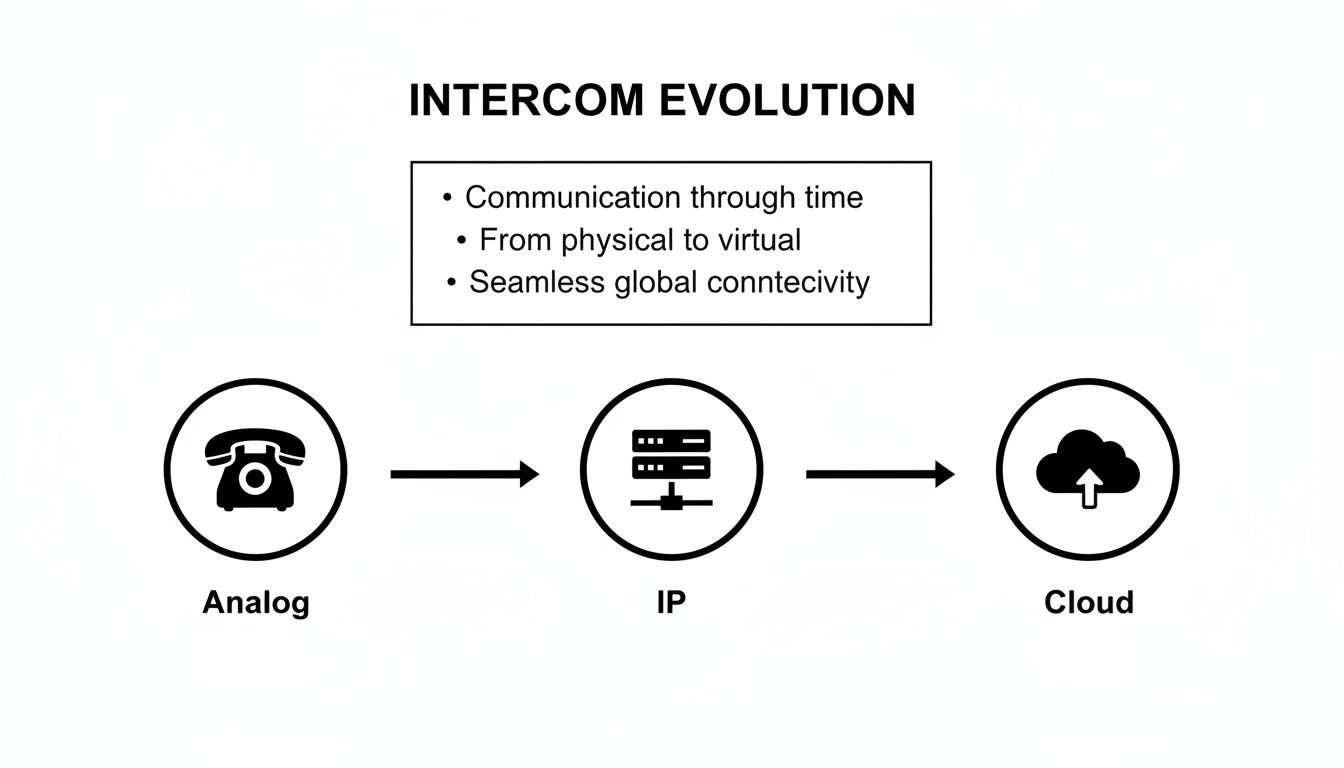
This journey from analog to IP servers and finally to the cloud highlights a massive shift toward smarter, more connected systems that can be managed from anywhere.
H3: Analog Intercoms: The Traditional Workhorse
Analog systems are the old guard of the intercom world. Think of them as a private telephone network just for your building, running on their own dedicated low-voltage wiring. Their biggest selling point is their straightforward reliability—no internet, no problem. They just work.
But that simplicity is also their biggest weakness. Analog intercoms are a real headache to scale or upgrade. If you need to add a new unit or fix a bad wire, you're often looking at tearing open walls for an expensive rewiring job. They also just don't offer the features today's tenants expect, like video calls or opening doors with their phones.
H3: IP Intercoms: The Networked Upgrade
IP (Internet Protocol) intercoms were a major leap forward. Instead of needing their own separate wiring, they piggyback on a building's existing Local Area Network (LAN). This lets them send high-quality audio and HD video over standard Ethernet cables. Many even use Power over Ethernet (PoE), which is a game-changer because it sends both power and data through a single cable, simplifying installation.
The advantages here are huge:
- Superior Quality: You get crystal-clear audio and sharp, high-resolution video. It’s night and day compared to old analog systems.
- Easier to Scale: Need to add a new station? Just plug it into the network. It makes expansion so much easier and cheaper.
- Plays Well with Others: These systems can talk to other devices on the network, like access card readers, security cameras, and even VoIP phone systems. If you want a deeper dive, you can learn more about what VoIP technology is and how it enables these digital communications.
The main thing to remember with IP systems is that their performance is completely dependent on your on-site network. A shaky network means a shaky intercom system.
H3: Cloud-Based Intercoms: The Modern Solution
Cloud-based intercoms, often called SaaS (Software-as-a-Service) systems, take the IP concept and push it even further. They move the main server and all the management software off-site into the cloud. This completely changes the game for both residents and property managers.
Cloud intercoms untether access control from the physical building. A resident's smartphone becomes the in-unit station, and a property manager's web browser becomes the central command center, accessible from anywhere in the world.
This approach offers incredible flexibility and a whole host of modern features. Residents can see who's at the door and buzz them in from their phones, whether they're on the couch or on vacation. Managers can update the tenant directory, create temporary "virtual keys" for contractors, and check entry logs from their laptops. Plus, software updates happen automatically, so the system is always getting better and more secure.
The market is clearly heading this way. The video intercom market was valued at USD 4.2 billion in 2023 and is expected to hit USD 8.7 billion by 2033. This growth shows a powerful industry-wide trend toward networked, video-enabled entry systems that offer more than just a simple doorbell.
H3: Feature Comparison of Building Intercom Systems
To make the choice clearer, let’s break down the key differences in a simple table. This gives you a side-by-side look at how each type of intercom stacks up across the features that matter most to property managers and tenants.
| Feature | Analog Intercoms | IP Intercoms | Cloud-Based Intercoms |
|---|---|---|---|
| Video & Audio Quality | Low-quality audio, typically no video | High-definition video and clear audio | High-definition video and clear audio |
| Scalability | Difficult and expensive to expand | Easy to scale on an existing network | Highly scalable with minimal hardware changes |
| Remote Access | Not available | Limited to the local network | Full remote access via mobile apps |
| Installation | Requires dedicated, extensive wiring | Uses standard Ethernet cabling (LAN) | Minimal wiring, leverages internet |
| Maintenance | Requires on-site technician visits | On-site network and hardware upkeep | Remote diagnostics, automatic updates |
| Best For | Small, budget-conscious properties | Corporate campuses, new constructions | All property types, especially retrofits |
So, what’s the takeaway? While analog systems still have a place for basic needs and IP systems are a powerful on-site option, cloud-based intercoms truly deliver the flexibility, convenience, and modern features that meet the expectations of today's world.
Getting Installation and Integration Right

Picking the right intercom is only half the battle. How that system gets installed and woven into your building's existing technology is what really makes it work for you. This is where a great piece of hardware becomes a genuinely powerful tool, but the path to get there looks very different depending on the system you choose.
If you’ve ever worked with old-school analog intercoms, you know the drill: a messy spiderweb of dedicated, low-voltage wiring. Every single in-unit station needs its own direct line back to the main entry panel. In a brand-new building, that’s one thing. But trying to retrofit that into an existing property? It often means tearing open walls and ceilings—a costly and disruptive headache.
Thankfully, modern IP and cloud-based systems play by a completely different set of rules. They ride on the same structured Ethernet cabling your building already uses for internet. This simple fact completely changes the installation game, especially for properties that already have a decent network in place.
The Magic of Structured Cabling and PoE
The backbone of any modern intercom is a solid telecom infrastructure. Instead of the tangled, point-to-point wiring of analog systems, IP intercoms use the standardized network you're already familiar with. A single Ethernet cable to an entry station or an indoor monitor can handle everything—video, audio, and even power.
That last part is thanks to a brilliant bit of tech called Power over Ethernet (PoE). PoE sends low-voltage power and data through the same network cable, which means you don't need a separate power outlet at every intercom location. It's a game-changer that drastically cuts down on wiring complexity, labor costs, and the number of things that can go wrong.
Here's why that matters:
- Cleaner, Faster Installs: Fewer cables to run means the job gets done quicker, with less mess and a lower price tag.
- Install It Anywhere: You can place intercom stations wherever you have a network drop, without being chained to the nearest electrical outlet.
- Rock-Solid Reliability: Power is managed centrally from your network switch. Hook that switch up to a battery backup, and your intercom system stays up and running even when the power goes out.
Creating a Truly Smart Building
Here’s where modern intercoms really shine: integration. An IP or cloud-based system isn't just an island. It’s designed to be a central hub that connects with your other critical building systems, creating a seamless ecosystem that makes life easier for property managers and residents alike.
Think of your intercom as the central nervous system for building access. When you connect it to other systems, you let them talk to each other. Suddenly, the entire building gets smarter and more responsive.
When your systems work together, you move beyond just opening a door. You start creating automated workflows that save time, cut down on manual tasks, and seriously beef up your security.
Key Connections for a Modern Intercom
The most powerful integrations are the ones that bring everything together under one roof. When your systems can share data and instructions, your team can manage everything from a single dashboard, which is a massive win for efficiency.
Here are the integrations that deliver the most bang for your buck:
- Access Control Systems: This is the most crucial link. Tying your intercom into your key card or fob system gives you a single, unified log of every entry. A resident might use their fob while a delivery driver is buzzed in through the intercom—and both events show up in one clean, simple record.
- Property Management Software (PMS): When a new tenant is added to your PMS, their info can be automatically synced to the intercom's directory. When they move out, their access is just as easily revoked. This kills the tedious, error-prone job of juggling multiple resident lists.
- Security Cameras (VMS): Pairing your intercom with your Video Management System gives you the full story. An intercom call can automatically trigger nearby cameras to start recording, giving you multiple angles of every visitor and a complete video trail for security audits.
- VoIP Phone Systems: In an office building, a call from the front door can be routed straight to an employee's desk phone or computer. Staff can grant access right from their workspace without needing a dedicated intercom handset, blending building security right into their daily routine.
The Real-World Costs: Compliance, Accessibility, and Your Bottom Line
Picking out the intercom hardware is the easy part. The real challenge—and where a smart investment truly pays off—is navigating the business and legal landscape that comes with it. Getting this right means your system won't just work well, but it will also be fair, accessible to everyone, and financially sound for years to come.
First things first: you absolutely have to get accessibility right. Overlooking these laws isn't just about creating a frustrating experience for residents and visitors with disabilities; it can land you in serious legal trouble with hefty fines. In modern property management, compliance isn't optional.
Don't Overlook Accessibility Standards
The Americans with Disabilities Act (ADA) has a lot to say about how people access buildings, and your intercom is a huge piece of that puzzle. The goal is simple: make sure anyone, regardless of their physical ability, can use the entry system without a struggle. While your local city or state might have its own spin on the rules, they all tend to focus on a few core principles.
Here's what the ADA typically requires for intercoms:
- Mounting Height: Can someone in a wheelchair reach all the buttons or the touchscreen? The operable parts must be installed within a specific height range so no one has to strain or stand to use the system.
- Clear Floor Space: You need to leave an unobstructed patch of floor in front of the unit. This gives a person using a wheelchair enough room to pull up and operate the intercom comfortably.
- Visual and Audible Cues: The system needs to communicate in more than one way. Think flashing lights or on-screen text paired with audible tones to confirm a call is going through or a door has been unlocked. This is a game-changer for users with hearing or visual impairments.
- A Simple, Clear Interface: If your intercom has a digital directory, the text needs to be large and clear. The navigation should be intuitive enough for people with a wide range of abilities to use without getting frustrated.
An accessible intercom isn't just about ticking a legal box. It's a clear signal that your building is designed for everyone. Thinking about these features from day one saves you from expensive retrofits later and helps build a truly inclusive community.
Thinking Beyond the Sticker Price: Total Cost of Ownership
The price tag on the box is only a tiny fraction of what an intercom system will actually cost you over its lifetime. To get the full financial picture, you need to look at the Total Cost of Ownership (TCO).
TCO forces you to look at every single expense, from the day you install it to the day you replace it. It’s a powerful reality check. A system that looks like a bargain upfront can quickly become a money pit if it demands constant repairs or expensive software upgrades. On the flip side, a more sophisticated system might cost more initially but end up saving you a fortune in the long run.
To really understand your TCO, you have to add up a few key things:
- Installation Labor: This covers the cost of pulling wires through walls, mounting the hardware, and getting everything programmed. This expense drops dramatically for cloud-based systems that don’t need dedicated wiring to every single apartment.
- Networking Gear: IP and cloud intercoms run on your building's network. If you have to upgrade your switches, routers, or ethernet cables to handle the new traffic, that’s all part of the TCO.
- Software and Subscriptions: Modern cloud intercoms are often sold as a service (SaaS), meaning you'll have a recurring monthly or annual fee. This usually covers crucial things like software updates, cloud hosting, mobile app access, and tech support.
- Maintenance and Repairs: What’s the plan when a station breaks? You have to account for the cost of sending a technician out, buying replacement parts, and dealing with any system downtime. Cloud systems can often diagnose problems remotely and push software fixes automatically, cutting these costs way down.
By mapping out all these potential expenses, you can make a true apples-to-apples comparison between different intercoms for buildings. You'll quickly see how a larger upfront investment in a modern, low-maintenance system can lead to serious long-term savings.
How to Select the Right Intercom for Your Building
Trying to bring all the technical details together to make a final decision can feel like a huge task, but a straightforward, step-by-step approach makes it much more manageable. Picking the right intercom isn’t just about the hardware; it's about finding the perfect match for your property's character, your budget, and the kind of experience you want your tenants to have.
The whole process kicks off with a good, hard look at your specific needs. You have to go beyond just comparing feature lists and start asking practical questions about how your building actually operates. A "one-size-fits-all" mindset just won't cut it here, since every property has its own quirks and requirements.
Assess Your Property's Unique Needs
Before you even glance at a product brochure, you need to map out a detailed profile of your building. This first step is the foundation for everything that follows, making sure you put your money into a system that actually solves your problems instead of causing new ones.
Start by digging into these key points:
- Building Type and Age: Is it a brand-new high-rise or a charming old low-rise? A new construction project can easily handle the structured cabling needed for an IP system. A historic building, on the other hand, would get much more value from a cloud-based intercom that avoids the mess and expense of tearing into walls for new wiring.
- Unit Count and Layout: How many apartments or offices are you connecting? A small building with under 20 units might do just fine with a simpler setup. But for a sprawling, multi-building campus, a cloud platform with a central dashboard for remote management becomes a non-negotiable tool.
- Existing Infrastructure: What’s already running through your walls? If you've got Cat5e or Cat6 Ethernet cable in place, upgrading to an IP or cloud system is a pretty direct path. If you’re dealing with old two-wire analog cabling, a wireless or cloud solution starts looking a lot more appealing and budget-friendly.
The goal is to find the path of least resistance. Choosing a system that works with your building's existing infrastructure dramatically cuts down on installation costs and gets you up and running faster, which means you see a return on your investment sooner.
Consider Your Tenant and Management Priorities
Once you have a handle on the building’s physical side, it’s time to think about the people who will be using the system every day. An intercom is a constant point of interaction for residents and a critical tool for your management team. Its features have to line up with what they expect and need to do their jobs well.
Ask yourself what kind of experience you're trying to create. Are you going for maximum convenience with features like mobile apps and virtual keys for package deliveries? Or is your number one priority rock-solid, on-site security for a corporate headquarters? Nailing down these goals helps you weed out the options that just don't fit.
It's also interesting to note how different the market can be around the world. North America, for example, is a leader in adopting high-end IP intercoms, with one analysis projecting it to hold about 35% of the market share by 2025. Meanwhile, the Asia-Pacific region is the fastest-growing market overall, thanks to a massive boom in residential construction. You can dig into more of these global intercom market dynamics to see how priorities in security and smart-building tech vary.
By pairing a solid technical assessment with a clear vision for your users, you create a powerful checklist. This framework turns a complicated decision into a logical one, ensuring the intercom you choose is a perfect fit for your property, your budget, and your community.
Intercom FAQs: Your Questions Answered
Alright, we've covered a lot of ground. But even with all the details on IP, analog, and cloud systems, you probably still have some practical questions. Investing in a building's core technology is a big deal, so let's clear up a few common queries we hear all the time.
Think of this as the final checklist to make sure you're confident in your decision.
How Long Does an Intercom System Last?
The lifespan of an intercom really depends on the technology you choose. A classic analog system is built like a tank; its simple electronics mean it can easily last 15-20 years. It’s a true workhorse.
IP intercoms, on the other hand, usually have a shorter lifespan, typically around 8-12 years. The challenge isn't that the hardware fails, but that the network components and software can become obsolete, just like an old computer.
Cloud-based systems change the game entirely. The physical hardware might still last that same 8-12 years, but the software is constantly being updated in the background. This means the system stays current, secure, and functional for much longer, sidestepping the obsolescence problem you get with purely hardware-based solutions.
The key difference is that with a cloud system, you're not just buying hardware; you're investing in a platform that evolves. Automatic updates ensure you get new features and security patches without needing a full system replacement.
Can I Upgrade My Old Intercom System?
Absolutely. Upgrading an old, clunky system is one of the most common projects we see. The best way to go about it really boils down to the wiring you already have in the walls.
- Got old two-wire analog wiring? This is a classic scenario. That old wiring just can't handle the data needed for modern IP video. The most practical solution here is a cloud-based intercom that uses cellular or Wi-Fi for the main panel and connects to residents via a mobile app. This lets you sidestep the massive cost and disruption of rewiring the entire building.
- Already have Cat5e/Cat6 Ethernet? You're in a fantastic spot. This modern cabling is perfect for today's IP and cloud-based intercoms, which makes the whole upgrade process much smoother and more affordable.
Is a Wired or Wireless Intercom Better?
This isn't an either/or question—the best systems use both. For the main entry station at the front door, a wired internet connection is non-negotiable. It's just more reliable. Wireless signals can be notoriously flaky, getting blocked by concrete and steel, which leads to dropped calls and frustrated visitors. A hardwired connection gives you rock-solid stability.
Where wireless truly excels is connecting to your tenants. Using residents' smartphones as the receiving station via a mobile app is brilliant. It completely eliminates the need to run new wires to every single apartment, saving a huge amount of money and mess. This hybrid approach—wired for reliability at the door, wireless for convenience inside—is the gold standard.
Feeling overwhelmed by the networking, installation, and integration details? That's where we come in. Clouddle takes the complexity out of the equation with managed Network-as-a-Service and professional installation. We make sure your property gets a reliable, future-proof solution without the headache. See how we can simplify your deployment at https://www.clouddle.com.


0 Comments