
Network cable installation tools separate professionals from amateurs. The right equipment makes the difference between a job completed on time and a project that drags on with costly mistakes.
At Clouddle, we’ve seen firsthand how proper tools prevent installation failures, reduce rework, and keep teams productive. This guide covers everything you need to build a toolkit that delivers results.
What Tools Do Professionals Actually Need for Cable Installation
Preparing cable properly determines whether your terminations hold up or fail months into deployment. A quality cable stripper removes the outer jacket without nicking the inner conductors-something cheap tools from discount suppliers simply cannot do consistently. Invest in a stripper with an adjustable gauge that works across UTP, STP, and multi-core cables. Avoid improvised methods like pocketknives, which damage insulation and create inconsistent results that lead to signal loss. For cutting aramid fibers in fiber optic cables, use dedicated Kevlar cutters rather than standard scissors or utility knives. Professional scissors with ergonomic handles increase cutting force by roughly 1.5 times compared to standard blades, reducing hand fatigue during all-day installations. These tools cost between 30 and 80 dollars but pay for themselves through faster work and fewer mistakes that require rework.
Crimpers That Deliver Flush Connections Every Time
Crimping quality separates installations that pass certification from those that fail. An RJ45 crimper supporting pass-through connectors enables cleaner terminations with less cable protruding from the connector, which is essential for high-speed networks where poor seating causes signal degradation. Cheap pass-through tools from AliExpress typically fail after just one or two terminations, leaving you stranded mid-project. Choose a crimper from established brands with replacement blade availability and verify it supports your specific connector type before purchasing.
Punchdown Tools That Speed Up Terminations
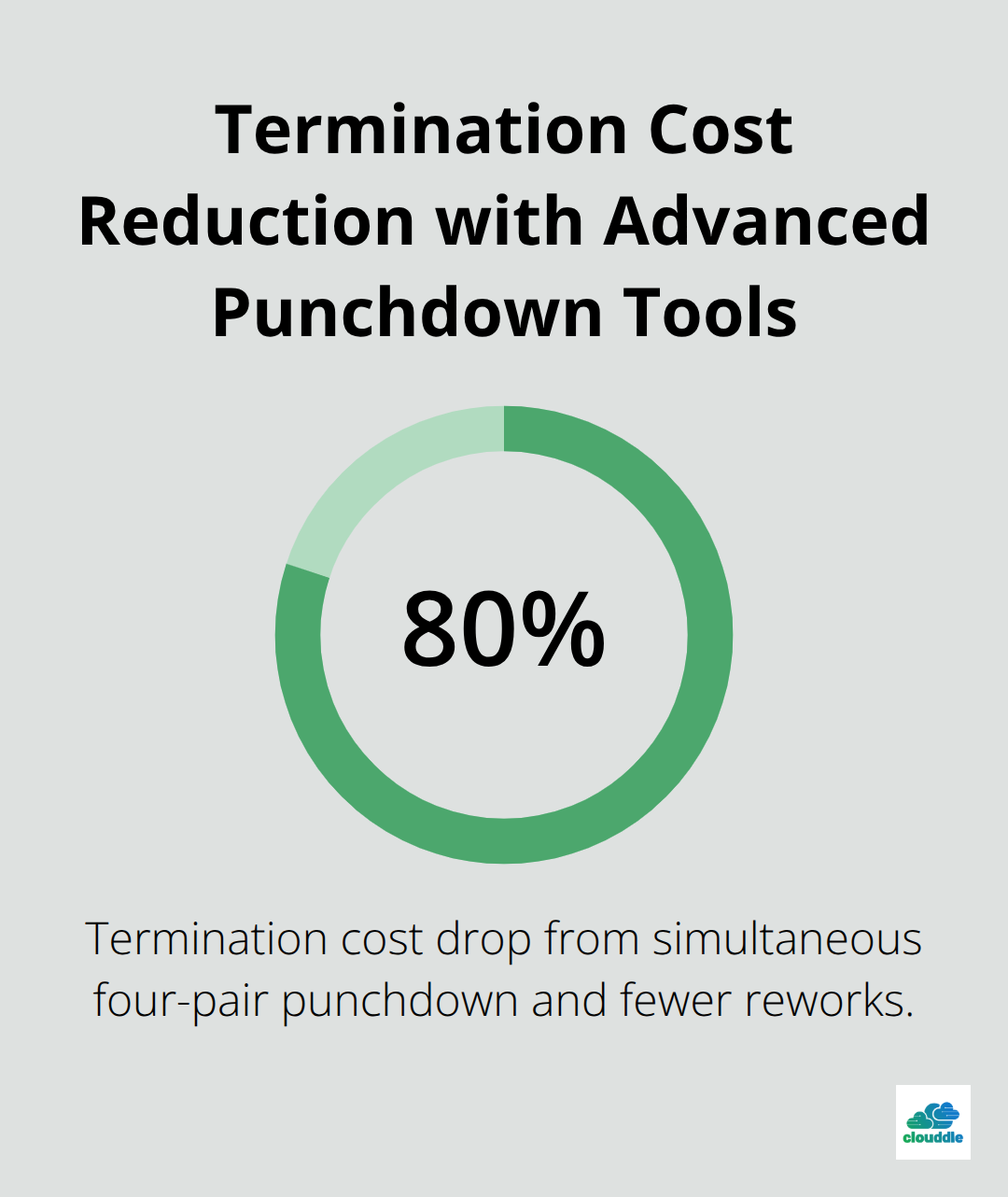
For punchdown terminations, advanced tools like the JackRapid increase productivity by six to eight times compared to manual punchdown tools. These tools terminate all four pairs with a single squeeze, improving consistency and reducing hand fatigue in tight spaces near walls. The termination cost drops by as much as 80 percent due to faster work and less rework. The JackRapid features a built-in blade, ergonomic handle, and replaceable blade head to support multiple jack types.
Testing Equipment That Validates Your Installation
Verification tools catch miswires, opens, shorts, and split pairs before cables go live. Basic wiremap testers cost under 50 dollars and identify fundamental faults that could disable network segments. However, certification tools from manufacturers like Fluke Networks provide the documentation required for warranty coverage backed by cable manufacturers. Without proper certification, you as the installer bear warranty responsibility if failures occur.
LinkIQ Cable and Network Testers combine copper qualification, Ethernet testing, and Wi-Fi readiness in one device, supporting end-to-end verification across mixed copper and fiber networks. The MicroScanner Cable Verifier provides quick wiremap verification and fault finding for technicians installing and troubleshooting Ethernet devices. If you want manufacturer warranty protection and compliance with industry standards, certification tools are not optional-they are mandatory for professional deployments.
The tools you select today determine whether your next project runs smoothly or encounters costly delays. Advanced equipment like the JackRapid and LinkIQ testers represent investments that compound over time, reducing labor costs and rework across multiple installations. Your toolkit foundation is now in place, but professionals who work with fiber optic networks face additional challenges that require specialized equipment designed specifically for high-speed deployments.
Tools That Speed Up Every Installation Phase
Fiber optic installations demand specialized equipment that copper terminations simply do not require. A professional fiber optic inspection scope with 200X magnification and SC/ST/FC adapters reveals connector contamination invisible to the naked eye, preventing insertion loss that degrades signal quality before cables even go live. Touchless connector cleaners like the Sticklers Pro360 maintain cleanliness without introducing new particles-a step many installers skip. High-density data centers increasingly rely on MTP/MPO solutions with cassette-enabled patching and trunk cables that maximize port density while reducing cabling complexity. MPO loss testing kits enable certification of MPO cabling and measurement of per-fiber loss, ensuring each connection meets performance standards before deployment. These tools cost between 300 and 800 dollars but are non-negotiable for fiber projects where rework means replacing entire cable runs.
Diagnostics Beyond Basic Wiremap Testing
Certification tools like Fluke Networks LinkIQ testers go far beyond identifying opens and shorts. The LinkIQ combines copper qualification, Ethernet testing, and Wi-Fi 6E readiness in one device, eliminating the need to carry multiple instruments to job sites. This reduces setup time and eliminates the risk of missing diagnostics because you left the wrong tester in the truck.
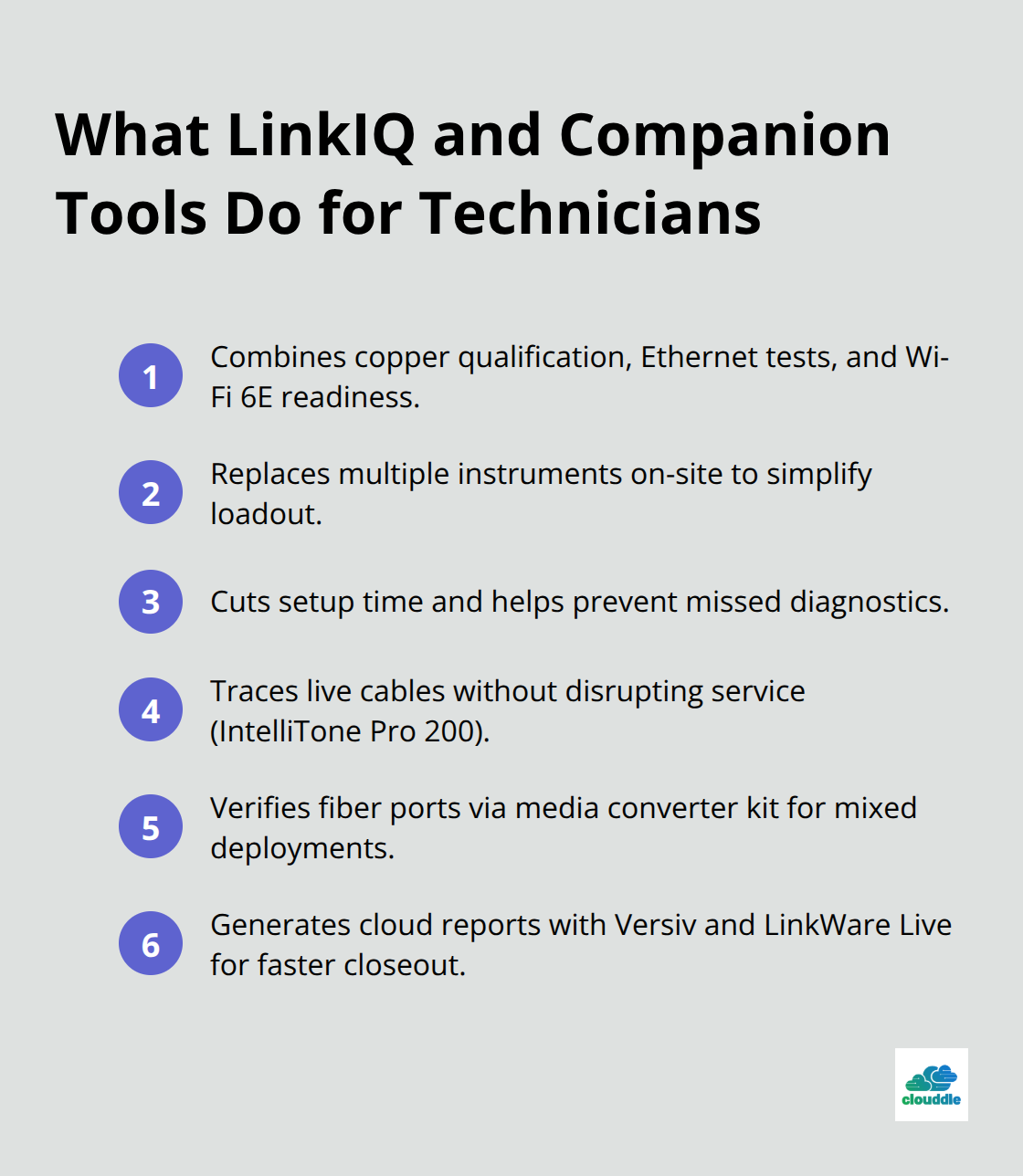
The IntelliTone Pro 200 LAN toner traces cables on active networks without disrupting service, letting you verify installations while systems remain operational. For fiber networks, the Fiber Media Converter Kit enables LinkIQ testers to verify fiber optic ports and connections, bridging copper and fiber diagnostics in mixed deployments. Professionals using centralized certification platforms like Versiv with LinkWare Live generate real-time cloud-based results and share reports instantly with stakeholders, eliminating manual paperwork and reducing project closure delays by days.
Efficiency Tools That Justify Their Cost
Cable pulling equipment and power tools separate professionals who complete three installations per week from those who complete five. Advanced punchdown tools like the JackRapid reduce termination time by 80 percent through simultaneous four-pair termination, but this represents only part of the efficiency equation. Hannay reels, Diamondback, FastLane, and Guard Dog cable management accessories protect cables in challenging environments while speeding deployment in tight conduit runs. A comprehensive on-site toolkit with tone generators, probes, and butt sets enables quick field verification without returning to the truck, cutting diagnostic time from 30 minutes to under five minutes per connection. Professionals who invest in quality pull lubricants and cable caddy systems reduce physical strain and complete installations faster, which compounds across dozens of projects annually into thousands of dollars in recovered labor costs.
The equipment you select determines whether your team moves through projects efficiently or wastes hours troubleshooting preventable problems. Fiber optic networks introduce additional complexity that separates installations requiring specialized knowledge from standard copper deployments, and the next section covers how to handle these high-speed environments without costly mistakes.
Where Installers Lose Time and Money
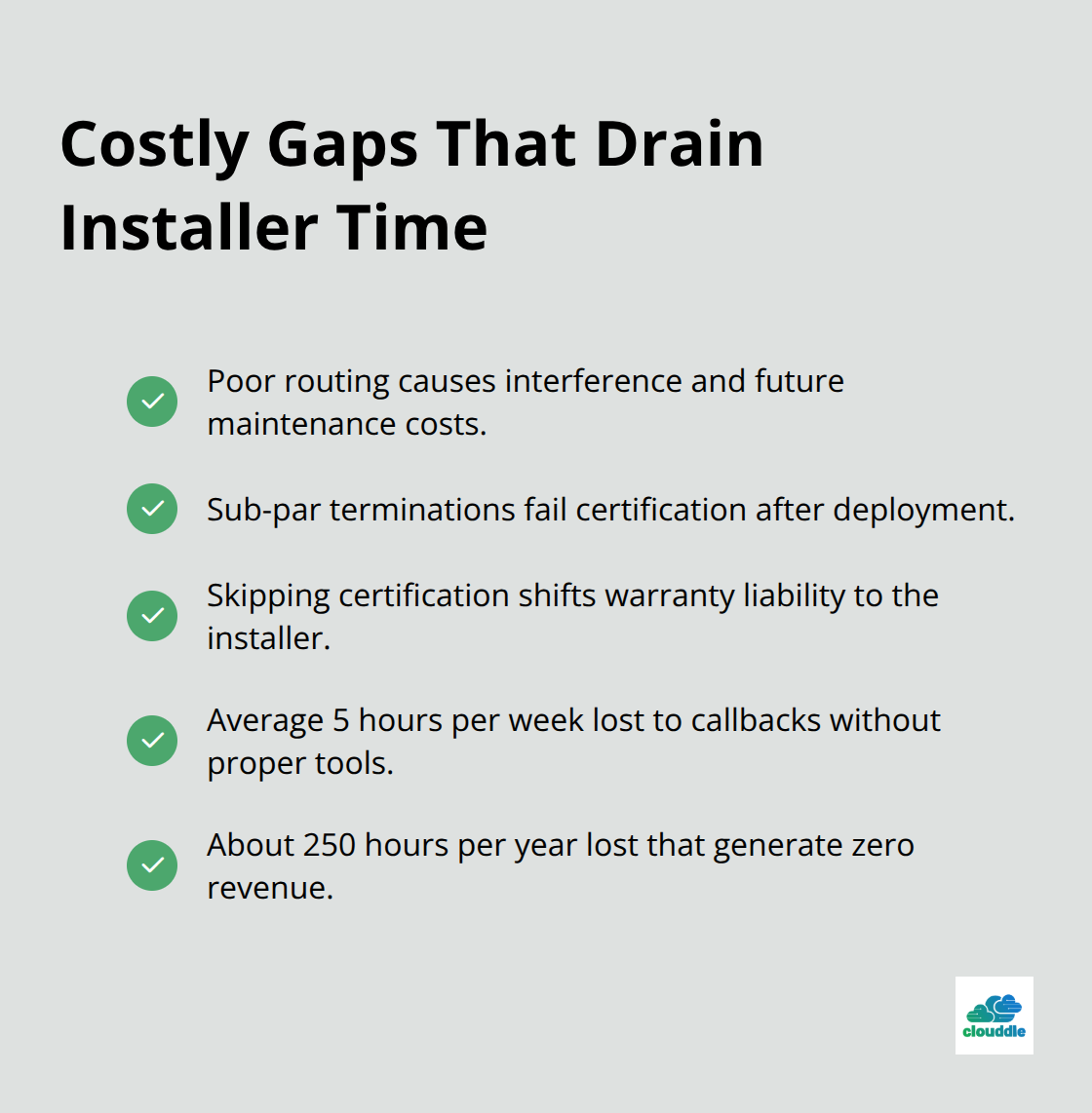
Most installation failures trace back to three preventable problems that professionals overlook or underestimate. Poor cable routing creates signal degradation, fire code violations, and future maintenance nightmares that cost far more to fix than prevention would have cost upfront. Terminations that look acceptable to the eye often fail certification testing because connectors sit at slight angles or have debris trapped inside, causing insertion loss that appears days or weeks after installation. Testing and certification gaps leave you personally liable for failures, yet many installers skip this step to save a few hours, only to face warranty disputes with clients or cable manufacturers who rightfully deny coverage. One technician working without proper certification tools loses an average of five hours per week on callbacks and rework, translating to roughly 250 hours annually that generate zero revenue.
Cable Routing Mistakes That Degrade Performance
Cable runs placed too close to electrical conduit, HVAC ducts, or power supplies introduce electromagnetic interference that degrades signal quality without obvious symptoms until network performance mysteriously declines. Tight cable bends exceeding the manufacturer’s bend radius specification physically damage conductors, creating high-frequency signal loss that certification tools identify immediately but field technicians often miss. Cables running horizontally across ceiling tiles without support sag under their own weight, creating tension that stresses connectors and causes intermittent connection failures months into deployment.
Proper routing requires measuring bend radius specifications for each cable type. Per industry standards, the minimum bend radius for Cat 6 and Cat 6A cable is 4 times the diameter of the cable. Secure cables every 4.8 feet using appropriate cable ties to prevent sagging and protect against accidental damage from ladder placement or equipment movement. Cable management accessories like hook-and-loop straps cost under 20 dollars per installation but eliminate 80 percent of routing problems that create callbacks.
Termination Quality Separates Professionals From Rushed Work
Flush terminations matter because incomplete seating causes insertion loss that accumulates across connections, eventually exceeding network performance thresholds. When cable protruding from an RJ45 connector exceeds 0.5 millimeters, the connector fails to seat properly in patch panels and wall jacks, introducing signal reflection that certification testers flag immediately. Use the correct punchdown tool for your specific jack type to prevent this problem entirely-advanced multi-wire punchdown tools like the JackRapid terminate all pairs simultaneously with precise blade depth, eliminating the hand-position inconsistencies that cause shallow or deep cuts across individual pairs.
Improper blade depth on punchdown terminations either leaves insulation on conductors or nicks them, both creating high-frequency attenuation that fails Cat6A certification. Professionals who use manual punchdown tools inconsistently achieve termination depths varying by 1 to 2 millimeters across a single jack, while advanced tools maintain tolerances within 0.1 millimeters. This precision difference determines whether installations pass certification on the first attempt or require extensive rework that doubles labor costs.
Certification Gaps Create Liability You Cannot Escape
Skip certification testing to save time, and you’ll face thousands in warranty disputes and repeat visits. Cable manufacturers like Corning explicitly state they provide warranty coverage only for installations certified with approved testing equipment-without certification documentation, the installer assumes all liability for failures. A basic wiremap tester costs under 50 dollars but identifies only fundamental faults like opens and shorts, missing high-frequency performance issues that certification tools catch.
Certification tools measure insertion loss, return loss, and near-end crosstalk at frequencies up to 2 gigahertz, documenting that cables meet performance standards before equipment connects. Installers who skip this step on Cat6A deployments face a harsh reality when a client’s network experiences degradation-they have no documentation proving the cabling meets specifications, making warranty claims impossible. One hour spent running certification tests on a 200-connection installation prevents 20 to 40 hours of troubleshooting and rework if problems emerge later. The cost difference between a basic tester and certification-grade equipment is roughly 300 to 500 dollars, which pays for itself on a single large project where certification prevents callbacks.
Final Thoughts
The network cable installation tools you invest in today determine whether your projects succeed or fail months after completion. Quality equipment prevents the costly mistakes that plague rushed installations, from improper terminations that fail certification to cable routing that introduces signal degradation. Professionals who prioritize proper tools reduce rework by 80 percent and recover hundreds of hours annually that build reputations for reliable deployments.
Building a professional toolkit requires balancing initial investment against long-term returns. A quality cable stripper, advanced punchdown tool like the JackRapid, and certification-grade tester cost roughly 500 to 800 dollars combined but prevent thousands in warranty disputes and callbacks across dozens of projects (these tools compound in value as your team completes more installations). Equipment costs transform into recovered labor hours that generate revenue instead of consuming it.
The separation between professionals and amateurs comes down to discipline in cable routing, flush terminations, and certification testing. At Clouddle, we understand that reliable network infrastructure depends on proper installation from the ground up, and our networking and data cabling solutions combine cutting-edge technology with expert support to ensure your infrastructure performs reliably.


0 Comments