
For owners of multi-dwelling units (MDUs), student housing, and build-to-rent (BTR) communities, robust network security for businesses has moved from the server room to the boardroom. It's no longer just an IT expense; it's a fundamental pillar of your property's operational and financial health. In communities where property-wide WiFi is a key amenity, an unsecured network is a critical liability.
It exposes your entire community—from resident data to essential building systems—to significant risk.
Why Network Security Is A Business Imperative for Residential Properties
Think of it this way: offering property-wide WiFi without strong security is like leaving the master key for your entire building under the front doormat. You’re giving digital intruders an open invitation to access not only your residents’ private information but also the very smart systems that keep your MDU, student housing, or BTR community running.
This goes far beyond preventing a student's laptop from getting a virus. The stakes are much higher. A single breach could compromise your entire smart building infrastructure, including access controls, security cameras, and HVAC systems. An event like that doesn't just cause an IT headache—it cripples operations and creates an immediate safety crisis for everyone on site.
The Real-World Impact on Your Property
The fallout from a security lapse hits your bottom line directly. When residents feel their personal data or physical safety is compromised, the trust you've built evaporates almost overnight. That erosion of trust has a direct, measurable impact on occupancy rates and your ability to attract and retain tenants in a competitive rental market.
The most pressing threats can appear in several ways, each carrying a significant business cost.
Immediate Security Risks for MDU and Residential Communities
The table below outlines the most common network security threats for properties like MDUs, student housing, and BTR communities, and their direct consequences for your operations and profitability.
| Threat Vector | What It Looks Like | Direct Business Impact |
|---|---|---|
| Data Breach | A resident’s personal or financial data is stolen over the unsecured WiFi network. | Loss of resident trust, potential legal action, and significant reputational damage. |
| IoT Hijacking | An attacker gains control of smart locks, thermostats, or security cameras in a student apartment. | Physical security risks, operational chaos, and potential for property damage or resident harm. |
| Network Downtime | A denial-of-service (DoS) attack or malware infection brings the entire property network down. | Residents lose internet access, smart amenities fail, and management operations are halted. |
| Ransomware | Building management systems are encrypted and held hostage for a ransom payment. | Complete operational shutdown, massive financial loss, and long-term recovery costs. |
These scenarios aren’t just theoretical. They represent clear and present dangers that can quickly devalue your asset and dismantle your brand reputation, especially in the close-knit world of student housing or build-to-rent.
The broader security environment is just as concerning. Recent research reveals that only 2% of companies globally feel they are fully resilient against modern cyber threats. That number paints a stark picture for any business where network availability is tied directly to revenue and safety.
In a market where property-wide WiFi is a standard amenity, a secure network isn't a feature—it's the foundation of a safe, modern, and profitable property. Failing to protect it is a direct threat to your Net Operating Income.
Ultimately, investing in modern network security is a strategic business decision. It protects your assets, secures your residents, and fortifies your property's reputation as a top-tier place to live. If you’re just getting started, a good small business network security guide can provide a solid foundation for building an effective defense.
The Unique Dangers of Property-Wide WiFi in Residential Communities
Securing an office network is one thing. Securing a property-wide WiFi network across a Multi-Dwelling Unit (MDU), student housing complex, or build-to-rent community is a different beast entirely. Unlike a controlled corporate environment, your network serves hundreds—sometimes thousands—of residents using personal devices you have absolutely no say over. This creates a far more complex and unpredictable environment where a single threat can spread like wildfire.
These dangers aren't just theoretical. They can hit your operations and residents in very real, very damaging ways. Picture this: a student connects to what they think is the community Wi-Fi, but it’s actually a fake portal set up by an attacker. Within minutes, dozens of residents could hand over their banking details, and suddenly, you’re facing a massive liability.
The Hidden Backdoors of Smart Devices
One of the biggest vulnerabilities today comes from the explosion of Internet of Things (IoT) devices. Every smart TV, connected thermostat, voice assistant, and even smart lock in a resident's apartment is another potential door for an attacker. These devices are notorious for shipping with default passwords and often go months, or even years, without a security update, making them low-hanging fruit for criminals.
An attacker could find their way onto your network through just one insecure smart speaker in a single unit. Once they have a foothold, they can start looking for ways to move laterally into more sensitive systems.
A compromised network in a residential community isn't just an IT headache—it's an operational crisis waiting to happen. An attacker could turn your own building's infrastructure against you, weaponizing smart locks and resident amenities.
Think about the chaos during move-in week at a student housing complex. A hacker could launch a ransomware attack that seizes control of every smart thermostat, demanding a hefty payment to restore access. The operational nightmare, resident panic, and damage to your reputation would be immediate and severe.
Ransomware: The Apex Predator
This kind of targeted attack is becoming all too common, especially for the small and mid-sized businesses that run these properties. Ransomware has firmly established itself as the top cyber risk. In fact, recent analysis shows ransomware was involved in 44% of all breaches, a number that jumps to an astonishing 88% for small and mid-sized businesses (SMBs)—precisely the enterprises managing MDUs and BTR communities. You can dig into this trend in the WEF’s Global Cybersecurity Outlook report.
These stats tell a clear story: property management businesses are prime targets. Attackers know that disrupting essential services for hundreds of residents puts immense pressure on you to pay up, and pay up fast.
Why Shared Networks Magnify Risk
In a shared residential network, the "attack surface" is massive. Every single device a resident connects—from a laptop with outdated antivirus to a phone running a malicious app—introduces risk to the whole community. If you don't have proper network segmentation in place, one infected device can become the launchpad for an attack that cripples the entire property.
This creates a few unique headaches for MDU and BTR operators:
- No Control: You can’t enforce security policies on your residents' personal devices.
- High Density: The sheer volume of connected devices in a student housing dorm or MDU dramatically increases the odds of a weak link.
- Interconnected Systems: All too often, resident Wi-Fi isn't properly isolated from operational networks that control things like security cameras or building access systems.
Securing these complex environments is a specialized skill. For a deeper dive into the specific challenges of managing public-facing networks, take a look at our guide on guest WiFi security. The principles of isolating traffic and managing access are absolutely vital for protecting both your residents and your business.
How to Architect a Secure Network for Your Residential Community
Knowing the dangers facing your property-wide WiFi is one thing; building a proper defense is another. When you're architecting a network for a multi-dwelling community, whether it's student housing or a build-to-rent property, you need to think in layers. A single password just won't cut it. The goal is to design a digital infrastructure that’s every bit as resilient as your physical buildings.
Think of it this way: your network architecture is the security blueprint for your entire property. A well-designed blueprint anticipates problems and builds safeguards in from the very beginning. This way, a single vulnerability can't bring the whole system down. It’s about getting ahead of threats, not just reacting to them after the damage is done.
The Foundation: Network Segmentation
If you take away only one principle, let it be this: network segmentation. It’s the single most effective architectural choice you can make for MDU, student housing, and BTR security.
I often tell property owners to picture their network as a large, open-plan building. If a fire starts in one corner, it has a clear path to spread everywhere, fast. Segmentation is like constructing permanent, fire-rated walls throughout that building, creating multiple contained zones.
In network terms, segmentation creates digital "gated communities" within your property's overall network. It ensures that a security issue on the resident WiFi—like a student accidentally downloading malware—is walled off and cannot spread to your critical operational systems, like access controls, security cameras, or management software.
This isn't just a "nice-to-have." Without proper isolation, your most sensitive operational assets are sitting on the same open network as thousands of personal, unmanaged devices. That's an enormous and completely unnecessary risk. By segmenting the network, you dramatically shrink the blast radius of any potential security breach.
The threats we're trying to contain are serious, ranging from data theft to full-blown ransomware attacks on your operations.
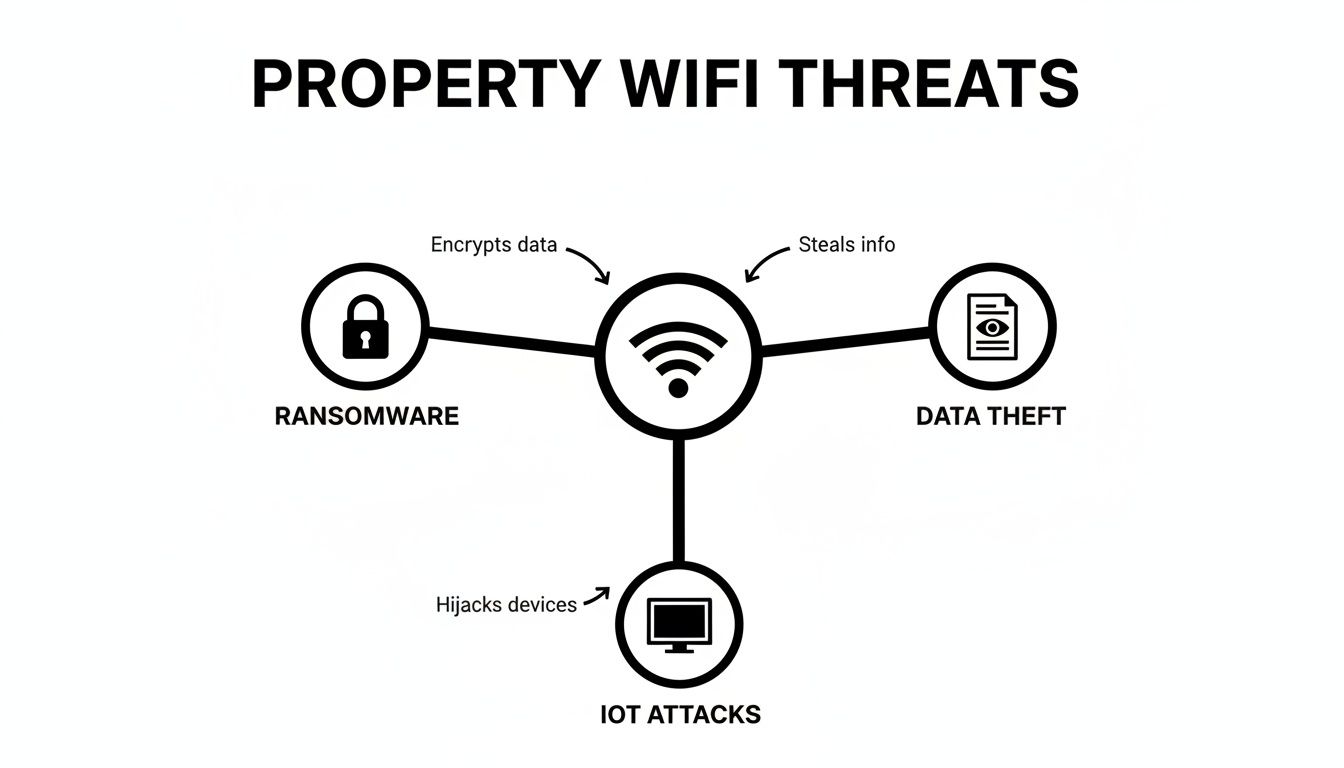
As you can see, the threats are varied and significant, which is why a defense built on multiple, interlocking components is so critical.
Essential Security Components
With segmentation as your foundation, you can layer on other key security components. Each one has a specific job to do, and together they create a truly robust defense.
Next-Generation Firewalls (NGFWs): Your firewall is the digital security guard posted at the main internet entrance, inspecting all traffic coming in and out of your property. But not all firewalls are equal. Unlike older models that just check addresses, NGFWs dig deeper. They can actually inspect the content of the data packets, allowing them to spot and block sophisticated threats like malware or an active intrusion attempt before they ever get inside.
WPA3 Encryption: If the firewall is your guard, think of encryption as the unbreakable lock on every single connection. WPA3 is the current gold standard for WiFi security, and it's a massive leap forward from older protocols. It makes it practically impossible for a bad actor to eavesdrop on a resident's activity or use brute-force attacks to crack the network password.
24/7/365 Monitoring and Response: A strong network defense is never "set it and forget it." New threats appear daily, so your security posture has to be a living, breathing thing. This is where continuous monitoring comes in. It requires specialized tools and, more importantly, a team of experts watching over your network around the clock. They're trained to spot suspicious activity, validate real threats, and respond in minutes—not days. Without that constant vigilance, even the strongest locks and guards can eventually be defeated.
These elements—segmentation, advanced firewalls, modern encryption, and active monitoring—are the essential pillars of a secure MDU, BTR, or student housing network. By putting these layers in place, you’re no longer just providing an internet connection; you’re delivering a protected and reliable digital experience for both your residents and your own critical operations.
Solving the Cybersecurity Skills Gap in Property Management
Designing a secure network is one thing. Having the specialized team to manage and defend it around the clock is another challenge entirely, and for most MDU and BTR management companies, it’s a massive hurdle. After all, your expertise is in real estate and resident services, not firewall rules and threat hunting.
You’re not alone in this. The cybersecurity industry is grappling with a well-known talent shortage. Finding, hiring, and keeping qualified security professionals is incredibly competitive and expensive, putting a dedicated in-house security team far out of reach for most property owners.
The Sobering Reality of Understaffed Defenses
The numbers don't lie. Recent research shows that a staggering 55% of cybersecurity teams are understaffed, and 65% of organizations report having a hard time filling open security roles. This problem is getting worse as demand for experts skyrockets, a trend detailed in ISACA’s latest global talent shortage report.
For operators of MDUs and student housing, this means that even if you buy the best security hardware on the market, your on-site team is probably not equipped to manage it. Your property staff is busy handling resident needs and property operations, not watching for unusual network activity or patching a zero-day exploit.
Relying on a general IT staff—or worse, no one at all—to manage network security for businesses in a high-density apartment building is like asking your superintendent to also be a full-time paramedic. They can handle a first-aid kit, but they aren't prepared for a major emergency. In cybersecurity, major emergencies are now a daily risk.
Without specialized expertise, even the most advanced security tools are just expensive boxes collecting dust. Threats change constantly, and your defenses need to adapt in real time. That requires a level of focus and knowledge that simply isn't realistic for most property management teams.
The Strategic Shift to Managed Security Services
So how do you get enterprise-grade security without the enterprise-level budget and HR headaches? The answer is to shift your strategy from trying to own security to finding the right partner. By working with a managed security service provider (MSSP), you effectively "rent" an entire team of cybersecurity experts who specialize in residential property networks.
This approach turns a huge capital expense and a staffing nightmare into a predictable, manageable operating expense. It’s a smart business move that delivers several clear advantages:
- Access to Expertise: You instantly gain a team of seasoned professionals whose only job is to monitor, manage, and defend your MDU or BTR network.
- 24/7/365 Monitoring: Threats don’t operate on a 9-to-5 schedule. A managed service provides around-the-clock vigilance, ensuring threats are caught and neutralized in minutes, not days.
- Cost-Effectiveness: You get to skip the six-figure salaries, benefits, and training costs that come with hiring an in-house team. A managed service model delivers better protection for a fraction of the cost.
- Focus on Your Core Business: Let your team get back to what they do best—managing properties and serving residents. Leave the complexities of cybersecurity to the specialists.
Partnering with a managed service provider turns a major operational weakness into a strategic strength. It allows MDU, student housing, and BTR owners to solve the skills gap problem once and for all, ensuring their network, residents, and business are protected by top-tier talent without the overhead.
Finding the Right Network-as-a-Service Partner

Handing over the keys to your property’s network security is a huge decision. The right partner acts as a true extension of your team, bringing specialized expertise that protects your business and your residents. The wrong one? They can leave you exposed, stuck with outdated equipment, and facing a mountain of unexpected costs.
For property owners in MDU, student housing, and build-to-rent communities, the Network-as-a-Service (NaaS) model has really changed the game. Instead of buying all your network hardware upfront, NaaS bundles everything—equipment, software, installation, monitoring, and 24/7 support—into one predictable subscription. It’s a smart financial move that flips a massive capital expense (CapEx) into a manageable operating expense (OpEx).
But here’s the thing: not all NaaS providers are cut from the same cloth. You need a partner who genuinely gets the unique challenges of a residential property.
Your Vendor Evaluation Checklist
When you’re vetting potential partners, you have to look past the sticker price. The best providers will demonstrate a real understanding of your business and offer a service that feels built just for you. Use this checklist to guide your conversations and separate the experts from the amateurs.
Proven Sector Experience: Have they actually worked with MDUs, student housing, or build-to-rent properties before? Ask for case studies and don’t be shy about requesting references from properties similar to yours. A partner with experience in your field already knows the specific traffic patterns and security headaches common to residential buildings.
24/7/365 Included Support: Cyber threats don’t work a 9-to-5 schedule. You need to confirm that round-the-clock monitoring and expert support are part of the core contract, not some pricey add-on. A security alert at 2 AM demands an immediate response, not a ticket that waits in a queue until morning.
Hardware Refresh Cycles: Technology ages fast. One of the biggest advantages of NaaS is that the provider handles equipment upgrades. Get clarity on their hardware refresh policy. This ensures your property stays protected by modern, effective gear without you having to foot another huge bill in a few years.
Zero Down Payment & Flexible Terms: The deal's financial structure matters. Look for partners who offer zero-down-payment options, which immediately aligns the cost with your operating budget. Flexible contracts, like 3- and 5-year options, let you match the agreement to your long-term business strategy.
A true NaaS partner doesn't just sell you equipment; they take ownership of your network's performance and security. Their success is tied directly to your operational stability, creating a powerful alignment of interests.
As you think about your property’s broader IT needs, it’s also smart to get familiar with different service approaches. Understanding the nuances of choosing IT support models, such as a basic helpdesk versus a more integrated service desk, will help you better evaluate a NaaS provider’s support capabilities.
NaaS Model vs. Traditional IT Procurement
To really see the value, it helps to compare the NaaS model directly against the old way of doing things. Traditional IT procurement saddles you with the entire burden—and risk—of ownership.
The table below breaks down the key differences for a residential property owner.
| Feature | Traditional IT Purchase | Clouddle NaaS Model |
|---|---|---|
| Initial Cost | High upfront capital expense for all hardware and software licenses. | Zero down payment, converting the cost to a predictable monthly OpEx. |
| Hardware | Becomes obsolete; you are responsible for expensive refresh cycles. | Hardware is refreshed automatically as part of the service contract. |
| Support | 24/7 expert support is often an expensive, separate contract. | 24/7/365 support is included, providing constant vigilance. |
| Expertise | Requires hiring and retaining a costly in-house security team. | Access to a dedicated team of security experts is built into the service. |
| Scalability | Scaling requires purchasing new hardware and complex integration. | Easily scalable to add new services or cover property expansions. |
At the end of the day, a great NaaS partner delivers more than just network security for businesses; they offer a complete, managed solution that adds real value to your property. You can see exactly how this model benefits large-scale residential networks by exploring our approach to Network-as-a-Service for hospitality and residential communities. By choosing the right partner, you can turn a complex operational headache into a strategic asset that fuels your growth.
The Financial Return of Proactive Network Security
It’s easy to mistake network security for businesses as just another unavoidable cost. For property owners in the MDU, student housing, and build-to-rent sectors, however, that mindset is outdated and costly. Proactive security isn't an expense line—it's a strategic asset that creates a clear, measurable financial return.
When you stop thinking only about preventing losses and start focusing on the gains, the picture changes completely. High-performance, secure property-wide WiFi has become a massive draw for high-value residents. It's a key differentiator that lets you justify premium rates, keep vacancies low, and directly increase your Net Operating Income (NOI).
Turning Security Into a Revenue Driver
In today’s competitive rental market, residents don’t just want an internet connection; they expect it to be fast, reliable, and completely safe. When you can confidently market your property as having a professionally managed, secure network, you’re no longer selling a utility. You're selling peace of mind—a premium feature modern renters will gladly pay for.
- Increased Occupancy: Properties offering superior digital amenities, especially with robust security, simply attract more applicants. This leads to faster lease-ups in new BTR communities and fewer empty units in established MDUs.
- Higher Rental Rates: A secure, always-on WiFi network is a justifiable reason to command higher rents, contributing directly to your revenue.
- Enhanced Retention: Nothing sours the resident experience like dropped connections or security scares. A stable, secure network is a huge factor in resident satisfaction and lease renewals, especially in the student housing market.
Investing in a managed security solution isn't just about protecting your backend systems. It's about building a better, more marketable product for your residents. A secure network elevates their daily experience, strengthens your brand, and delivers a tangible return that easily surpasses the initial cost.
The Quantifiable Cost of Doing Nothing
On the flip side, the financial fallout from ignoring security can be catastrophic. The damage goes far beyond the immediate bill for fixing a breach. A single security incident can set off a chain reaction of financial hits that chip away at your property's value and reputation for years.
These aren't hypothetical costs. We're talking about real money for regulatory fines, legal fees, and the staggering expense of restoring compromised systems. The worst part? The loss of resident trust. That can trigger an exodus of tenants and leave you with a tarnished name that is incredibly difficult and expensive to fix. To get a better handle on the numbers, you can learn more about calculating the ROI for managed IT services and see the financial stakes for yourself.
Ultimately, proactive network security is a direct investment in your property’s profitability and long-term health. It guards against devastating losses while opening up new ways to generate revenue and keep residents happy, making it an essential part of any modern MDU, BTR, or student housing strategy.
Frequently Asked Questions
When it comes to network security, property owners of MDUs, student housing, and build-to-rent communities often have a lot of questions. We've compiled answers to some of the most common ones we hear, helping you understand the real-world implications for your property.
My Property Already Has Wi-Fi. Isn't It Secure?
That's a common misconception. The Wi-Fi you provide is likely just a basic internet connection with a password, which is a bit like having only a doorknob lock on a bank vault. It’s simply not equipped to handle the sophisticated threats common in multi-tenant environments.
True network security for businesses in residential communities is a multi-layered system. It involves commercial-grade firewalls to block malicious traffic, constant monitoring to detect threats in real-time, and crucially, network segmentation. An unmanaged network doesn't just put residents at risk; it exposes your entire building's operational systems.
Can My Property Afford Enterprise-Grade Security?
You can't afford not to have it, but the good news is, it's more accessible than you think. While hiring an in-house team of cybersecurity experts is prohibitively expensive for most MDU and BTR operators, modern Network-as-a-Service (NaaS) models change the game entirely.
With a NaaS partner, there's typically no down payment for the equipment. Instead, all the hardware, software, and 24/7 expert management are rolled into a single, predictable monthly fee. This smart financial model turns a massive capital expenditure into a manageable operating expense, putting top-tier security well within reach.
Think of it this way: with a NaaS provider, you are essentially renting an entire team of dedicated cybersecurity experts. You get around-the-clock protection from specialists without the enormous overhead of hiring, training, and retaining them yourself.
How Does Network Security Improve My Property's NOI?
This is the critical question, and the answer directly impacts your bottom line. A secure network boosts your Net Operating Income (NOI) in two powerful ways.
First, it’s a defensive play. It helps you avoid the catastrophic costs of a data breach—think emergency remediation, regulatory fines, and the permanent damage to your property's reputation in a competitive rental market.
Second, it’s an offensive strategy. A secure, fast, and reliable Wi-Fi network isn't just an expense; it's a premium amenity that residents now expect and will pay more for. It directly helps you attract and retain high-quality tenants, reduce turnover, and justify higher rental rates, turning your property-wide WiFi into a genuine revenue-driver.
What Is Network Segmentation and Why Is It Crucial for My Property?
Imagine your property's network as a large, open-plan building. If a fire starts in one corner, it can quickly spread everywhere. Network segmentation is like building fire-rated walls throughout that building, creating contained zones.
In technical terms, it creates separate, isolated networks for different users. Most importantly, it builds a digital wall between the network your residents use for streaming and browsing and the one that runs your critical building operations (like security cameras, keycard access, and management software). If a student accidentally downloads a virus, segmentation ensures it can't spread and take down your entire operational infrastructure. For any shared living space like an MDU, student housing, or BTR community, it's non-negotiable.
Ready to transform your property’s network from a liability into a strategic asset? Clouddle Inc. delivers managed network security solutions designed specifically for MDU, student housing, and build-to-rent communities, ensuring your residents and operations are protected. Learn how our Network-as-a-Service model can boost your NOI and provide peace of mind at https://www.clouddle.com.


0 Comments