
Hotels today face a critical choice: outdated copper networks that can’t handle modern guest demands, or fiber optic cabling that delivers the speed and reliability your property needs.
At Clouddle, we’ve seen firsthand how the right infrastructure transforms guest experiences and operational efficiency. Fiber optic networks aren’t just faster-they’re built to scale with your business, handle peak usage without slowdowns, and require less maintenance than traditional systems.
This guide walks you through everything from planning your fiber installation to optimizing performance long-term, with practical strategies designed specifically for hotel operations.
What Makes Fiber the Only Viable Backbone for Modern Hotels
Fiber optic cabling delivers speeds that copper networks simply cannot match, and the gap widens every year. A single fiber strand carries data at nearly the speed of light, achieving downstream speeds up to 2.5 Gbps per GPON port with straightforward upgrades to 10 Gbps or 25 Gbps through endpoint device swaps rather than infrastructure replacement. Copper networks max out around 1 Gbps and degrade significantly over distance, making them obsolete for properties managing 1,200 to 4,000 simultaneous device connections. The math is brutal: a 200-room resort with guests carrying 3-4 connected devices each creates demand that copper cannot sustain during peak hours.
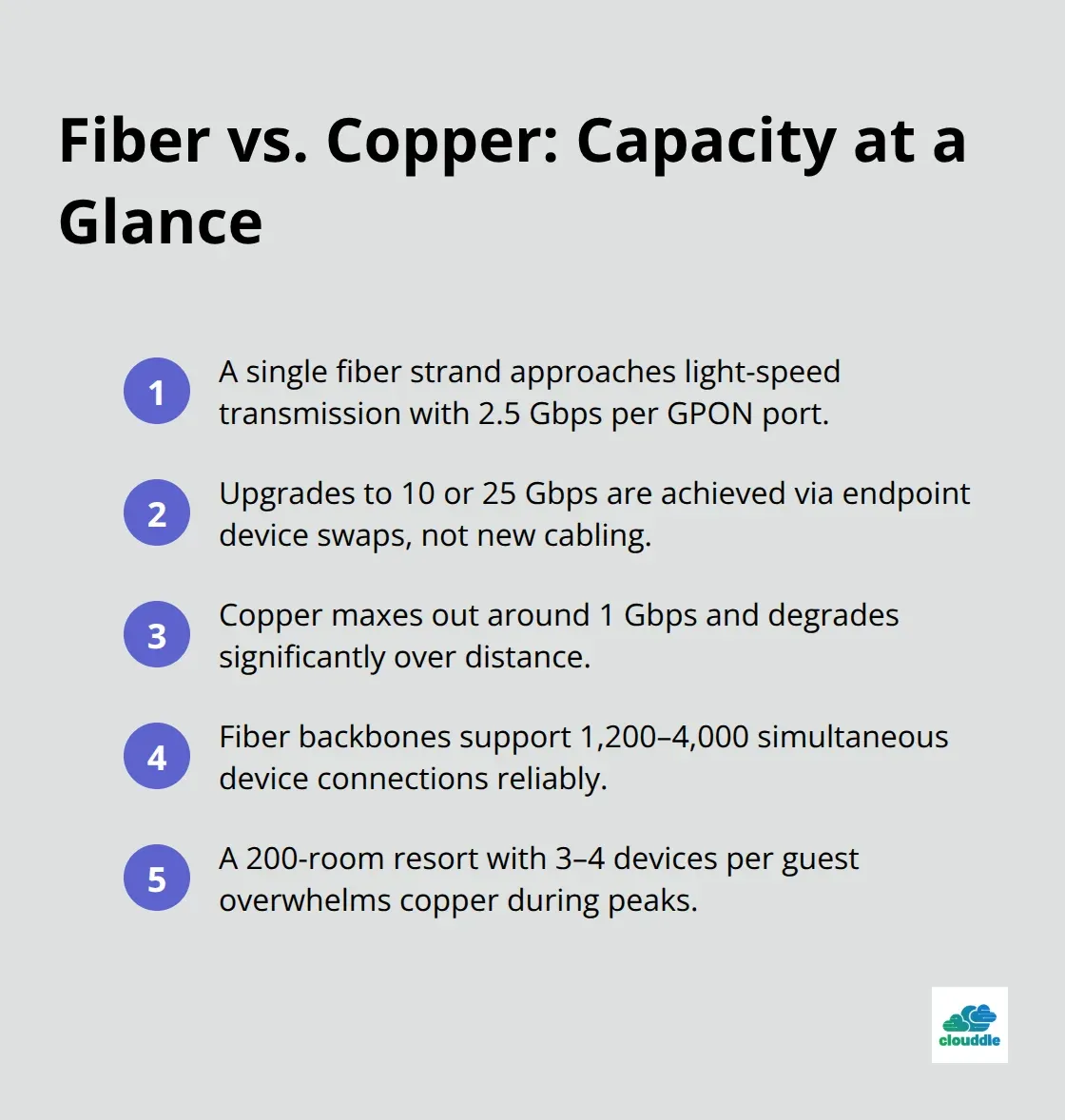
Streaming 4K video requires 25 Mbps per stream and 8K demands 50-100 Mbps; when dozens of rooms stream simultaneously, only fiber provides the symmetrical bandwidth needed. Copper also suffers from electromagnetic interference in environments packed with HVAC systems, kitchen equipment, and electrical panels, whereas fiber carries no electrical current and remains immune to EMI, delivering consistent performance across every room.
The Real Cost Difference Between Fiber and Copper
Installing fiber to each room costs €15,000 to €40,000 for 100-room properties and €80,000 to €120,000 for 300+ room hotels, but the payoff arrives within 3-5 years through energy savings and revenue generation. Fiber-based networks reduce operational costs dramatically because GPON systems support higher data transmission rates with a theoretical maximum of 10 Gbps. Copper requires constant replacement as signal degradation accelerates, and labor costs compound quickly.
Hotels offering tiered internet-free basic service at 20 Mbps paired with premium 200+ Mbps tiers-generate €5-€15 daily per guest, offsetting infrastructure investment faster than most property owners expect. Energy efficiency gains alone deliver 15-30% reductions in power consumption across properties, supporting sustainability certifications like Green Key that attract environmentally conscious travelers willing to pay premiums.
Why Fiber-to-the-Room Changes Everything
Fiber-to-the-Room architecture places a compact ONT with integrated WiFi 6E or 6G directly in each guest room, delivering real-world speeds of 2-5 Gbps when properly fed by fiber backbone infrastructure. This topology scales effortlessly: adding rooms or upgrading speeds requires endpoint device swaps, not cable replacement. Passive fiber splitters distribute single trunk lines to multiple buildings on resort campuses, reducing active equipment maintenance and creating resilience that copper simply cannot replicate.
Network segmentation becomes straightforward with fiber backbones, isolating guest WiFi from critical hotel systems like property management, point-of-sale, and security networks. WiFi 6E unlocks the 6 GHz spectrum, reducing interference and supporting 320 MHz channels that enable higher throughput, while centralized controllers (such as Cisco Meraki or Aruba) dynamically manage hundreds of access points across properties, maintaining consistent performance even during sold-out weekends.
How Fiber Eliminates Peak-Hour Bottlenecks
Peak occupancy creates network chaos on copper infrastructure, but fiber handles simultaneous demand without slowdowns. When 500 rooms each stream video, video conference, and upload photos simultaneously, copper networks collapse under the load. Fiber’s symmetrical bandwidth means upload speeds match download speeds, critical for guests uploading work files or streaming content to social media. The dedicated fiber connection to each room (rather than shared bandwidth across floors) means one guest’s heavy usage never impacts another’s experience, directly improving online reviews on Booking.com, TripAdvisor, and Google Reviews.
Properties that upgrade to fiber see measurable improvements in guest satisfaction scores and occupancy rates, particularly among digital nomads and bleisure travelers who increasingly seek office-quality internet. These guests stay longer and pay premium rates for guaranteed speeds and reliable connectivity, transforming fiber from a cost center into a revenue driver.
Planning Your Fiber Backbone for Long-Term Growth
Fiber infrastructure supports future technologies that will reshape hospitality within the next two years. Cloud gaming, augmented reality, and virtual reality applications demand ultra-low latency and stable, high-throughput connections that fiber provides natively. A properly designed fiber backbone today positions your property to capitalize on these emerging guest expectations without costly retrofits. Installation timelines for 100-200 room hotels span 2-4 weeks with planning 3-4 months ahead, and pre-terminated fiber installations eliminate fusion splicing, expanding the labor pool and accelerating deployment.
The decision to install fiber backbone infrastructure determines whether your property competes effectively in 2026 and beyond. Properties without fiber face declining occupancy as guests choose competitors offering superior connectivity. The next section examines specific implementation strategies that minimize disruption while maximizing performance gains.
Getting Fiber Installation Right From Day One
Conduct a Thorough Site Assessment Before Construction Starts
A detailed site survey 3-4 months before construction begins prevents costly mistakes and extended timelines. The assessment maps existing infrastructure, identifies cable routes through walls and ceilings, and locates obstacles like load-bearing structures or hazardous materials. This survey determines whether you’ll use aerial, underground, or hybrid deployment routes, which directly impacts labor costs and installation speed.
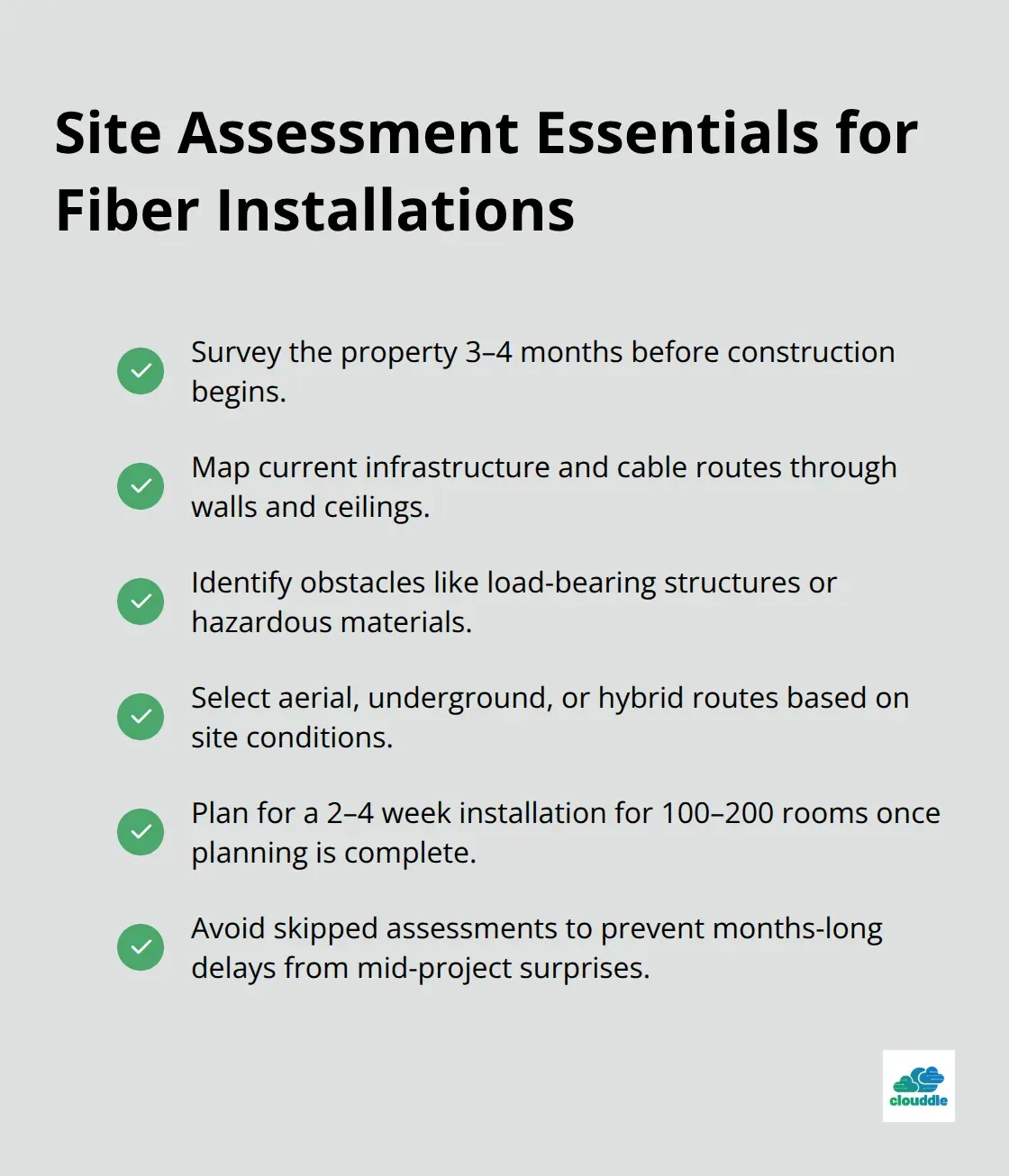
For a 100-200 room hotel, installation typically runs 2-4 weeks once planning is complete, but skipping the assessment phase stretches timelines to months as crews discover surprises mid-project.
Pre-terminated fiber eliminates fusion splicing requirements and expands your labor pool beyond specialized technicians. Standard installation crews execute plug-and-play connections, reducing both cost and schedule risk compared to hiring fusion-splice specialists who command premium rates and limited availability. The fiber backbone should run through dedicated pathways-conduit or tray systems-separate from electrical and HVAC runs to prevent future interference and simplify maintenance. Cat6a or Cat7 cabling extends from the fiber termination point to edge devices like access points and switches, providing 10 Gbps capacity with superior shielding against electromagnetic interference from kitchens and HVAC equipment common in hotel environments.
Phase Installation to Minimize Guest Disruption
Phasing installation by building or floor section rather than attempting property-wide deployment simultaneously protects guest experiences. Schedule construction during low-occupancy periods, typically January through March in most markets, and complete work floor-by-floor to isolate impacts to specific guest areas. Inform guests in advance through email and room notices about temporary WiFi interruptions, and offer compensatory perks like breakfast credits or late checkout to offset inconvenience and protect online reviews.
Structure Fiber as a Revenue-Generating Investment
The infrastructure cost for fiber-to-the-room deployment ranges from €15,000 to €40,000 for smaller properties up to €80,000-€120,000 for 300+ room hotels, but the investment recovers within 3-5 years through tiered internet revenue and energy savings. Hotels implementing tiered internet service models for hotels generate daily revenue per guest choosing premium access, directly offsetting capital expenses. Energy efficiency improvements from fiber-based networks deliver reductions in power consumption across properties, supporting sustainability certifications like Green Key that justify premium rates to environmentally conscious travelers.
Structure fiber as a hybrid investment where immediate revenue generation from premium tiers funds infrastructure costs while operational savings accumulate, creating positive cash flow within the first operational year. This approach transforms fiber from a capital expense into a strategic asset that pays for itself while improving guest satisfaction.
Prepare Your Network Architecture for Peak Performance
Once installation timelines and costs align with your budget, the next critical decision involves designing the network architecture that will handle peak occupancy without slowdowns. The backbone design determines whether your property can support the simultaneous connections and bandwidth demands that modern guests expect.
Keeping Fiber Networks Running at Peak Performance
Your fiber backbone is installed and guests experience speeds they’ve never encountered before. Now the real work starts: maintaining that performance consistency through peak seasons, identifying bottlenecks before they degrade guest experiences, and scaling capacity as demand grows. Hotels that neglect network monitoring discover problems only when guests complain in reviews, by which point damage to reputation has already occurred. Real-time visibility into network performance lets you address issues within hours rather than days, protecting occupancy rates and guest satisfaction scores.
Real-Time Monitoring Prevents Revenue Loss
Install network monitoring software immediately after fiber deployment goes live. Tools like Cisco Meraki or Aruba provide centralized dashboards showing bandwidth consumption, connected device counts, and access point performance across your entire property. These platforms alert you when individual APs drop below acceptable performance thresholds or when specific floor sections experience congestion, enabling proactive intervention before guests notice slowdowns. A 500-room resort handling 2,000–3,000 simultaneous connections during peak occupancy cannot operate without visibility; you need concrete data on network performance rather than hoping the system functions adequately.
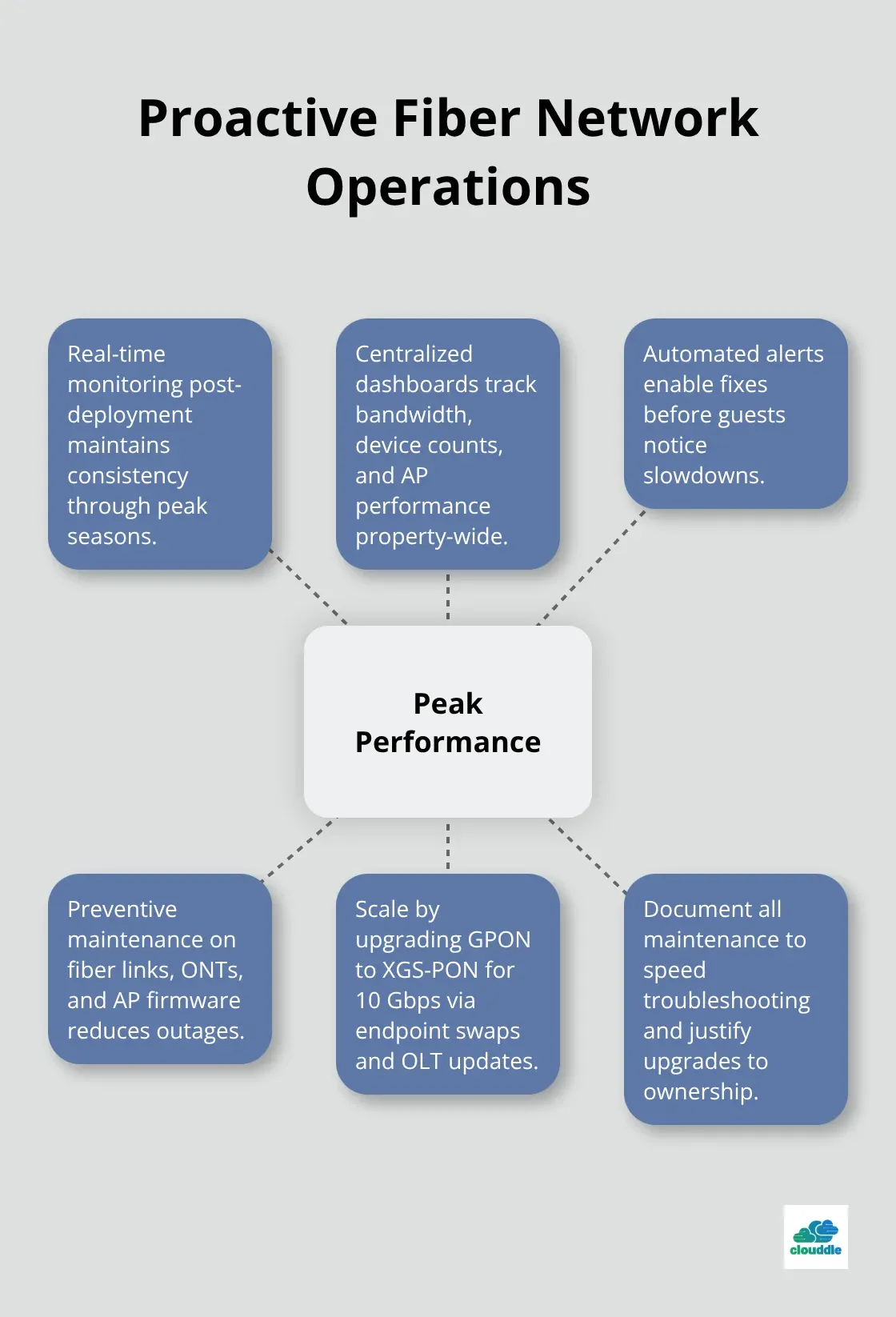
Hotels tracking these metrics identify that certain areas consistently experience higher demand during specific times (business centers during morning hours, pool areas during afternoons), allowing you to adjust channel allocation and transmit power dynamically to match real usage patterns. GPON systems supporting fiber backbone uptime 99.9% when properly monitored, but that remaining downtime translates to guest frustration that spreads across social media. Preventive maintenance schedules focused on fiber connections, ONT devices, and access point firmware updates eliminate most outages before they occur.
Fiber Infrastructure Requires Minimal Maintenance But Demands Discipline
Fiber cables carry no electrical current, eliminating short-circuit and fire risks that plague copper installations in dense electrical environments. This inherent safety advantage simplifies maintenance requirements significantly, but discipline remains essential. Quarterly inspections of fiber connections, ONT devices, and access points check for physical damage, verify firmware versions match your documented standards, and confirm that network redundancy remains properly configured between guest and administrative networks.
Dust accumulation on fiber connectors degrades signal quality, so cleaning ONT connection points annually prevents performance degradation that users attribute to your network rather than their devices. Access point batteries for backup power require semi-annual testing to function during power outages, protecting guest connectivity during emergencies. Document every maintenance activity in a centralized log that tracks which technician performed work, what was replaced, and performance metrics before and after each intervention. This documentation becomes invaluable when troubleshooting recurring issues or justifying upgrade investments to ownership.
Scaling Fiber Requires Strategic Planning, Not Emergency Retrofits
Your 200-room hotel operates at 85% occupancy consistently, and demand for premium WiFi service grows faster than expected. Fiber architecture enables straightforward scaling through endpoint device upgrades rather than infrastructure replacement. Upgrading from GPON delivering 2.5 Gbps to XGS-PON delivering 10 Gbps requires swapping ONT devices in guest rooms and updating the optical line terminal at your fiber termination point, typically a weekend project that avoids extended guest disruptions. This flexibility separates fiber from copper, where bandwidth expansion demands complete network replacement.
However, scaling requires advance planning. When occupancy trends show consistent 90%+ rates and monitoring data reveals growing demand during peak hours, initiate equipment procurement 6–8 months before you need capacity online. Lead times for ONT devices and optical equipment stretch 12–16 weeks during peak seasons, and waiting until performance degrades forces expensive expedited shipping or temporary service compromises. Engage your fiber service provider in quarterly business reviews examining occupancy trends, guest device counts, and bandwidth consumption patterns. These conversations surface scaling needs early, enabling cost-effective upgrades rather than emergency deployments.
Final Thoughts
Fiber optic cabling transforms hotel operations from reactive network management into a strategic competitive advantage that directly impacts occupancy and revenue. Properties that deploy fiber-to-the-room architecture eliminate bandwidth constraints that plague copper networks, improve guest satisfaction measurably, and recover installation costs of €15,000 to €120,000 within 3-5 years through tiered internet revenue and energy savings of 15-30%. Fiber infrastructure appreciates as guest expectations evolve toward cloud gaming and augmented reality applications that demand ultra-low latency and stable throughput, positioning your property ahead of competitors who delay investment.
Implementation requires discipline but delivers concrete results when you conduct thorough site assessments 3-4 months before construction, phase installation to minimize guest disruption, and structure fiber as a revenue-generating investment rather than a pure capital expense. Deploy monitoring software immediately after installation goes live, establish preventive maintenance schedules, and plan scaling upgrades 6-8 months in advance based on occupancy trends and bandwidth consumption data. Properties without fiber lose high-value guests to competitors offering superior connectivity, making this infrastructure decision non-negotiable for competitive properties in 2026.
Your next step is scheduling a site assessment with your fiber service provider and beginning the planning process that transforms your property’s connectivity landscape. Contact Clouddle to explore how fiber infrastructure supports your property’s long-term growth and positions you ahead of market trends. We help property management companies and real estate groups implement fiber solutions that enhance guest experiences while delivering substantial returns on investment.
For more information visit us at hppts://www.couddle.com or email at Solutions@clouddle.com


0 Comments