Property management companies face a constant pressure to do more with less. Your IT infrastructure needs to support growing tenant demands, regulatory requirements, and operational complexity-without draining your budget or requiring constant maintenance.
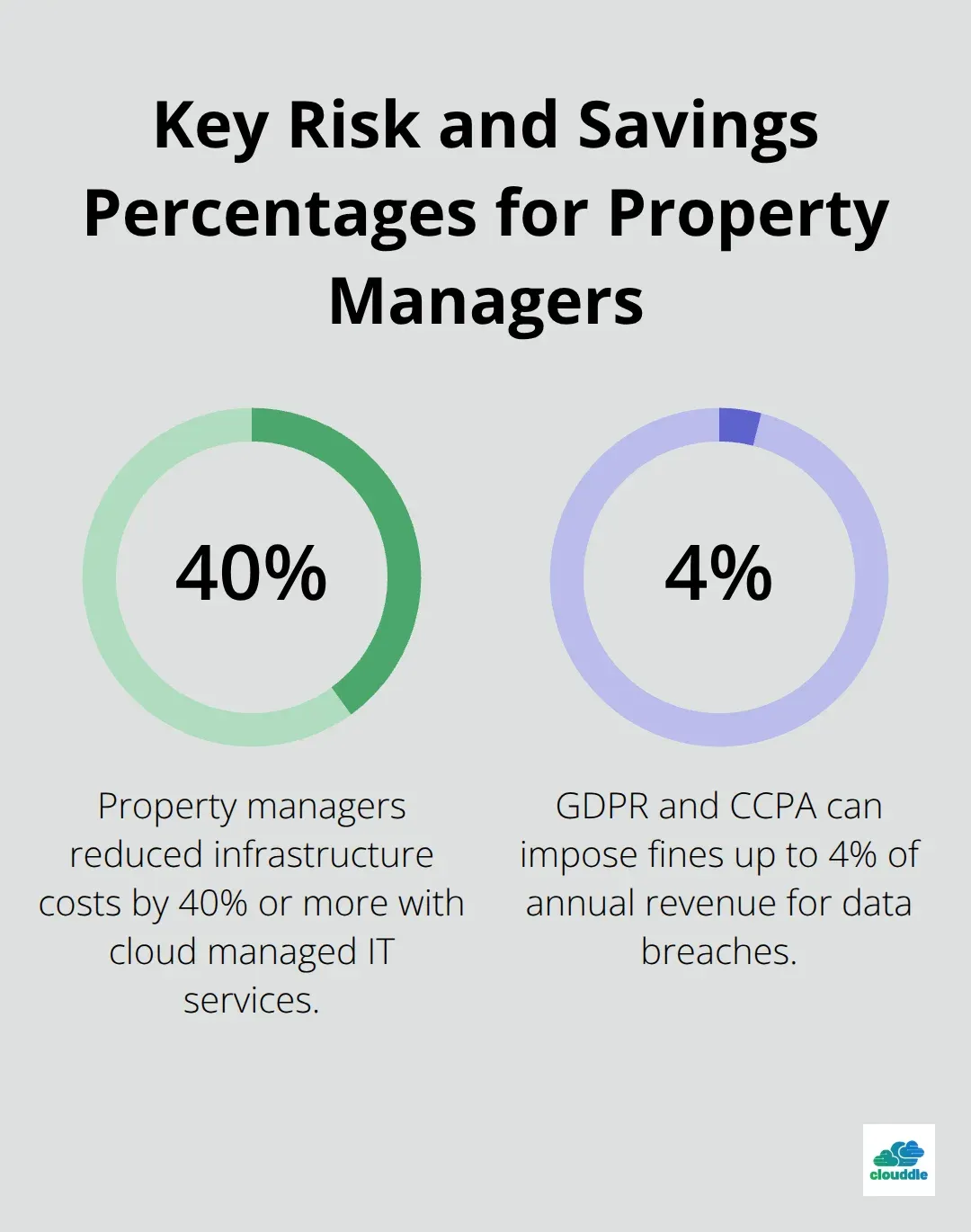
Cloud managed IT services eliminate the need for expensive on-site servers and dedicated IT staff. At Clouddle, we’ve seen property managers reduce their infrastructure costs by 40% or more while gaining the flexibility to scale operations instantly. This blog post shows you exactly how to evaluate cloud providers and avoid the mistakes that leave companies stuck with inflexible, expensive solutions.
Why Cloud Services Cut Real Costs for Property Managers
Property management companies face significant IT costs when running on-premises servers and maintaining dedicated IT staff. That figure covers hardware maintenance, software licenses, server replacements every 3-5 years, and salaries for in-house technicians. Cloud managed IT services shift this from capital expenditure to operational expenditure, meaning you pay only for what you use each month with no surprise hardware replacement costs. IDC research shows this subscription model improves cash flow predictability, letting you allocate budget to tenant experience and portfolio growth instead of server rooms. Property managers also eliminate the hidden costs of server downtime, which costs the real estate industry roughly $5,600 per minute in lost transactions and tenant communication delays.
Scaling Without Building New Infrastructure
Physical server limitations force property managers to plan for peak capacity months in advance, purchasing equipment that sits idle during slower periods. Cloud infrastructure scales on-demand, meaning your system handles 500 tenant portals during lease signing season and scales down when traffic normalizes, without requiring capital investment in additional hardware. Gartner research confirms that cloud managed IT services enable on-demand scaling of compute, storage, and network resources, reducing provisioning time from weeks to hours. A multi-location property manager adds new office locations or expands tenant communications without IT infrastructure becoming a bottleneck. AppFolio and QuickBooks integrations work seamlessly across unlimited users and locations, so your accounting team in one office and maintenance coordinators in another access the same data in real-time without network congestion that plagues on-premises systems.
Downtime Kills Rent Collection
When your property management software goes down, rent payments stop processing, maintenance requests disappear, and tenants cannot access lease documents or submit payments online. 24/7 managed IT support with automated monitoring detects issues before they cause outages, while multi-cloud backup strategies using AWS and Azure provide offsite redundancy that keeps operations running even if one data center fails. Disaster recovery with geo-redundant backups means your critical tenant and financial data restores within minutes, not days. A managed provider handles automated backups, security patches, and system updates outside business hours, so your team wakes up to fully operational infrastructure instead of emergency maintenance calls at 6 AM.
What Separates Strong Providers from Weak Ones
The difference between a managed IT provider that protects your operations and one that leaves you vulnerable comes down to three factors: proactive monitoring, integration capability, and response speed. Providers that monitor your systems 24/7 catch problems before they impact rent collection or tenant communications. Those that integrate seamlessly with your existing AppFolio, QuickBooks, and Microsoft 365 stack eliminate data silos and manual workarounds.
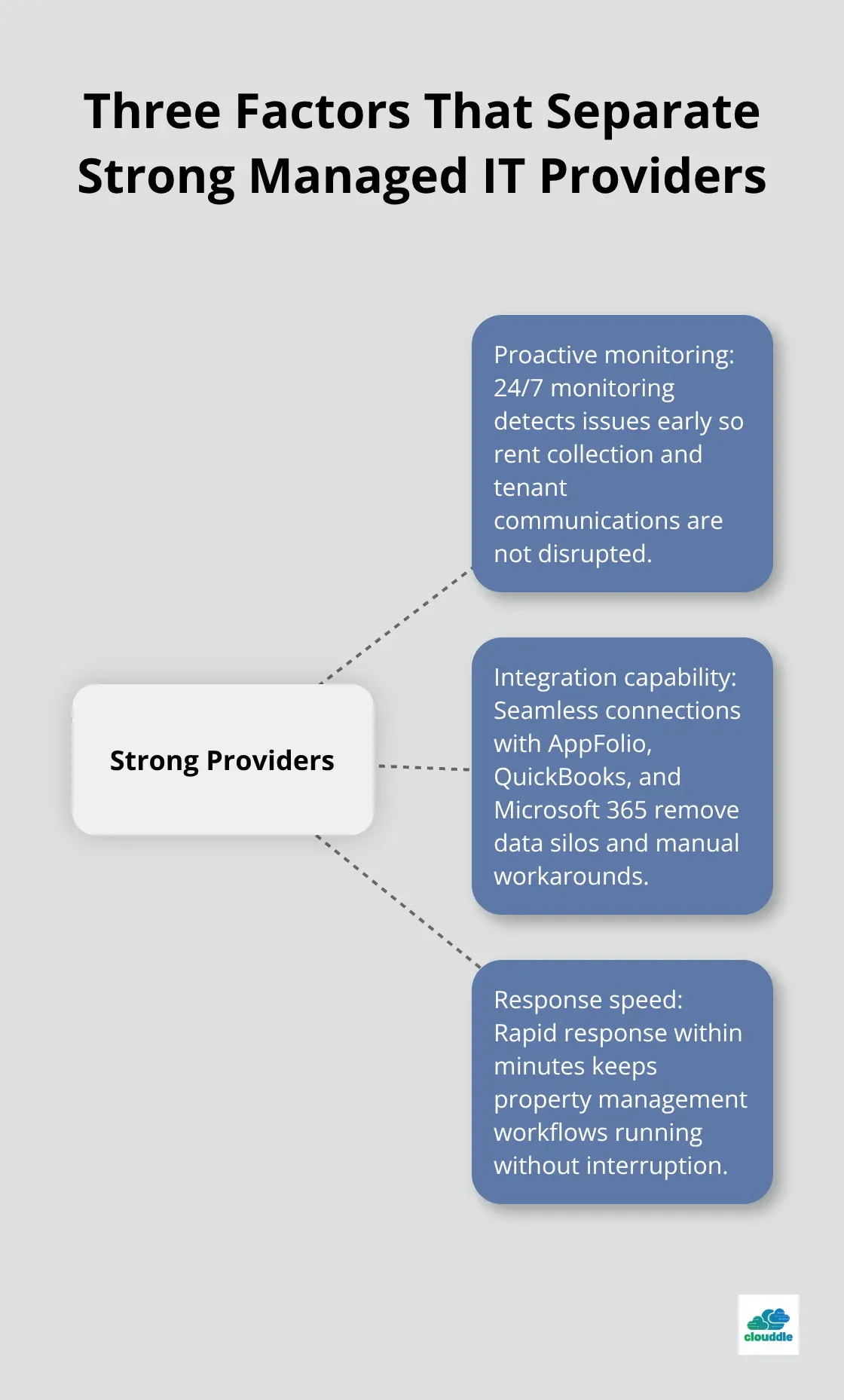
Those that respond to critical issues within minutes (not hours) keep your property management workflows running without interruption. A real estate firm operating across 40+ properties from New York to Miami Beach transitioned from legacy on-premises systems to a cloud-first model and achieved near-continuous uptime with downtime never exceeding one hour, compared to their previous pattern of infrastructure failures that disrupted rent collection and maintenance workflows. This level of reliability requires a provider that treats your operations as mission-critical, not just another account.
What Separates Providers That Actually Work
Automated Monitoring Stops Problems Before They Start
Automated monitoring catches problems before they impact your operations, not after your tenants call complaining about downtime. A managed IT provider deploys monitoring agents across your entire infrastructure-servers, networks, applications, endpoints-and flags anomalies 24 hours a day. When a backup fails, a security patch misses a critical server, or network latency spikes during peak rent collection hours, the monitoring system alerts your provider immediately. Your team doesn’t waste time troubleshooting; the provider’s technicians already have context on what failed and why.
Proactive maintenance means your systems run scheduled updates during off-peak hours, not emergency patches that disrupt tenant communications at 2 PM on a weekday. A real estate operation processing thousands of rent payments monthly cannot afford reactive IT management where problems surface only after revenue stops flowing. Gartner research confirms that unified observability across cloud environments enables proactive issue detection and faster remediation, directly protecting your cash flow.
Integration Capability Eliminates Data Silos
Integration capability separates providers that simplify your operations from those that create manual workarounds and disconnected systems. Your AppFolio platform manages leases and tenant data, QuickBooks handles accounting and reconciliation, Microsoft 365 enables team collaboration, and your tenant portal requires secure connectivity across multiple office locations. A managed IT provider that understands property management workflows ensures these systems communicate seamlessly without requiring your staff to manually export data from one platform, clean it up, and import it into another.
Real-time synchronization between your property management software and accounting platform means your finance team sees accurate rent collection data instantly instead of waiting for batch processes that run overnight. When your provider integrates cloud managed IT services and Microsoft 365 properly, your team accesses lease documents, maintenance requests, and financial reports from anywhere with an internet connection-critical for property managers handling emergencies after hours or managing multiple locations across different time zones. Poor integration forces your staff to spend hours on data entry instead of tenant communication and portfolio growth.
Response Speed Determines Whether You Lose Revenue
Response speed matters most during critical failures. A provider that responds to urgent issues within 15 minutes keeps your rent collection systems running; one that responds in 2 hours means tenants cannot submit payments and maintenance coordinators lose access to work orders. Look for providers offering defined response times tied to severity levels, with financial penalties if they miss those commitments (this accountability ensures your provider prioritizes your emergencies over routine maintenance for other clients).
The difference between a provider that protects your operations and one that leaves you exposed comes down to these three factors working together. Monitoring catches problems early, integration keeps your systems connected, and fast response times prevent revenue loss when issues do occur. Your next step involves evaluating which managed IT solutions actually deliver on these promises rather than simply claiming to offer them.
Avoiding the Cloud Provider Traps That Cost Property Managers Thousands
Selecting a cloud provider feels straightforward until your infrastructure depends on a single vendor’s pricing, security standards, and service roadmap. Property managers who rush into cloud contracts without understanding exit costs, compliance requirements, or performance guarantees often find themselves paying premium rates to escape bad partnerships. The real cost of a poor provider choice extends beyond monthly fees-it includes migration expenses, business disruption, and months of rebuilding trust with tenants after service failures. NIST guidelines emphasize that a clear shared responsibility model reduces governance overhead by delineating security and compliance duties between provider and customer, yet many property managers sign contracts without understanding who owns responsibility when a security breach occurs or a compliance audit reveals gaps.
Vendor Lock-In Costs More Than You Think
Switching cloud providers requires weeks of planning, data migration windows, testing, and staff retraining on new systems. A property manager with 500 units across five locations pays $8,000 to $15,000 per location for migration services, plus lost productivity when your team learns new interfaces and troubleshoots compatibility issues with your property management software. Some providers deliberately design contracts with automatic renewal clauses that lock you in for another year unless you cancel 60 days before expiration-a deadline many property managers miss because IT contract management gets buried under operational priorities.
Ask your provider for a clear exit clause that allows you to migrate your data within 30 days of contract termination at no additional charge. Verify they provide your data in standard formats (not proprietary databases that require expensive conversion). Multi-cloud strategies reduce vendor lock-in by allowing workload placement based on cost, performance, and security requirements, meaning providers competing for your business deliver better pricing and service when they know you can leave.
Security and Compliance Standards Vary Wildly Between Providers
Your property management systems store tenant personal information, financial records, and lease documents-data covered by GDPR and CCPA regulations that impose fines up to 4% of annual revenue for breaches. A provider claiming GDPR compliance without demonstrating how they enforce data residency, encryption standards, and access controls leaves you exposed to regulatory penalties. ISO/IEC 27001 certification indicates a provider follows standardized information security practices, but you need to verify they actually implement those controls in the specific regions where your tenant data lives.
Many providers offer encryption at rest but fail to encrypt data in transit between their data centers, creating security gaps that penetration testing would reveal. Request your provider’s security audit report (SOC 2 Type II certification), confirm they use end-to-end encryption for all data flows, and verify they maintain automated backup redundancy across geographically separated data centers so a regional outage does not destroy your tenant records. During peak rent collection periods when thousands of transactions flow through your systems simultaneously, inadequate security infrastructure sometimes triggers false-positive alerts that lock your account for hours while compliance checks run, preventing tenants from submitting payments.
Peak Demand Performance Failures Destroy Revenue
Property management creates predictable traffic spikes-lease signing season generates 300% higher login volume, rent collection days see thousands of simultaneous payment submissions, and maintenance request systems must handle urgent repairs during weather events. A provider offering standard cloud infrastructure without reserved capacity sometimes throttles your application during peak demand, causing tenant payment portals to timeout and maintenance coordinators to lose access to work orders.
Ask your provider whether they guarantee performance during your peak demand windows and what happens if response times degrade below acceptable thresholds. Some providers offer financial credits if they miss uptime commitments, while others provide vague promises with no accountability. Test your provider’s infrastructure during a realistic peak scenario before migration; a provider that claims 99.9% uptime but has never tested your specific workload under your actual demand profile will disappoint you during lease signing season when you cannot afford downtime. Multi-cloud backup strategies using AWS and Azure provide resilience against single-provider failures, meaning your rent collection systems continue operating even if your primary provider experiences a regional outage.
Final Thoughts
Cloud managed IT services transform property operations by eliminating the infrastructure burden that distracts you from tenant experience and portfolio growth. You stop spending budget on server replacements, emergency repairs, or IT staff salaries, and instead pay predictable monthly fees for systems that scale with your business, integrate seamlessly with AppFolio and QuickBooks, and stay operational 24/7 with automated monitoring and rapid response. The real estate firms that thrive in competitive markets treat IT as a strategic advantage rather than a cost center.
Before you commit to any provider, ask three critical questions. First, what happens if you need to leave-request a clear exit clause allowing 30-day data migration at no charge and verify they provide your data in standard formats.
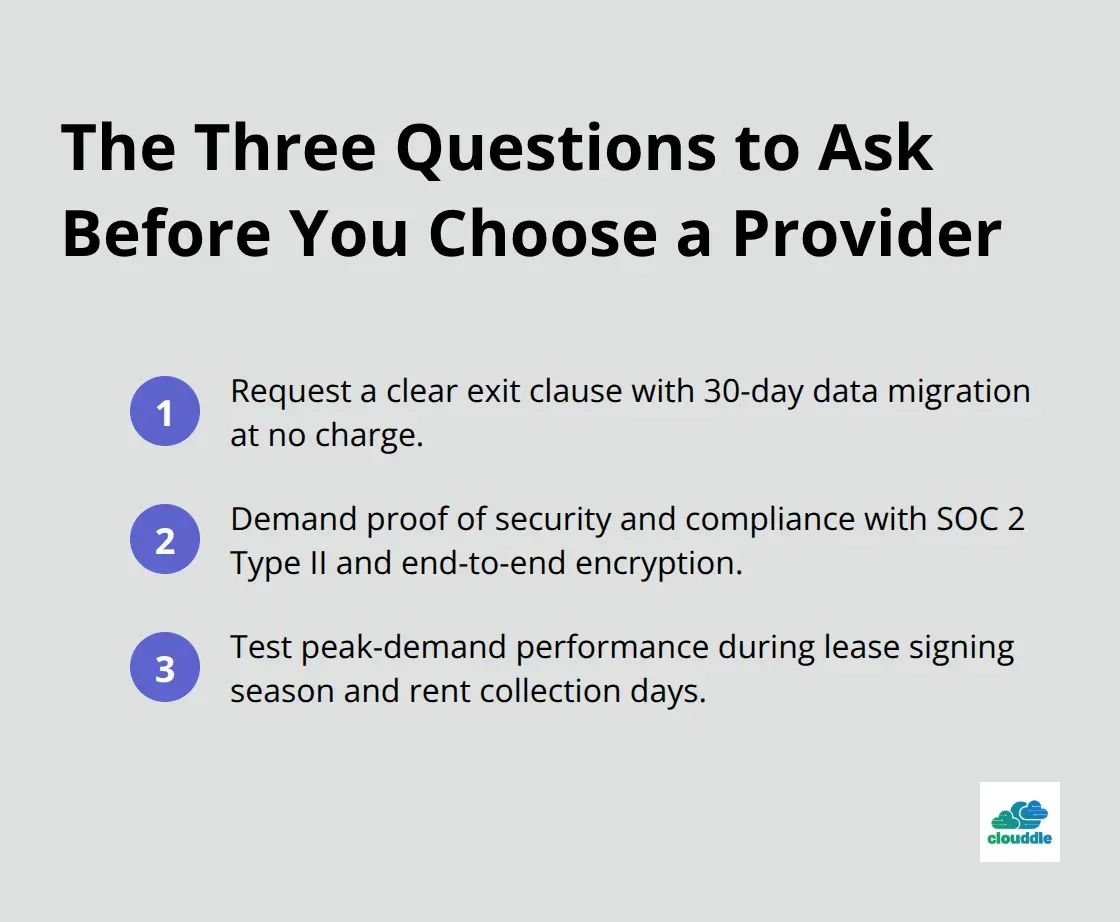
Second, how do they prove security and compliance-demand SOC 2 Type II certification, confirmation of end-to-end encryption, and documentation of GDPR and CCPA compliance controls specific to your data locations. Third, can they handle your peak demand-test their infrastructure during lease signing season or rent collection day to confirm response times remain acceptable when thousands of tenants access your systems simultaneously.
Your implementation timeline starts with a technology assessment that identifies which systems migrate first and which stay on-premises during transition. Plan for 60 to 90 days of parallel operation where your old and new systems run together, allowing your team to validate data accuracy before fully switching over, and assign one person to own the migration timeline and vendor communication so IT decisions don’t get lost in daily operational chaos. Clouddle specializes in seamless connectivity and smart home solutions for student housing, multi-family units, and build-to-rent properties, enhancing tenant experience while delivering returns for property owners.
For more information visit us at hppts://www.couddle.com or email at Solutions@clouddle.com



0 Comments