
Student housing WiFi has become as essential as utilities like water and electricity. Properties that fail to deliver reliable connectivity lose residents to competitors who do.
At Clouddle, we've seen firsthand how network quality directly impacts occupancy rates and student satisfaction. The properties winning the leasing game aren't just offering beds-they're offering the connectivity students demand.
Why Connectivity Shapes Student Housing Success
Poor WiFi Drives Residents Away
Poor WiFi is now the number one reason students leave properties. College students average $260–$410 per month in disposable income, yet many properties squander this potential by failing to meet the connectivity expectations students consider non-negotiable. When students move into off-campus housing, reliable internet ranks alongside having a bed and furniture. Properties that underestimate this reality watch residents break leases early or choose competitors before move-in day even arrives.
The student rental cycle is annual and unforgiving-with turnover concentrated around semesters, a reputation for poor connectivity spreads faster than the network itself. Word-of-mouth referrals represent one of the most cost-effective leasing tools in student housing, but they cut both ways. One student's complaint about buffering during online exams or gaming lag reaches dozens of potential residents through social media and group chats.
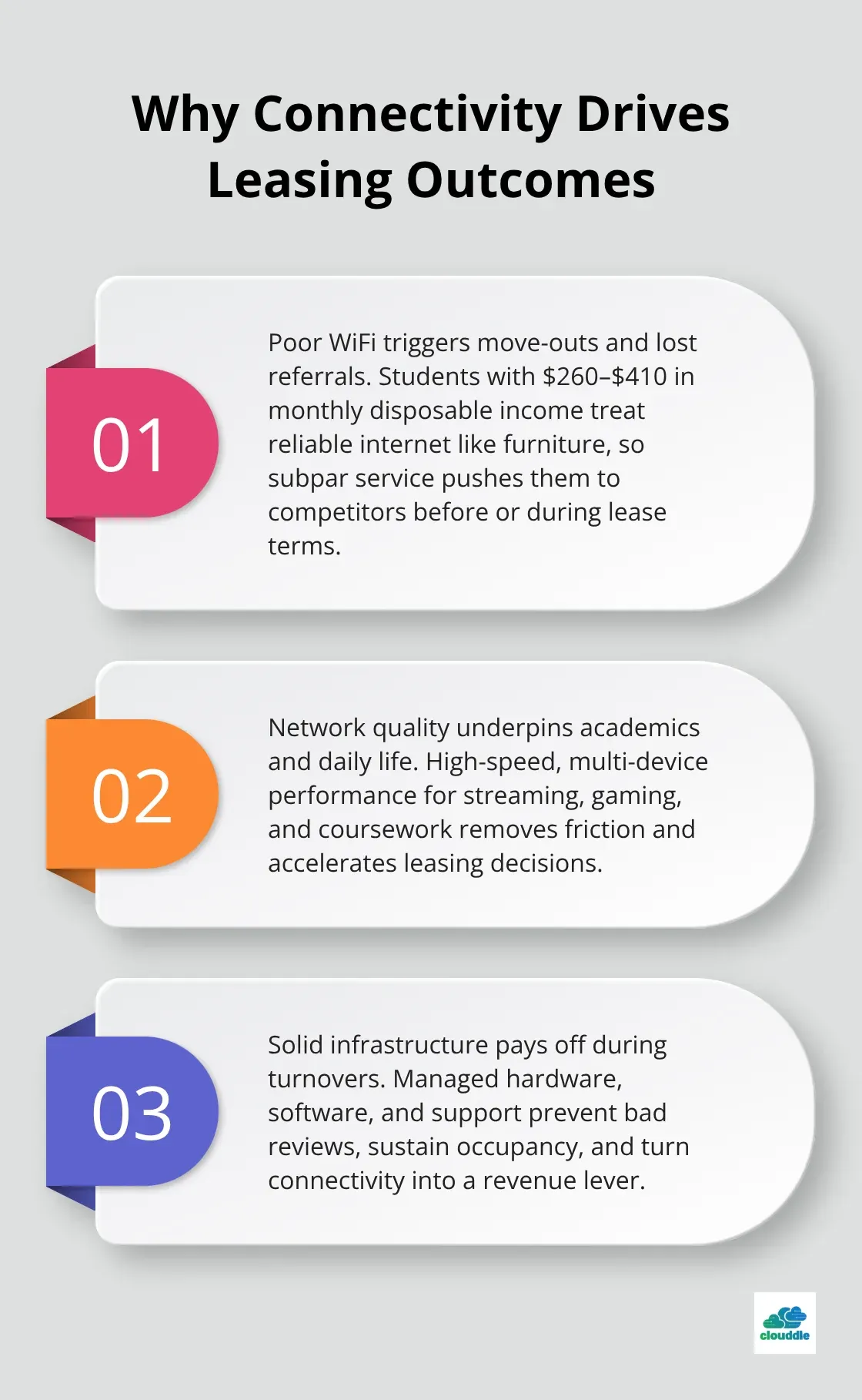
Property managers who ignore this lose not just individual residents but entire cohorts of friends who would have rented together.
Network Quality Determines Academic Success
Students now demand high-speed, reliable, multi-device WiFi to support streaming, gaming, and online coursework. This is not a nice-to-have amenity-it's the foundation of their daily life. Properties that invest in enterprise-grade networks across all buildings see faster leasing cycles and higher occupancy rates because they eliminate a critical friction point in the decision-making process.
Renting by bedroom rather than by unit creates higher revenue per property, but it also multiplies connectivity demands exponentially. A four-bedroom unit with eight students and fifteen connected devices requires fundamentally different network infrastructure than a traditional single-tenant lease. 24/7 managed internet installation, monitoring, and resident support reduce complaints and free leasing staff to focus on closing deals rather than troubleshooting connectivity issues.
Infrastructure Investments Pay Off During High Turnover
Properties with durable finishes and robust infrastructure perform better during high-turnover periods, and the same logic applies to network design. A managed approach that includes hardware, software, network management, and dedicated support prevents the common scenario where residents blame poor internet for poor grades, leading to negative reviews and reduced willingness to renew. Properties positioned well in local markets with reliable connectivity maintain occupancy rates that competitors struggle to match, which makes network quality a direct lever for revenue growth and resident retention.
Building Networks That Handle Real Student Housing Density
Enterprise-Grade Infrastructure for High-Density Living
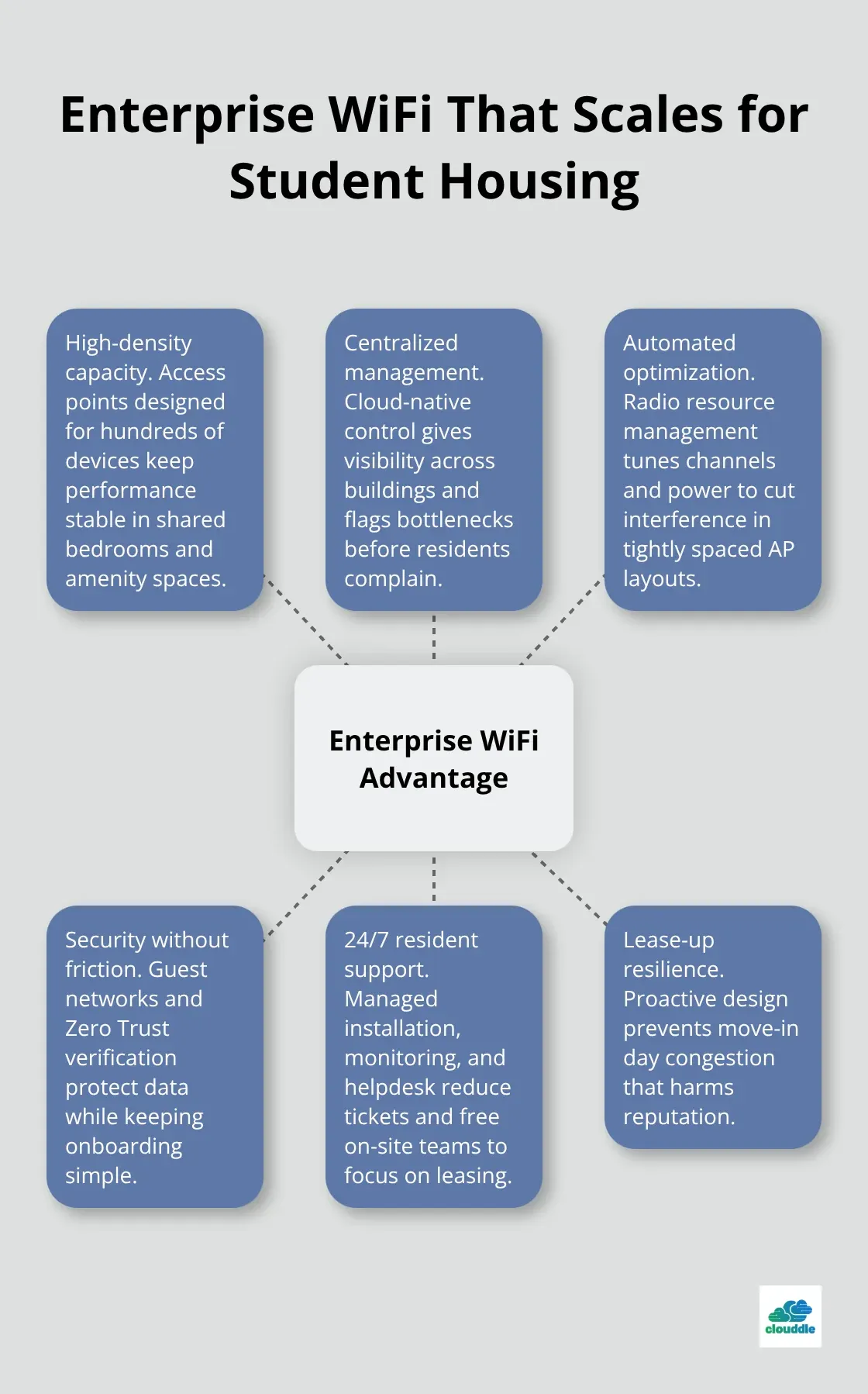
Enterprise-grade WiFi infrastructure for student housing demands fundamentally different specifications than residential broadband or traditional multifamily networks. A four-bedroom unit with eight residents running simultaneous video calls, gaming, streaming, and online coursework generates exponentially more traffic than a single-tenant apartment. Properties across major markets like Rambler Columbus (407,465 square feet) and projects like Subtext's VERVE Charlottesville (1,332 beds) and Texas A&M College Station (1,738 beds) require access points designed to handle hundreds of connected devices without degradation.
Real-Time Visibility Across Multiple Buildings
Cloud-native WiFi architecture with centralized management provides real-time visibility into network performance across multiple buildings, allowing property managers to identify bottlenecks before residents complain. Advanced radio resource management tools automatically optimize channel selection and power levels, reducing interference in dense environments where access points sit closely together. This proactive approach prevents the common scenario where move-in day network congestion crashes the network for everyone, forcing emergency troubleshooting that damages your leasing reputation.
Security and Guest Access Without Friction
Guest network capabilities separate student devices from visitor traffic, maintaining security and performance for residents while allowing friends and family to connect without compromising data protection. Zero Trust security frameworks continuously verify every device attempting to connect, protecting sensitive student information without creating friction during the onboarding process. Managed WiFi solutions that include hardware, software, network monitoring, and dedicated resident support eliminate the false economy of cheap internet that generates constant complaints.
Proven Results From Industry Leaders
University Partners emphasized that high-quality WiFi throughout the property is essential to meet growing bandwidth demands, and Subtext's turn management team coordinates WiFi installation as part of their move-in success strategy. Properties that deploy these systems before peak leasing season close faster and maintain higher occupancy because connectivity becomes a genuine competitive advantage rather than a source of frustration. The infrastructure investment pays for itself through reduced turnover, faster lease-up cycles, and the ability to command premium rents in competitive markets where students expect enterprise-grade connectivity as standard.
These network capabilities form the foundation for maximizing revenue, which depends on converting connectivity from a cost center into a strategic asset that attracts residents and justifies premium pricing.
How Enterprise WiFi Converts Skeptical Prospects Into Paying Residents
Connectivity determines lease-up speed. When property managers at Subtext coordinated WiFi installation as part of their move-in strategy, they reported their most successful leasing season to date. Students comparing two properties with similar amenities, location, and price select the one with demonstrably better internet every time. This isn't speculation-it's how the student rental market actually works. Properties that prominently feature enterprise-grade WiFi in their marketing materials and highlight uptime guarantees compress lease-up cycles by weeks, directly translating to higher occupancy rates and faster revenue recognition. The competitive advantage isn't subtle; it's the difference between filling a building in six weeks versus three months, which compounds across multiple lease cycles throughout the year.
Resident Retention Drives Financial Returns
The financial case strengthens when you factor in resident turnover costs. Off-campus student housing experiences annual turnover concentrated around semesters, and replacing a resident costs far more than retaining one. Each vacancy requires marketing spend, showing time, screening, application processing, and unit turnovers with cleaning and repairs. Properties that deliver reliable connectivity across all buildings see residents renew leases at significantly higher rates because internet quality directly influences satisfaction scores that predict renewal decisions. University Partners' emphasis on high-quality WiFi throughout properties reflects this reality-they understand that poor connectivity ranks among the few operational failures that students cite when justifying early lease termination. Conversely, properties that invest in managed WiFi solutions eliminate a major source of frustration before it damages renewal rates. A single resident retained through superior connectivity pays for months of network management costs. When you multiply this across dozens of residents choosing renewal over departure, the ROI becomes undeniable.
Managed Services Eliminate Hidden Operational Drains
Most property managers underestimate the operational cost of managing internet in-house or through cheap, unsupported bulk internet providers. When residents report connectivity issues, leasing staff spend hours troubleshooting rather than closing deals. Maintenance teams get pulled into network problems that require specialized expertise they don't possess. This operational drag compounds during move-in season when bandwidth demands spike and network problems become unavoidable without proper capacity planning.
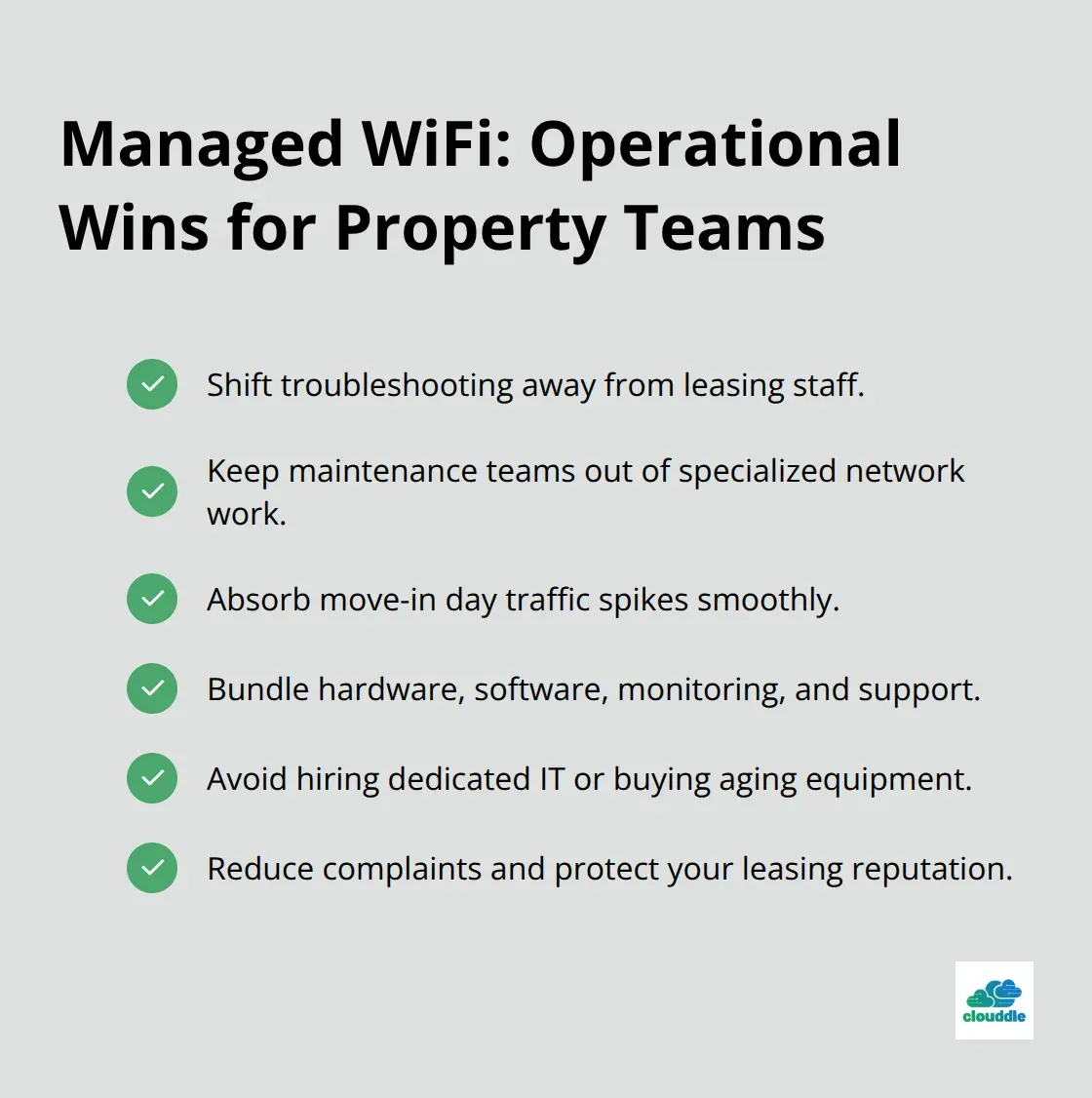
Managed WiFi solutions that bundle hardware, software, network monitoring, and dedicated support transfer responsibility to providers with the expertise and infrastructure to handle student housing scale. Properties across major markets like Rambler Columbus and Subtext's VERVE Charlottesville avoid hiring specialized IT staff or maintaining expensive on-site equipment that becomes obsolete within years through this model.
Premium Positioning Commands Higher Rents
Properties that position WiFi quality as a premium amenity command higher rents per bedroom, particularly in competitive markets where students have choices. Renting by bedroom rather than by unit already generates higher revenue per property than traditional leasing, but enterprise-grade connectivity amplifies this advantage. Students willing to pay premium rates for quality housing also expect premium internet as standard. Properties that clearly communicate network specifications, uptime guarantees, and support responsiveness attract residents who value reliability and are less price-sensitive. This resident profile also exhibits lower turnover and fewer complaints, reducing operational friction while improving net operating income. The pricing power compounds when you consider that student housing outperforms conventional multifamily in rent growth and occupancy according to recent market analysis, and properties with demonstrable connectivity advantages capture disproportionate share of that growth.
Final Thoughts
Student housing WiFi has moved from a nice-to-have amenity to a core operational requirement that directly impacts your bottom line. Properties that treat connectivity as a strategic asset rather than a cost center see measurable improvements in lease-up speed, resident retention, and revenue per unit. A single resident retained through superior connectivity pays for months of managed services, and when you multiply this across dozens of residents renewing leases instead of departing, the ROI becomes undeniable.
Implementation costs concern many property managers, but the math favors action. Properties across major markets have already made this shift, and competitive pressure means waiting only increases the risk that your properties fall behind in a market where students actively choose based on network quality. Student housing WiFi solutions that bundle hardware, software, network monitoring, and dedicated support eliminate the operational drain of troubleshooting while freeing your team to focus on leasing and resident experience.
We at Clouddle understand the specific demands of student housing operations. Our Network as a Service approach combines managed IT, networking, WiFi, and security without requiring upfront capital investment. Explore how Clouddle transforms student housing connectivity and unlocks the revenue potential that reliable infrastructure delivers.
For more information visit us at hppts://www.couddle.com or email at Solutions@clouddle.com

0 Comments