
High-speed internet is no longer just another utility you can tack onto a lease. For residents in apartments, student housing, or build-to-rent communities, it’s as fundamental as running water. They don't just want it; they expect it to work flawlessly, everywhere. This is where Managed Wi-Fi providers come in, offering a professional, property-wide network that completely replaces the old, chaotic model of letting every tenant fend for themselves.
Why Property Wide WiFi Is Your Most Critical Amenity
For decades, the internet strategy at most multi-family properties was simple: do nothing. Each resident was responsible for calling a provider, getting a router, and setting it up. This hands-off approach created a nightmare of competing signals, spotty coverage, and a constant barrage of tech support calls to a front office staff who had no way to help. That model is officially broken.
Today’s residents depend on a rock-solid connection for everything—remote work, online classes, streaming, and gaming. When the internet sputters, so does their patience. The impact on your business is real. A recent study revealed that over 90% of residents now consider high-speed internet their single most important amenity, ranking it far above pools or fitness centers. Poor connectivity leads directly to bad reviews, frustrated residents, and ultimately, higher turnover.
The Problem with Traditional Internet in MDUs
Think about what happens when hundreds of individual Wi-Fi routers are all crammed into one building. The traditional approach was destined to fail in dense residential settings like multi-dwelling units (MDUs), student housing, and build-to-rent (BTR) communities for a few key reasons:
- Signal Congestion: Dozens, or even hundreds, of separate networks all screaming over each other creates a wall of wireless interference. The result is sluggish performance and dropped connections for everyone, no matter how "fast" their individual plan is.
- Inconsistent Coverage: The cheap router a resident gets from their internet provider is designed for a small, single-family home. It was never meant to push a strong signal through concrete walls, leaving dead zones in bedrooms and home offices.
- Support Burden: When a resident's Netflix starts buffering, their first call isn't to their provider—it's to your leasing office. This pulls your team away from their real jobs to troubleshoot tech problems they aren't trained for and can't solve.
A truly effective solution has to be managed from the top down. Partnering with a specialized managed Wi-Fi provider isn't just a fix; it's a strategic move to turn one of your biggest headaches into a premium, revenue-generating amenity.
Moving to a centralized, professionally managed network is about more than just delivering better internet. It's about future-proofing your property. A strong, property-wide network becomes the backbone for all your other smart building technology, from keyless entry and security cameras to smart thermostats and leak sensors.
By taking control of your property's digital infrastructure, you're not just checking a box—you're boosting your property’s value, making your operations more efficient, and delivering the modern living experience residents demand. You can learn more about this approach in our complete guide to property-wide WiFi.
When your residents start calling about slow internet, the last thing your property team wants to do is play tech support. Yet, that's exactly what happens in the traditional model where every resident is left to fend for themselves with individual internet service providers (ISPs). This inevitably creates a frustrating cycle for tenants and a huge time-sink for your staff.
This is the exact problem that managed WiFi was designed to solve for MDU, student housing, and BTR communities.
So, what does “managed WiFi” actually mean for a multi-family, student housing, or build-to-rent property? It’s not just about flipping a switch for internet access. A much better way to think about it is as a complete, hands-off utility service for connectivity—just like how you already manage water or electricity.
A true managed WiFi solution means a single expert partner takes complete ownership of your property’s network from top to bottom. This isn't just a loose agreement; it's a comprehensive service that covers:
- Custom Network Design: Engineering a robust system specifically for your building's unique layout to guarantee 100% coverage and eliminate dead zones.
- Professional Installation: Handling the deployment of all necessary hardware, from access points in every unit to the core switches and routers in your network closet.
- 24/7 Monitoring and Maintenance: Proactively keeping an eye on network health to identify and fix issues, often before residents even notice something is wrong.
- Dedicated Resident and Staff Support: Providing a direct support line for everyone, completely removing your team from the troubleshooting process.
The common cycle of resident frustration is something every property manager knows well. This diagram shows exactly what a managed service is built to prevent.
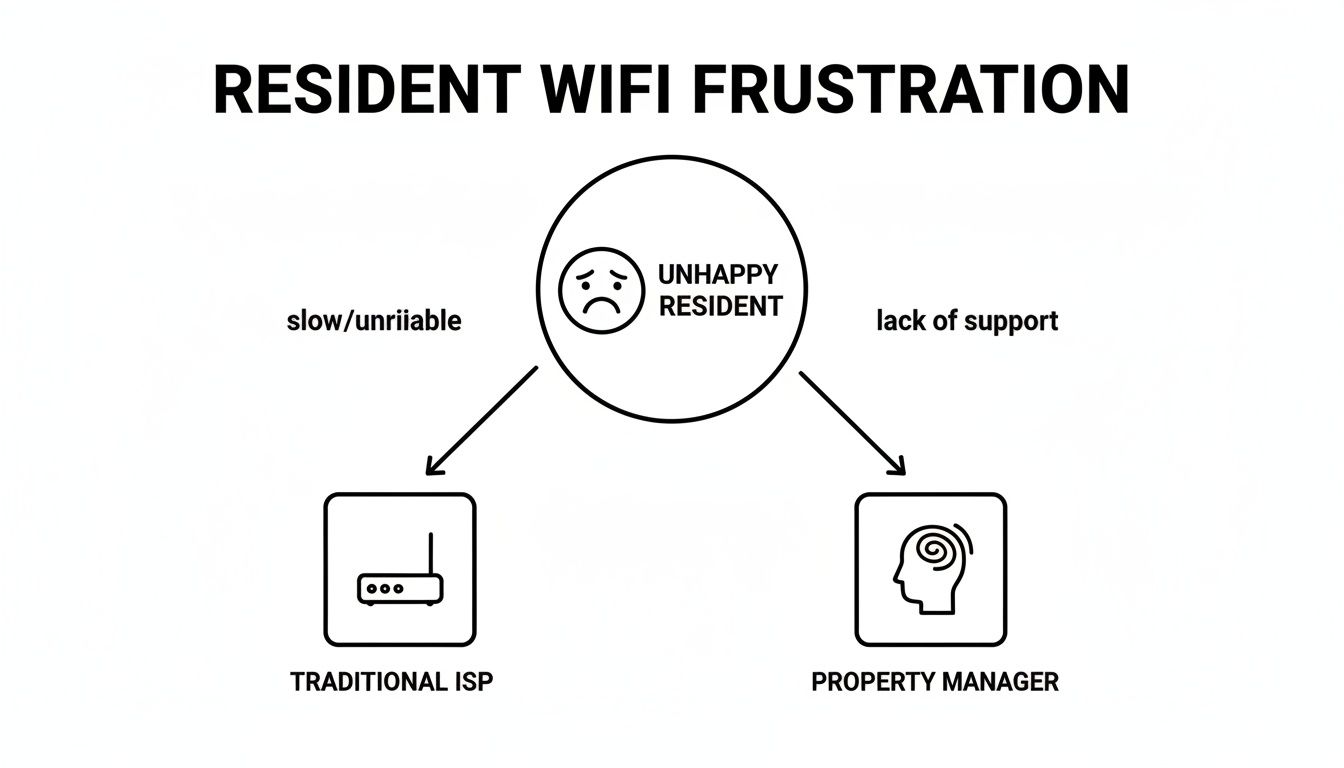
As you can see, residents get stuck in the middle. The ISP blames the building's wiring, and the property manager can only shrug and point back to the ISP. A managed approach puts one expert in charge, providing a single point of contact and total accountability for a great connection.
Introducing Network as a Service (NaaS)
To deliver this kind of all-in-one service, the best providers use a model called Network-as-a-Service (NaaS). This is the modern financial and operational framework that makes enterprise-grade network technology accessible and affordable for properties of any size.
In the past, deploying a property-wide network meant a massive upfront investment in hardware. This is known as a Capital Expense (CAPEX). You'd have to buy all the routers, switches, and access points yourself, which could easily run into tens or hundreds of thousands of dollars—not to mention the ongoing headache of maintaining and eventually replacing it all.
The NaaS model flips this script entirely. It transforms the entire cost of the network from a one-time CAPEX hit into a predictable, recurring Operational Expense (OPEX). It’s a subscription for your network.
This is a game-changer for property owners. Instead of a huge capital outlay, you simply pay a predictable monthly or annual fee. That subscription covers everything: the initial design, all the hardware, professional installation, ongoing software updates, 24/7 support, and even hardware upgrades down the line.
The market is responding in a big way. Valued at USD 11.6 billion in 2024, the managed Wi-Fi solutions market is projected to more than double to USD 25.8 billion by 2030. You can find a full analysis of this fast-growing market on ResearchAndMarkets.com. This explosive growth shows just how essential these services have become for residential communities.
Managed WiFi vs Traditional Internet for Properties
To put it all in perspective, here’s a clear breakdown of how a modern managed service compares to the old way of doing things in an MDU or student housing environment.
| Feature | Managed WiFi (NaaS) | Traditional ISP Plan |
|---|---|---|
| Cost Structure | Predictable OPEX (monthly fee) | Residents pay individual bills; potential CAPEX for owner for common areas |
| Hardware | Included and managed by provider with regular refreshes | Residents must purchase/rent their own routers; owner buys common area gear |
| Installation | Professional, property-wide installation by certified experts | Varies; self-install or technician visit for each resident |
| Support | 24/7 dedicated support for residents and staff | Residents must contact their ISP; staff has no support channel |
| Coverage | Guaranteed 100% coverage across the entire property | Inconsistent; depends on resident's router placement and quality |
| Performance | Proactively monitored and optimized by the provider | No performance guarantees; "best effort" service |
| Security | Centralized, enterprise-grade security for the entire network | Varies by resident; no property-wide protection |
The difference is clear. One model is a fragmented, reactive system that creates headaches, while the other is a proactive, professionally managed utility that adds real value to your property.
Why NaaS Is the Smarter Choice for Your Community
The NaaS model does more than just simplify your budget; it de-risks a major technology investment and aligns your provider's goals with your own. Since their recurring revenue depends on the network performing perfectly, they are highly motivated to ensure it’s always stable, fast, and secure.
By partnering with a NaaS provider, you can:
- Eliminate Huge Upfront Costs: Deploy a state-of-the-art network with little to no down payment.
- Achieve Total Budget Predictability: Lock in a flat-rate operational expense that’s easy to forecast and manage.
- Future-Proof Your Property: Ensure your building always has current technology without facing surprise capital requests for upgrades.
- Focus on Your Core Business: Free up your staff’s time and your property's capital to focus on what you do best—creating great resident experiences.
What Separates a Top-Tier Managed WiFi Provider from the Rest?
Not all managed WiFi services are created equal. While plenty of companies throw the term around, a true partnership does more than just give you internet—it turns your property's connectivity from a constant headache into a powerful asset. For anyone managing multi-family, student housing, or build-to-rent communities, certain features are non-negotiable.
Choosing the right provider means looking past the initial price tag to see how their service actually works. A top-tier partner doesn’t just bolt some hardware to the walls and vanish. They become an extension of your team, dedicated to making sure every resident, in every unit, has a flawless online experience.

Proactive Network Monitoring and Management
Here’s the biggest difference between a basic and a premium managed WiFi provider: one waits for problems, the other prevents them. A reactive provider relies on residents to complain, turning your staff into a frustrated IT help desk. A proactive partner, on the other hand, uses sophisticated tools to watch the network 24/7, finding and fixing issues before anyone even notices.
The key to this is a technology called Remote Monitoring and Management. The right RMM software gives providers a real-time dashboard showing the health of every access point, switch, and router on your property. This lets them spot a failing device or a congested signal and fix it remotely, often before a resident’s video call has a chance to drop.
This "always-on" approach is what separates a good network from a great one. It keeps things running at peak performance, which means happier residents and a much lighter support load for your on-site team.
Comprehensive Cybersecurity for a Multi-Tenant Environment
When you have hundreds of people sharing the same network, security isn't just a feature—it's a necessity. Protecting personal data is job number one. A top-tier provider brings enterprise-grade security tools that are built specifically for the unique challenges of a multi-tenant property.
The most important piece of this puzzle is network segmentation. This is typically done using something called a VLAN (Virtual Local Area Network), which essentially creates a private, secure network for each apartment.
Think of it like a digital wall between apartments. Even though everyone is connected to the same core system, network segmentation ensures that a resident in Unit 101 cannot see or access the devices of their neighbor in Unit 102. This prevents snooping and keeps personal information safe.
But segmentation is just the start. A solid security offering should also include:
- Firewall Management: To shield the entire network from outside attacks.
- Content Filtering: The ability to block malicious sites or inappropriate content—a must-have for student and family housing.
- Secure Onboarding: A process ensuring every new resident connects to their own private network through a secure portal, not some shared, easily compromised password.
Guaranteed Uptime with an Ironclad Service Level Agreement
A vague promise of "fast WiFi" is completely meaningless without a guarantee to back it up. A reputable provider will put their money where their mouth is with a formal Service Level Agreement (SLA). This is a contract that spells out exactly what level of service you can expect, including hard numbers for network uptime, support response times, and how quickly issues will be fixed.
The SLA is your quality assurance. It should clearly promise a specific uptime percentage—look for 99.9% or higher. If the provider doesn't hit that mark, the SLA will detail the credits or other remedies you're owed. It’s what holds your provider accountable and ensures you're buying reliability, not just hope.
The market for these kinds of professional services is growing at an incredible 20.4% CAGR. This boom is fueled by providers using cloud-based systems to deliver carrier-grade reliability, which lowers the total cost of ownership for properties. For communities where network uptime is directly linked to 25-40% higher resident satisfaction scores, these guarantees are essential. You can dig deeper into a market report that covers these managed Wi-Fi trends from Grandview Research.
Dedicated 24/7 Resident and Staff Support
When a resident can't connect to their online class or your property manager loses access to the building's security cameras, they need help now, not tomorrow. A premier provider offers dedicated 24/7/365 technical support for both your residents and your own staff. Critically, this support should come from the provider's own in-house experts, not a generic third-party call center that has no idea who you are.
This one feature takes your leasing office completely out of the tech support business. Instead of fielding angry calls, residents have a direct line to someone who can actually solve their problem. This can easily save your staff dozens of hours every month, letting them focus on what they do best.
Integrating Managed WiFi Across Your Community
So, how does a managed Wi-Fi network actually get built on your property? It’s a carefully planned process that transforms an empty building or an existing community into a fully connected, high-performance environment. This is where a professional managed WiFi provider really shows their value.
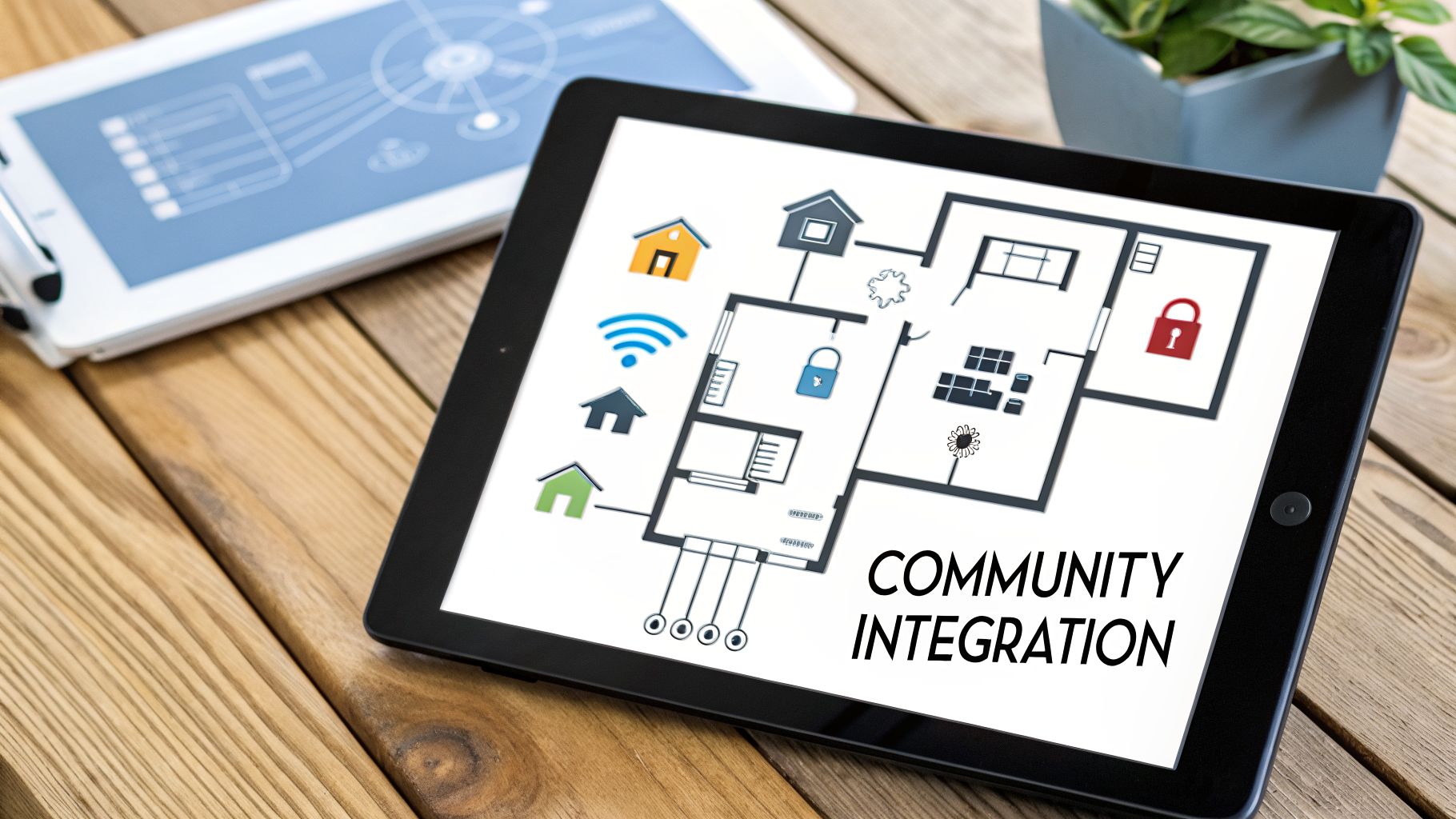
It all starts long before the first access point is installed. The first step is a professional site survey. This isn't just a quick walk-through; it's a scientific analysis using specialized tools to map out how radio frequencies (RF) behave across your entire property. Experts hunt down potential sources of interference and pinpoint the exact placement for every access point to ensure a perfect signal reaches every corner of every unit.
From Blueprint to Backbone: The Structured Cabling Plan
Using the data from the site survey, the provider crafts a detailed structured cabling plan. This is the physical blueprint for your network. It lays out the exact path for all the low-voltage wiring that will link your access points back to the network core, ensuring the infrastructure can handle today's needs and whatever comes next.
For properties like multi-family, student housing, and build-to-rent communities, getting this right is non-negotiable. A solid plan is what guarantees 100% coverage with zero dead spots, so a resident working from a spare bedroom has the same great connection as someone sitting right next to an access point.
Creating the Central Nervous System for Your Property
Once the network is live, it becomes much more than just an internet connection. It’s the central nervous system for your entire property. A professionally managed network is the foundation that all your other modern property technology (PropTech) is built on. This convergence simplifies your operations, lowers costs, and helps create a genuinely smart building.
Think of your managed Wi-Fi network as the digital highway system running through your community. Just as roads connect homes, stores, and offices, the network connects all your critical operational and resident-facing technologies, allowing them to communicate and function as a cohesive whole.
This unified backbone ensures everything from a smart lock on a resident’s door to a security camera in the parking garage works reliably. We dive deeper into how this works in our guide to smart building-ready Wi-Fi solutions.
Seamless Integration with Key Property Technologies
One of the biggest wins of working with an experienced managed WiFi provider is their ability to seamlessly integrate the network with all the other systems that keep your community running. This makes life easier for your staff and delivers a much better experience for residents.
Here are a few key integrations in an MDU or BTR community:
- Smart Apartment Devices: The network provides stable, reliable connectivity for Internet of Things (IoT) devices like smart thermostats, locks, and leak detectors. This gives you centralized management and monitoring, which helps cut utility waste and prevent expensive damage.
- VoIP Phone Systems: Instead of paying for pricey, old-school phone lines, your leasing office and staff can use Voice over IP (VoIP) phones that run on the same network and offer more advanced features.
- IP Security Cameras: Modern security systems depend on the IP network to send high-definition video from cameras to your recording and monitoring platforms, keeping the property safe.
- Common Area Access Control: Systems that manage access to amenities like pools, gyms, and clubhouses can be tied into the network, making it simple to manage resident permissions and track access.
Bringing all these technologies together on one professionally managed platform gets rid of the headache of juggling multiple, disconnected systems. This integration is what turns your property into an efficient, modern, and highly attractive place to live.
How to Vet and Select the Right Managed WiFi Provider
Choosing a partner for your property's connectivity isn't just an IT decision—it's a massive factor in resident satisfaction and your operational sanity. In high-density environments like multi-family, student housing, and build-to-rent communities, the right provider feels like an extension of your own team. The wrong one? They quickly become the source of endless complaints and late-night headaches.
This isn't about finding a vendor; it's about finding a long-term partner. Let's walk through how to properly vet your options and make a choice you won't regret.
First things first, look past the shiny sales deck and zero in on their actual experience. A provider that mostly handles coffee shops or small offices simply doesn't grasp the physics and support demands of a 300-unit apartment building. You need a team with a deep, proven portfolio in high-density residential properties.
Define Your Needs and Scope of Work
Before you even think about requesting a proposal, you need a crystal-clear vision of what you want to achieve. Are you just trying to offer basic internet, or are you laying the foundation for a full suite of smart apartment technologies? Getting this down on paper is the single most important step you'll take.
To avoid crossed wires and unmet expectations, you have to write a clear scope of work. This document forces you to define everything from performance and coverage guarantees to how the network will integrate with other systems like access control or security cameras. This scope will become the heart of your Request for Proposal (RFP).
Key Questions for Your RFP
Your RFP is your opportunity to go beyond surface-level promises. It's time to ask tough, specific questions that force potential partners to prove their expertise. Don't be shy about getting into the details.
Make sure your RFP demands answers on these critical points for your MDU, student housing, or BTR project:
- Network Design and Hardware: How do they perform predictive and on-site surveys? What specific brands and models of access points, switches, and firewalls do they propose? What's their plan to guarantee 100% coverage without dead spots?
- Resident Onboarding and Support: Walk me through the move-in experience for a new resident. Is your support team available 24/7/365? Is that support handled by your own employees or outsourced to a third-party call center?
- Security Protocols: How do you guarantee every resident gets their own private, secure network? What specific measures are in place to shield the property's network from cyberattacks?
- Future-Proofing and Upgrades: What is your policy for hardware lifecycle management? When Wi-Fi 7 becomes the standard, is the upgrade to new access points included in our agreement, or is that a new cost?
Choosing the right technology partner is essential for maintaining a competitive edge. Global competition in the managed Wi-Fi sector is accelerating innovation, with 80% of enterprises now prioritizing vendors that use AI for traffic routing and user insights.
This kind of sophisticated management isn't just for show—it can directly reduce network-related operational costs by 20-35%. It also unlocks the ability to offer tiered tech amenity packages that can seriously boost your Net Operating Income (NOI). Modernizing a property often involves deploying miles of new low-voltage cabling and swapping out old gear for Wi-Fi 6 technology built to handle today's device-dense environments.
Evaluating Proposals and Checking References
Once the proposals start rolling in, remember that this is not just about the bottom-line price. A cheap bid from a provider who's learning on your dime will end up costing you far more in resident turnover and staff burnout.
To make this easier, use a scorecard to compare providers head-to-head on the criteria that truly matter.
Provider Evaluation Scorecard
Use this scorecard to rate and compare potential managed WiFi providers across the most important criteria for your property.
| Evaluation Criteria | Provider A Score (1-5) | Provider B Score (1-5) | Notes |
|---|---|---|---|
| MDU/Residential Experience | Does their portfolio match our property type? | ||
| Quality of Proposed Hardware | Are they using reputable, enterprise-grade gear? | ||
| In-House 24/7/365 Support | Is support handled by their own W-2 employees? | ||
| SLA Strength & Guarantees | Are the uptime and response times clearly defined? | ||
| Security & Privacy Measures | How robust is their plan for resident network isolation? | ||
| Future-Proofing/Upgrade Path | Is there a clear, fair plan for technology refreshes? | ||
| Reference Check Feedback | What did their current clients really say? | ||
| Pricing & Contract Terms | Are the terms clear, fair, and transparent? |
And finally, always check their references. Don't just ask for a list—talk to other property managers who have worked with them. Ask about the reality of the network's reliability, the feedback they get from residents, and how responsive the provider is when problems inevitably pop up.
By following a structured process, you can move forward confidently, knowing you’ve selected a managed WiFi provider who will not only deliver incredible service but also help enhance your property's long-term value. For a deeper dive into your specific needs, a free network design and ROI assessment can provide invaluable clarity.
Got Questions About Managed Wi-Fi? We've Got Answers.
If you’re a property owner or developer in the multi-family, student housing, or build-to-rent space, you’re likely weighing the same handful of critical questions. Deciding on a major technology investment comes down to the real-world impact on your revenue, your residents' happiness, and your long-term budget. Let's tackle those head-on.
Can Managed Wi-Fi Actually Create a New Revenue Stream?
Yes, and it's a significant one. Instead of watching that revenue walk out the door every month to big-name internet service providers, a property-wide solution lets you bring it in-house. By bundling high-speed internet into the rent or offering it as a flat-rate tech amenity, you create a new, predictable income source.
The beauty of this model is that the margin you earn is almost always better than what residents pay for individual plans. This has a direct, positive effect on your Net Operating Income (NOI), turning what was once a simple utility into a genuine asset for your community.
What’s the Move-In Experience Like for New Residents?
A great managed Wi-Fi partner makes move-in day incredibly simple. Forget the usual headache of scheduling and waiting for a cable technician to show up. The goal here is instant-on connectivity.
Residents should be able to walk into their new home, open their laptop or phone, and connect to their own private network right away. A quality provider has a system where a resident selects their network and is walked through a one-time, secure login. From that point on, the provider handles everything—all setup, authentication, and any tech support calls, which completely frees up your on-site team.
In a multi-tenant building, security is non-negotiable. The right provider uses network segmentation, often with something called a VLAN (Virtual Local Area Network), to create a private, secure network for every single unit. Think of it as building a digital wall around each apartment, completely isolating one tenant's devices from their neighbors'. It’s as if they were on entirely different networks.
This kind of isolation is a massive security advantage over the old model where residents bring their own, often insecure, routers.
What Happens When the Wi-Fi Hardware Gets Old?
This is one of the single biggest advantages of choosing a Network-as-a-Service (NaaS) partner. With a true NaaS model, you're not just buying equipment; you're buying a promise that your network will never become obsolete. Your provider takes full responsibility for managing the entire hardware lifecycle.
They don't just install it and disappear. They actively monitor the technology landscape and plan for the future. So, when the industry inevitably moves from Wi-Fi 6 to Wi-Fi 7, your provider manages the entire hardware refresh. This ensures your property stays competitive and technologically current without you having to face another huge, unplanned capital expense down the road.
Ready to stop seeing connectivity as a cost center and start treating it like the valuable asset it is? The expert team at Clouddle Inc specializes in designing, deploying, and supporting property-wide WiFi solutions for MDU, student housing, and build-to-rent communities. Discover how our Network-as-a-Service model can boost your NOI and deliver the five-star resident experience you need. Learn more about our approach to property-wide Wi-Fi.


0 Comments