
Zero Touch Provisioning, or ZTP, is a method for automatically configuring network hardware—like routers and access points—the second it’s connected to the network. For owners of MDU, student housing, and build-to-rent properties, it’s the difference between a slow, expensive manual setup and a fast, error-free deployment that gets your property online and generating revenue much sooner.
A New Era of Property Network Deployment
Setting up property-wide WiFi for a new 300-unit student housing community used to be a massive undertaking. It meant coordinating a team of specialized technicians for days, sometimes weeks, to painstakingly configure every single access point. This process was not only slow and costly but also a breeding ground for human error, where one typo could create frustrating connectivity issues for hundreds of residents.
Zero Touch Provisioning completely changes that game. It functions like a central command center for your entire property network.
Think of it this way: instead of manually assembling 300 identical nightstands from a flat-pack, you have a system that automatically builds and places each one perfectly according to a master blueprint. With ZTP, you define your ideal network for your property—the "golden configuration"—just once. From that point on, the system automatically applies that template to every new access point that gets plugged in.
The Shift From Manual Labor to Smart Automation
This isn’t just a minor improvement; it's a fundamental shift in how property-wide WiFi networks are built. The global market for ZTP was valued at USD 2,726.6 million in 2022 and is on track to more than double to USD 5,978.5 million by 2030. That growth is happening because property developers and operators are getting rid of manual work that once consumed 40-50% of their deployment time and are cutting human error by as much as 70%.
For property owners, the benefits are immediate and tangible. You can launch critical services like property-wide managed WiFi much faster, which directly helps boost your Net Operating Income (NOI) without the usual operational headaches. You can find more data on how these market trends impact operational costs.
Manual Provisioning vs. Zero Touch Provisioning
To really grasp the difference ZTP makes for property-wide WiFi, let's compare the old way of doing things with the modern, automated approach for a typical multi-dwelling property. The contrast is stark.
| Factor | Manual Provisioning (The Old Way) | Zero Touch Provisioning (The Modern Way) |
|---|---|---|
| On-Site Staff | Requires expensive, specialized network engineers. | A general contractor or low-voltage tech can handle installation. |
| Time to Deploy | Days or even weeks per property. | Hours. Devices are live within minutes of being plugged in. |
| Configuration | Each device is configured individually on-site. | One "golden configuration" is created in the cloud and pushed to all devices automatically. |
| Risk of Error | High. Typos and inconsistencies are common, leading to troubleshooting headaches for residents. | Near zero. Automation ensures every device is configured identically and correctly. |
| Scalability | Poor. Adding new devices or properties to a portfolio is a slow, repetitive process. | Excellent. Easily scales from one property to hundreds with consistent results. |
| Cost | High labor costs, plus the opportunity cost of a delayed property opening or unhappy residents. | Significantly lower operational costs and faster time-to-revenue. |
As the table shows, ZTP isn't just an incremental improvement for property-wide WiFi. It fundamentally redefines the entire deployment process, turning what was once a major project bottleneck into a streamlined, efficient task.
The whole point of ZTP is to get to a place where you no longer need a network expert on-site for the installation. Anyone can simply plug in the hardware, and the system does the rest.
How ZTP Works in a Property Setting
In a real-world MDU or build-to-rent community, the on-the-ground process for deploying property-wide WiFi becomes incredibly straightforward. New access points and switches are shipped directly to the job site. An installer—who could be an electrician or general contractor with no IT training—simply mounts the hardware in each unit and common area and connects it to power and the network.
That's when ZTP takes over. Here’s what happens behind the scenes:
- Calling Home: The new device powers up and immediately reaches out over the internet to a central, cloud-based controller.
- Authentication: The controller checks the device's unique serial number against its inventory, confirming it’s an authorized piece of hardware for your property.
- Configuration Download: Once verified, the controller sends down the pre-built configuration template. This includes everything: WiFi network names (SSIDs) for residents, security settings, and specific access rules for each unit.
Within minutes, that device is fully configured, secure, and ready to provide service. No one on-site had to log into a command line or a clunky interface. This is how modern properties deliver the reliable, high-performance property-wide WiFi that today’s residents expect. It's the practical application of what zero touch provisioning is and how it powers a better resident experience from day one.
How ZTP Automates Your Property Network Setup
Setting up property-wide WiFi across an entire MDU, student housing, or build-to-rent community used to be a massive headache. For property owners, it meant expensive, time-consuming on-site IT work. Zero Touch Provisioning changes all of that, turning a complicated technical job into a simple plug-and-play installation.
The whole process happens in three main stages, almost like a new employee’s first day on the job. Behind the scenes, a Network-as-a-Service (NaaS) platform coordinates this entire sequence for every switch and access point you have, whether it's for one building or an entire portfolio of properties.
Stage 1: Device Bootstrapping
The first step is what we call device bootstrapping. Think about a new hire showing up for their first day. The very first thing they do is check in. A ZTP-enabled access point does something similar. The moment it's plugged into power and connected to the network in a resident's unit, it powers on and automatically "calls home."
This isn't a random call; it’s a secure message sent over the internet to a central controller or provisioning server that's been set up ahead of time. The device is essentially saying, "I'm here in Unit 204, I'm online, and I'm ready for my assignment." No technician needs to touch it. This alone is a major shift from the old way of doing things.
Stage 2: Enrollment and Verification
Next up is enrollment and verification. Back to our new employee: HR needs to verify their identity against company records to confirm they are who they say they are. It’s the same with your network hardware. The central server gets that "call home" request and immediately checks the device's unique identifier, like its serial number.
That ID is checked against a master list of approved hardware for your property. It's a critical security check to ensure only authorized devices can join your property's network.
By automatically verifying every device, ZTP effectively locks the door on unauthorized hardware. This prevents rogue access points from being connected to your network, a critical security measure for protecting resident data in multi-tenant environments like MDUs and student housing.
Once the device is confirmed as legitimate, the server officially enrolls it, and it becomes a trusted part of your property’s network. This is a cornerstone for building a reliable and secure property-wide WiFi system. If you want to dive deeper into the basics of network infrastructure, this network setup and optimization guide is a great read.
Stage 3: Automated Configuration
The final stage is all about configuration. Once our new employee is verified, IT doesn't hand them a blank laptop. They get a machine that's fully configured with the right software, email account, and security settings for their role. ZTP does the exact same thing for your access points and switches.
The central server pushes down a pre-built "golden configuration" template to the newly enrolled device. This isn't just a basic setup; it’s a complete package with everything the device needs to operate perfectly within your property’s environment. This typically includes:
- WiFi Network Names (SSIDs): Creating the right networks for residents, staff, and common areas.
- Security Protocols: Applying strong encryption and password policies everywhere.
- User Rules and Bandwidth Limits: Ensuring every resident gets their fair share of bandwidth for a great experience.
- Firmware Updates: Automatically pushing the latest software to keep performance and security top-notch.
This flowchart really highlights the difference between the old manual process and the automated ZTP workflow for property-wide WiFi.
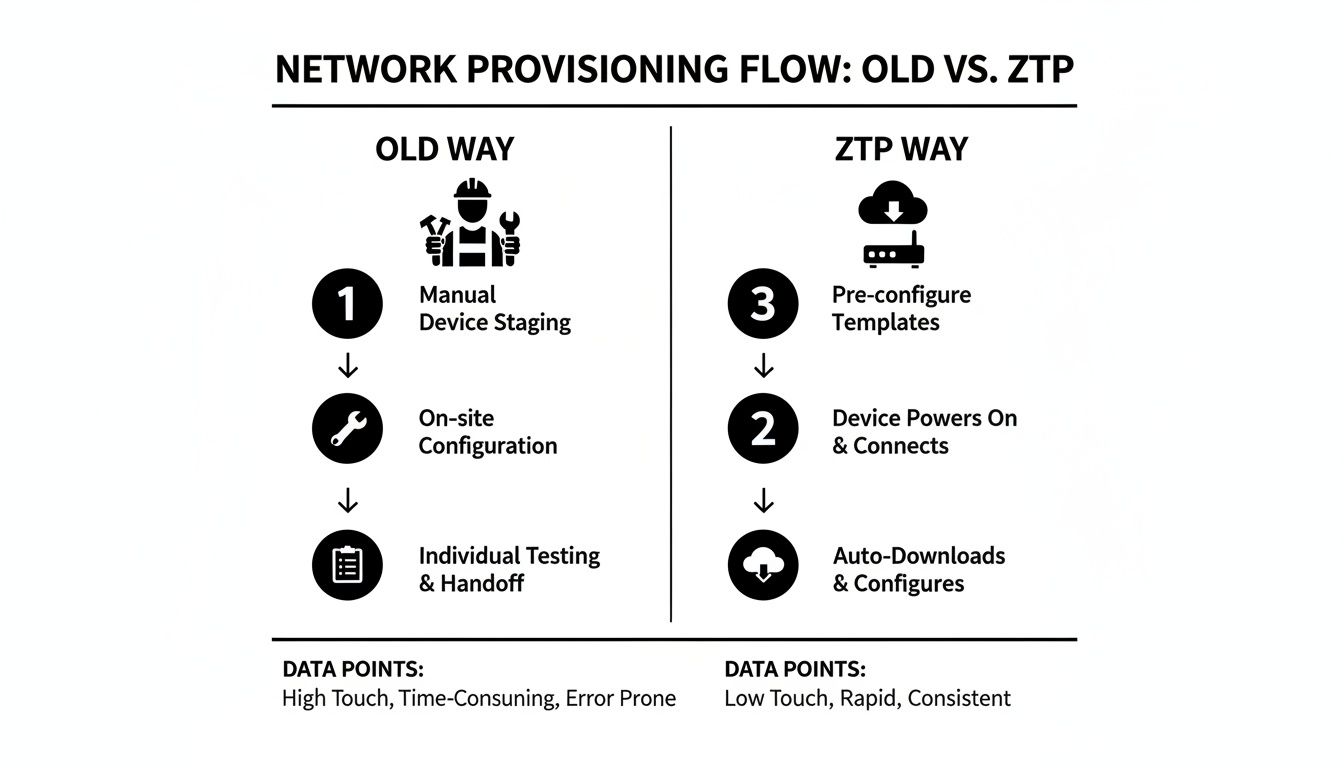
As you can see, ZTP replaces slow, error-prone manual steps with a fast, automated, and centrally managed process. In just a few minutes, a new access point is fully functional, secure, and ready to provide service to your residents—all without a technician ever having to configure it by hand.
The Bottom-Line Benefits Of ZTP For Property Owners
While the technical side of Zero Touch Provisioning is impressive, what really counts for property owners and investors are the results you can see on the balance sheet. ZTP’s automation directly boosts your Net Operating Income (NOI) and keeps residents happy, whether you're managing MDUs, student housing, or build-to-rent communities.
It all boils down to three core wins: getting your property-wide WiFi live faster, slashing operational expenses, and delivering consistent, rock-solid security. This isn't about making small adjustments to the old way of doing things; it's a complete overhaul of how property networks get built.
Accelerate Time-to-Revenue
In any new construction or major renovation, time is literally money. Every day a building sits empty is a day of lost rent. Traditional network installations often become the main bottleneck, taking weeks and holding up your "move-in ready" date. ZTP completely removes that roadblock.
Think about a new 200-unit student housing complex. With ZTP, you can light up the entire property’s WiFi network in just a few days. The hardware is shipped directly to the site, where general contractors can simply plug it in. The network configures itself, meaning you’re ready to welcome residents and start collecting rent from day one.
This rapid deployment lets you:
- Open your doors sooner, maximizing rental income right from the start.
- Hit aggressive construction deadlines without IT getting in the way.
- Onboard new residents instantly with the high-speed internet they demand.
Getting to revenue faster is a huge financial advantage, turning a common headache into a competitive edge and a quicker path to profitability.
Drastically Reduce Operational Costs
One of the most immediate benefits of ZTP is its impact on how to reduce operational costs. The old model depended on sending expensive, specialized technicians to every property for setup, troubleshooting, and updates—a practice we call "truck rolls."
With ZTP, those costly site visits are virtually a thing of the past for network deployment.
By automating the configuration, you eliminate the single largest line item in network deployment: specialized labor. This benefit extends to ongoing management, too, since updates and changes can be pushed out from a central dashboard instantly across your entire portfolio.
The savings add up quickly. It’s no surprise the global ZTP market was valued at USD 3.9 billion in 2024 and is expected to hit USD 11.6 billion by 2030, all driven by these real-world efficiencies. Businesses have reported deploying networks up to 60% faster and cutting operational expenses (OPEX) by 30-40%—critical figures for MDU, BTR, and student housing properties running on tight margins.
Enhance Security and Resident Trust
In multi-tenant properties like MDUs and student housing, network security isn't just a technical detail; it’s fundamental to your residents' trust and your property's reputation. The single biggest source of security holes is often human error during manual setups—things like forgotten default passwords or misconfigured firewalls.
ZTP brings military-grade consistency. By using a pre-approved "golden configuration," it ensures every access point on the property gets the exact same, hardened security settings applied automatically. No device is overlooked, and no inconsistencies are introduced.
This uniform security posture protects resident data, lowers your liability, and builds your reputation as a modern, secure place to live. Achieving this level of standardization is nearly impossible with manual work, especially for managers using a Network-as-a-Service approach for their properties across a large portfolio.
ZTP In Action Across Different Property Types
The theory behind Zero Touch Provisioning is one thing, but its real value shines when you see how it adapts to the unique demands of different properties. It's not a rigid, one-size-fits-all solution. For property owners, truly understanding ZTP means seeing how it directly solves the headaches specific to their market, whether that's a high-rise MDU, a sprawling student housing complex, or a brand-new build-to-rent community.
While the goal is always the same—delivering rock-solid, property-wide WiFi as a core amenity—the way ZTP gets you there changes depending on the environment. Let's break down how this technology performs in these key sectors and what it means for resident satisfaction and your bottom line.
MDU and Build-To-Rent Communities
In today's hyper-competitive multi-dwelling unit (MDU) and build-to-rent (BTR) markets, fast, managed property-wide WiFi isn't just a perk anymore. It’s a utility, as essential as water and electricity, and renters expect it to work flawlessly from the moment they get their keys. ZTP is what makes this expectation a reality, especially at scale.
Imagine a new community with 150 single-family rental homes or a 400-unit apartment building. Using ZTP, a developer can have every home pre-wired during construction and then, with the flip of a switch, bring the entire network online in a single day. This completely sidesteps the old, frustrating model where residents had to book their own ISP appointments, leading to a mess of different providers, scheduling delays, and technicians drilling new holes in your walls.
With a ZTP-powered property-wide WiFi network, you can:
- Offer instant-on WiFi as a powerful move-in amenity, which is a massive differentiator for modern renters.
- Control the entire network infrastructure, giving you the power to guarantee a consistent quality of service for every single resident.
- Generate new ancillary revenue by offering tiered internet packages, turning your WiFi network into a profit center.
A ZTP approach gives property managers centralized control over the network. This means they can ensure every unit receives a consistent, secure, and reliable connection, which is a powerful tool for attracting and retaining high-value tenants in a crowded market.
This level of control also makes day-to-day management incredibly simple. When a tenant moves out, their network access can be shut off instantly. When a new one arrives, their private, secure network is ready to go before they've even unpacked a single box. If this model sounds right for you, your next move should be to explore managed WiFi providers who have deep experience with ZTP deployments in MDUs and BTR communities.
Student Housing Deployments
The student housing world runs on a famously tight schedule, and it all comes down to one chaotic event: move-in day. Operators often have a tiny window of just a few days to turn over an entire property. Trying to manually set up or fix a property-wide WiFi network for hundreds of students in that compressed timeframe is a guaranteed recipe for disaster.
Zero Touch Provisioning is tailor-made for this kind of high-stakes environment. All the network hardware—the access points and switches—can be physically installed in rooms and hallways over the summer. Then, just before the students pull up with their moving vans, the entire network can be activated, configured, and tested remotely.
Speed is one thing, but ZTP brings another crucial benefit to student housing: network segmentation. A ZTP system can be configured to automatically create completely separate, secure virtual networks for different groups of people.
This allows you to instantly roll out specific access policies, such as:
- Student Network: A secure network for all residents, where each student gets their own Personal Area Network (PAN) to keep their devices private and safe from their neighbors.
- Administrative Network: A totally separate, firewalled network for the leasing office and other back-of-house operational systems.
- Common Area Network: A guest network with its own rules for common spaces like lobbies, gyms, and study lounges.
This segmentation is absolutely critical for both security and compliance. It ensures sensitive student data is kept completely isolated from the property’s administrative traffic. For a 500-bed student housing facility, ZTP means every student gets a secure, high-speed connection from day one, all without creating security risks or an operational nightmare for your team.
Your ZTP Implementation Checklist
Thinking about bringing Zero Touch Provisioning to your property-wide WiFi network? You’re on the right track. But a successful rollout is more than just a hardware refresh; it’s a strategic move that needs a solid plan.
This checklist is your guide. We’ve designed it for property owners in MDU, student housing, and build-to-rent communities to help you navigate the process from start to finish. The goal is to build a network that not only boosts resident satisfaction but also your bottom line.
1. Define What Your Network Actually Needs to Do
Before you look at a single piece of hardware or talk to a vendor, the first step is to define what a "great network" means for your specific property. The demands of a luxury MDU complex are completely different from those of a high-density student housing community.
Get clear on these core questions:
- User Density and Usage: How many people will be online at once? A 500-bed student dorm has vastly different capacity needs than a 50-unit BTR property.
- Service Tiers: Are you offering a one-size-fits-all connection, or will you create tiered packages (like standard, premium, or even a "gamer" tier) as an ancillary revenue stream?
- Security and Privacy: Do you need to segment the network to keep resident traffic completely separate from your property management systems? Will you offer Personal Area Networks (PANs) for each unit so residents' devices can't see their neighbors'?
2. Choose the Right ZTP-Capable Partner and Platform
This is arguably the most critical step. True ZTP isn't just a feature—it's an operational model that relies on a powerful cloud platform and deep networking expertise. Your partner matters more than any single piece of hardware.
Look for a provider who offers a comprehensive Network-as-a-Service (NaaS) solution. This approach bundles the hardware, software, licensing, and crucial 24/7 support into a predictable subscription. It's the perfect model for property owners who want reliable outcomes without becoming IT experts themselves.
Think of your NaaS partner as an extension of your own team. They should understand the unique headaches of MDU, BTR, and student housing environments. It's their job to build the configuration templates, manage the device inventory, and provide the constant monitoring that makes the "zero touch" promise a reality.
3. Confirm Your Hardware is ZTP-Ready
Here’s a technical detail that can’t be overlooked: ZTP only works with hardware specifically designed for it. Your access points, switches, and routers must have firmware that allows them to "call home" to a central management platform upon being plugged in.
We've seen it happen time and again—trying to force ZTP onto older, incompatible equipment is a recipe for a costly headache. A good NaaS partner completely removes this risk by specifying and providing only hardware that is guaranteed to work seamlessly with their platform.
4. Create Your "Golden Configuration"
The golden configuration is the master blueprint for your entire property's network. This is where all the needs you defined in Step 1 get translated into technical policies and settings. Your partner will build this template with you in their cloud controller long before any equipment arrives on site.
This single configuration file dictates everything:
- WiFi network names (SSIDs) and passwords for residents and staff
- Security protocols (like WPA3)
- Bandwidth limits and Quality of Service (QoS) rules to prioritize traffic
- Specific device and user access policies (like Personal Area Networks)
5. Plan for a Radically Simple Physical Installation
With a proper ZTP plan, the on-site physical installation of your property-wide WiFi becomes incredibly straightforward. Since all the complex configuration is done ahead of time in the cloud, the job on-site is simply to mount the hardware and plug it in.
This completely changes the game. You no longer need to fly in expensive, specialized network engineers for the deployment. A low-voltage electrician or even a trusted general contractor can handle the physical install, saving you significant time and money on your project.
6. Activate, Monitor, and Relax
This is where the magic happens. As soon as the new hardware is connected to power and the internet, the ZTP process kicks in automatically.
From their own offices, your partner will watch on their central dashboard as each device comes online, authenticates itself, and downloads the golden configuration. From that moment on, they handle all the ongoing monitoring, security patches, and performance updates remotely, ensuring your network runs smoothly for years to come.
Are You Ready for ZTP?
Making the move to ZTP requires some internal readiness. This simple scorecard can help you gauge where you stand and identify areas to focus on before you begin your search for a partner. For each area, score your property's current state from 1 (Not Ready) to 5 (Fully Prepared).
ZTP Implementation Readiness Scorecard
| Readiness Area | Key Question | Score (1-5) |
|---|---|---|
| Strategic Alignment | Do we have clear business goals for a new network (e.g., improve NOI, increase resident retention)? | |
| Budgetary Planning | Have we shifted from a CapEx mindset (one-time purchase) to an OpEx model (subscription)? | |
| Stakeholder Buy-In | Are property management, operations, and ownership all aligned on the need for a network upgrade? | |
| Existing Infrastructure | Is our property's low-voltage cabling modern and sufficient to support new hardware? | |
| Decision-Making Process | Do we have a designated project lead who can make timely decisions? | |
| Partner Vetting | Have we defined the criteria for selecting a NaaS partner beyond just the lowest price? |
A higher score suggests a smoother transition. If you find your scores are low in a few areas, that's a great starting point for internal discussions to get everyone on the same page.
Answering Your Top Questions About ZTP
As property owners across the multi-family, student housing, and build-to-rent sectors look to upgrade their networks, a few questions about Zero Touch Provisioning always pop up. It’s a totally different way of doing things compared to traditional network rollouts, so it's natural to want some straight answers. Here, we'll tackle the most common questions we hear from clients, giving you the confidence that ZTP is the right foundation for modern, property-wide WiFi.
We've designed each answer to cut through the technical noise and focus on what really matters for your operations, your residents, and your bottom line.
Is Zero Touch Provisioning Secure For My Residents?
Yes. In fact, a property-wide WiFi network deployed with Zero Touch Provisioning is far more secure than one configured by hand. Think about it: the biggest source of network vulnerabilities is almost always human error. A forgotten default password on one router, an incorrectly applied security setting on another—these small mistakes create massive risks in a multi-tenant environment.
ZTP takes human error completely out of the equation. Because every single access point and switch automatically pulls its configuration from a central, pre-approved template, you achieve perfect consistency across the board.
For property-wide WiFi in environments like student housing or MDUs, where hundreds of residents live in close proximity, this automated approach is critical. It enforces enterprise-grade security policies across the entire network from the moment of activation, dramatically improving the security posture and protecting resident data.
This means you can rest assured that there are no weak links in your network’s armor, creating a much safer digital environment for everyone on your property.
Does All Network Hardware Support ZTP?
No, and this is a critical point every property owner needs to grasp. ZTP isn’t a universal feature that just works with any off-the-shelf equipment you can buy online or at a big-box store. It requires specific capabilities built right into the device's firmware, allowing it to "call home" to a provisioning server the moment it's plugged in.
This is exactly why partnering with an experienced managed service provider is so vital. They ensure that every piece of hardware they provide—from the access points in resident apartments to the switches in your network closets—is guaranteed to be compatible with their ZTP platform.
Trying to piece together a ZTP network with older or mismatched hardware is one of the most common reasons we see self-managed projects fail in the MDU space. It leads to endless frustration, costly delays, and ultimately negates the entire "zero touch" benefit you were hoping for. A true plug-and-play experience depends on a perfectly matched ecosystem of hardware and software.
How Do I Change WiFi Settings Across The Property Later?
This is where a ZTP-powered network truly shines and shows its long-term operational value. The same centralized control that makes the initial deployment so simple also makes ongoing management incredibly efficient for MDU and student housing portfolios. Gone are the days of dispatching a technician on-site to manually update hundreds of devices one by one.
Imagine you need to change the guest WiFi password for all the common areas across your entire portfolio. With a ZTP-managed network, you just log into a single cloud dashboard, make the change once, and the new configuration is automatically pushed to every relevant device in minutes.
This same principle applies to all sorts of management tasks, including:
- Pushing critical security patches to all access points simultaneously.
- Adjusting bandwidth rules to optimize performance during peak hours.
- Rolling out a new, separate network for a new commercial tenant or for property-owned IoT devices.
This capability generates massive, ongoing savings in both time and operational costs. It frees up your property management team to focus on resident-facing priorities instead of getting bogged down in network maintenance.
How Does ZTP Relate To Network-as-a-Service?
It's best to think of Zero Touch Provisioning and Network-as-a-Service (NaaS) as two sides of the same coin, especially in the context of property-wide WiFi. ZTP is the powerful automation engine that does the heavy lifting, while NaaS is the complete business model built around that engine. They work in tandem to deliver a headache-free experience for property owners.
Here’s a simple way to look at their relationship:
- ZTP is the "how." It's the technology that automates device deployment and configuration.
- NaaS is the "what." It's the service that bundles the ZTP-compatible hardware, management software, licenses, and 24/7 expert support into a single, predictable subscription.
The ZTP engine is what makes the NaaS model so effective and scalable for property-wide WiFi. It enables a provider to ship hardware directly to your site for a simple plug-in installation by any general contractor, eliminating the need for huge upfront capital investments in both equipment and specialized IT labor. This synergy fits perfectly with the operational expense (OpEx) model that modern MDU, BTR, and student housing operators are moving toward.
Ready to deliver the instant-on, reliable WiFi that modern residents demand? The experts at Clouddle Inc specialize in designing and deploying ZTP-powered Network-as-a-Service solutions for MDU, student housing, and build-to-rent communities. Let us show you how to boost your NOI and future-proof your properties. Get in touch with us today to start the conversation.

0 Comments